
Defeating Power Compression: Thermal Dissipation Secrets in Architectural Drivers

About Author: Kevin Wu
Founder & Principal Audio Engineer, LECOVITA
Specialize in acoustic engineering, high-fidelity speaker and amplifier design, precision manufacturing, sonic innovation, immersive audio solutions, and premium audio system development.
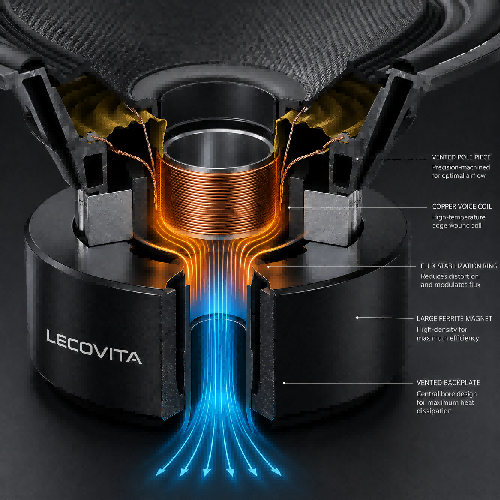
Table of Contents
Defeating Power Compression: Thermal Dissipation Secrets in Architectural Drivers
When a high-fidelity architectural speaker operates under heavy continuous loads, up to 95% of the amplifier's electrical energy is converted into wasted heat rather than sound waves. This intense thermal energy bakes the copper voice coil, driving up electrical resistance and causing an immediate drop in output volume known as power compression. Overcoming this physical bottleneck requires advanced structural thermal paths: oversized vented magnet motors, aero-designed chassis cooling grids, and heat-wicking voice coil assemblies that lock in continuous sonic linearity.
The Hidden Thermal Trap: The Phenomenon of Power Compression
In premium architectural home cinemas or continuous-duty commercial audio zones, speakers are frequently pushed to deliver high Sound Pressure Levels (SPL) for hours at a time. During these intense listening conditions, an invisible electrical tax is extracted inside the driver's motor structure.
Because audio drivers are inherently inefficient transducers, almost all incoming amplifier wattage turns into heat directly inside the voice coil. As the voice coil's copper wiring temperature spikes past $100^\circ\text$, the natural electrical resistance of the metal multiplies. According to Ohm's Law, this resistance surge means the speaker can no longer pull the required current from the power supply. The speaker suffers a severe drop in volume, squashes dynamic musical peaks, and loses its low-frequency authority. This phenomenon is known as thermal power compression.
[Continuous High Power] ===> Heat Trapped in Motor ===> Resistance Multiplies ===> Power Compression & Flat Audio
[Vented Thermal Design] ===> Forged Airflow Escape ===> Cool Coil Stability   ===> Pure Dynamics & Linear Punch
1. Vented Magnet Pole Geometries and Aero-Damping
To keep the voice coil operating within its safe, linear thermal window, structural engineers focus heavily on the design of the heavy rear motor assembly. Standard commodity speakers use a completely sealed iron magnet backplate, trapping high-temperature stagnant air inside the tight gap where the voice coil moves.
Premium architectural designs implement a precisely machined vented center pole-piece. This engineering design features a smooth aerodynamic tunnel cut straight through the core of the heavy rear magnet assembly. As the woofer cone pumps rapidly back and forth, it acts as a natural mechanical air pump, forcing hot air out through the center channel and pulling cool atmospheric air directly across the exposed voice coil windings. This constant forced convection reduces internal motor temperatures by up to $30^\circ\text$, completely smoothing out power compression curves.
2. High-Mass Anodized Magnet Backplates as Thermal Sinks
In high-end architectural audio where rear enclosures or back boxes are used to prevent sound bleed, the space behind the speaker frame can become a micro-thermal oven. Dissipating heat effectively under these conditions requires leveraging physical material mass.
                  [Exposed Copper Voice Coil]
                               │
            ┌──────────────────▼──────────────────┐
            │  [Forced Convection Air Currents]   │
            │  (Pushed out through center vent)   │
            └──────────────────┬──────────────────┘
                               ▼
            [Heavy CNC-Machined Iron Backplate]
                               │
  =============[Black Anodized Hardwood Thermal Sink]=============
                               │
                               ▼
                [Heat Dissipated into Free Air]
Elite custom speaker frames replace thin, stamped-steel rear brackets with massive, CNC-machined structural iron backplates finished in a black anodized hard-coat. The dark anodized finish significantly increases the material's thermal emissivity, allowing it to radiate infrared heat into the free air cavity much faster than polished raw metals. This structural backplate acts as an internal thermal heat sink, absorbing massive spikes of kinetic thermal energy away from the delicate voice coil wires and protecting the system during extended high-volume operation.
Thermal Dissipation Profiles: Commodity Hardware vs. Hardened Driver Engineering
| Thermal Factor | Standard Commercial Speakers | Advanced High-Output Drivers |
| Magnet Assembly | Sealed flat backing (Traps hot air) | Oversized with CNC-machined center pole vent |
| Backplate Material | Thin stamped steel (Low thermal capacity) | Heavy-duty high-mass black anodized iron |
| Power Compression Risk | Severe; drops up to $3\text-4\text$ of volume | Minimal; maintains uniform output stability |
| Voice Coil Wire Shielding | Standard single-layer enamel coat | High-temperature multi-layer resin insulations |
| Long-Term Durability | Prone to thermal sagging and coil warping | Exceptional; handles prolonged thermal loads |
3. High-Temperature Resin Insulations and Voice Coil Core Formers
The final line of defense is the composition of the voice coil assembly itself. The wire strands must remain perfectly bonded to their cylindrical tube (the former) under intense heat cycles.
Standard drivers use basic copper wires insulated with low-cost enamels that melt or unwrap when pushed too hard. High-output architectural drivers use premium copper or copper-clad aluminum (CCAW) wires coated in advanced high-temperature polyamide or polyimide resins rated to survive temperatures exceeding $220^\circ\text$. This wire is wrapped around a high-stability aluminum or fiberglass former that pulls heat away from the winding gaps, preventing the coil cylinder from warping, bubbling, or scraping against the narrow magnet walls.
Expert Q&A
Q1: How does thermal power compression alter what a customer hears during a long movie or party?
A: When a system experiences power compression, it doesn't just get slightly quieter overall. Because the mid-bass woofer coil heats up at a different rate than the small tweeter coil, the crossover balance shifts mid-way through the playback. The bass and mid-range frequencies lose their punch and recede, making action sequences sound thin, vocals sound distant, and the overall mix sound fatiguing and flat.
Q2: What is the benefit of using Copper-Clad Aluminum Wire (CCAW) in high-power voice coils?
A: CCAW blends the structural benefits of both metals. Aluminum is exceptionally lightweight, which reduces the moving mass of the driver and results in incredibly fast, accurate transient response and high efficiency. By bonding an outer layer of premium copper around the aluminum core, engineers preserve excellent electrical conductivity and improve heat dissipation capabilities, creating a highly durable, cool-running coil.
Q3: Does using a speaker with a higher power handling rating require a larger amplifier?
A: Not necessarily, but it provides peace of mind. A speaker rated for high power handling simply means its internal thermal paths—like vented magnets and high-temperature resins—can safely handle massive voltage spikes without melting. You can still drive it efficiently with a modest amplifier, but using an appropriately matched, clean amplifier prevents clipping, keeping thermal distortion energy out of the motor entirely.
