
architectural-speaker-multi-angle-waveguide-dispersion

About Author: Kevin Wu
Founder & Principal Audio Engineer, LECOVITA
Specialize in acoustic engineering, high-fidelity speaker and amplifier design, precision manufacturing, sonic innovation, immersive audio solutions, and premium audio system development.
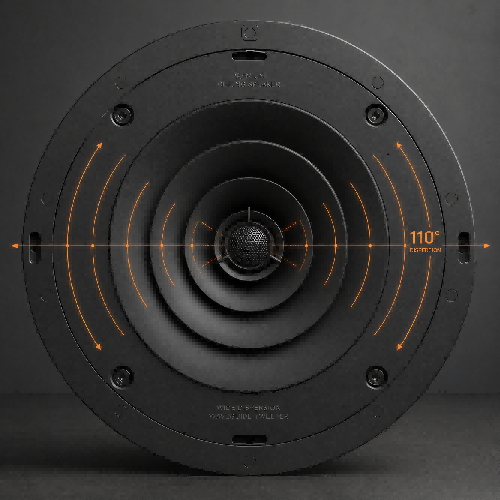
Table of Contents
Spatial Precision: Designing Multi-Angle Waveguides for Uniform Room Coverage
TL;DR: High frequencies naturally narrow into a restrictive beam as they rise, making off-axis listening spaces sound dull and detached. Overcoming this directivity bottleneck requires custom multi-angle waveguide engineering. By wrapping the tweeter in mathematically modeled, multi-tiered acoustic boundaries, engineers can uniformize sound pressure distribution across wide angles, creating wide, realistic soundstaging regardless of seating position.
The Angular Drop-Off: The Combat for Off-Axis High Frequencies
When mapping out a premium multi-room distributed audio system or an immersive home theater layout, listeners are rarely standing or sitting perfectly perpendicular to an in-ceiling speaker. Most ears occupy an off-axis listening window angled anywhere from $30^\circ$ to $60^\circ$ away from the structural center-line.
For unguided or poorly mounted drivers, this angular offset is a critical failure point. High frequencies above $8\text$ hold very short wavelengths that easily beam directly forward. When you step out of this narrow sound beam, the treble response collapses rapidly, dropping by up to $12\text$ or more. This sudden loss of upper-register energy muddies dialogue, diminishes transient detail, and shrinks the realism of the soundstage. Eliminating these sonic dead zones requires tailoring the physical boundary geometry directly surrounding the high-frequency radiator.
[Unguided Tweeter] ===> Beaming Highs (High Loss Off-Axis) ===> Small Sweet Spot / Muffled Corner Audio
[Multi-Angle Guide] ===> Wide Conical Expansion (Uniform)  ===> Balanced Sound and Intelligibility Everywhere
1. The Geometry of Multi-Angle Flare Transitions
A multi-angle waveguide acts as a precision acoustic lens. Rather than utilizing a straight, basic horn funnel—which can introduce internal reflections and harsh, localized horn honk—advanced waveguides employ multiple progressive geometric zones.
The initial throat section immediately surrounding the dome tweeter controls the lower treble boundary layer (around $3\text – 6\text$), forcing the expanding sound wave to speed up its lateral dispersion. As the wave travels further outward, it meets a secondary, wider flare angle that opens up to $110^\circ$ or $120^\circ$. This multi-tiered transition seamlessly matches the wider dispersion profile of the underlying woofer cone at the crossover point, establishing a perfectly balanced, cohesive acoustic blend.
2. Eliminating Edge Diffraction and Wave Smearing
When high-frequency sound waves travel across a smooth speaker baffle and suddenly strike a sharp mechanical transition—such as an un-rounded frame rim or a deep screw cavity—the wave hits a physical bottleneck.
This interaction creates acoustic diffraction. The sharp edge acts as a tiny, parasitic secondary sound source, sending secondary delayed sound waves backward across the baffle. These delayed waves collide with the original primary wave, causing phase cancellations, comb filtering, and blurred high-end imaging. Premium multi-angle waveguides completely isolate the sound path by using continuous mathematical curves ($XO$ and $X1$ profiles) that guide the wave cleanly past all mechanical edges, preserving crisp, time-aligned transient details.
Dispersion Symmetry Matrix: Flat Baffles vs. Multi-Angle Waveguides
| Dispersion Parameter | Flat Standard Baffle Layout | Multi-Angle Waveguide Assembly |
| High-Frequency Directivity | Narrow, beam-like projection ($<45^\circ$) | Broad, controlled conical dispersion ($110^\circ+$) |
| Off-Axis Response Match | Severe treble loss at $45^\circ$ angles | Maintains linear frequency balance out to $60^\circ+$ |
| Crossover Blend Fluidity | Severe phase dip between woofer & tweeter | Flawless acoustic blending at the crossover point |
| Edge Diffraction Artifacts | High; creates blurred imaging and reflections | Zero; optimized flare profiles eliminate edge artifacts |
| Spatial Soundstaging | Confined, boxy, and easily localized | Deep, airy, and realistic pin-point accuracy |
3. Expanding Spatial Soundstage Depth
In a dedicated home cinema setup or a premium open-concept hospitality space, wide dispersion is what creates the illusion of an expansive, open venue.
When a waveguide distributes high-frequency energy evenly across a room, it creates a highly balanced balance between direct sound and early reflections. Because the off-axis sound hitting the walls holds the exact same smooth frequency balance as the direct on-axis sound, the room's ambient boundaries blend seamlessly into the mix. This expands the perceived "sweet spot" across the entire room, allowing multiple listeners to enjoy pinpoint spatial accuracy and natural vocal weight simultaneously.
Expert Q&A
Q1: How do multi-angle waveguides help when speakers are mounted in exceptionally high ceilings?
A: In soaring spaces like luxury open-plan entries or double-height commercial lobbies, standard narrow-dispersion speakers cannot project high-frequency details downward effectively before the sound is lost into the environment. A multi-angle waveguide shapes the wave front into a reliable conical projection beam, driving vocal clarity and acoustic energy safely down to ear level without needing to over-drive the amplifier.
Q2: What is Finite Element Analysis (FEA) modeling in waveguide design?
A: FEA modeling is an advanced computer-simulation process where the physical space surrounding a tweeter is broken down into millions of tiny mathematical nodes. Engineers simulate acoustic pressure waves moving across these nodes in real-time. This allows them to adjust the micro-curves of a waveguide to eliminate phase anomalies long before cutting physical manufacturing tooling for production.
Q3: Can a speaker with a wide-dispersion waveguide replace a pivoting tweeter design?
A: Yes, and in many installation scenarios, it performs better. While a pivoting tweeter lets you angle the speaker toward a specific seat, it can create an acoustic null on the opposite side of the room. A precision multi-angle waveguide creates a naturally wide, uniform $360^\circ$ coverage cloud that blankies the entire room seamlessly, rendering mechanical tilting unnecessary for standard room layouts.
