
Decentralized Intelligence: The Physics and Architecture of Smart In-Wall Amplifiers

About Author: Kevin Wu
Founder & Principal Audio Engineer, LECOVITA
Specialize in acoustic engineering, high-fidelity speaker and amplifier design, precision manufacturing, sonic innovation, immersive audio solutions, and premium audio system development.
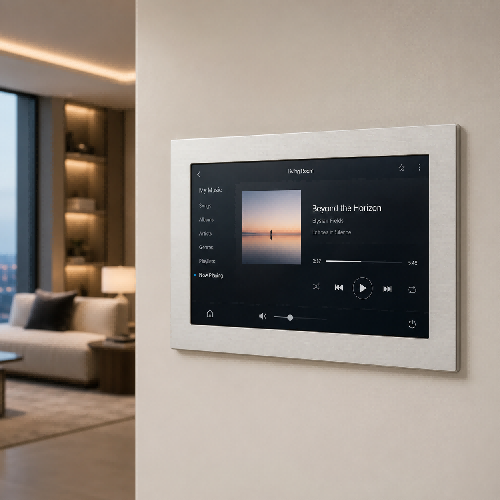
Table of Contents
Decentralized Intelligence: The Physics and Architecture of Smart In-Wall Amplifiers
Traditional architectural audio relies on long, lossy speaker cable runs tracing back to a centralized equipment rack. Smart in-wall touchscreen media players disrupt this old model by shifting processing, streaming, and amplification directly to the room's wall plane. Operating on localized Linux or Android architectures and featuring high-efficiency Class-D chipsets, these compact systems deliver lossless multi-zone streaming while interfacing natively with RS-485, TCP/IP, and wireless automation buses.
The Paradigm Shift: Breaking the Centralized Rack Bottleneck
For decades, multi-zone residential audio followed a fixed blueprint: all source players and multi-channel amplifiers were stacked in a single utility closet. While effective for large whole-house matrices, this centralized layout creates hidden integration penalties for targeted zones like master suites, guest apartments, or modern commercial boardrooms.
Long copper wire runs inevitably introduce impedance load fluctuations and high-frequency signal attenuation. Furthermore, users lose immediate, tactile physical control over their localized audio source, forcing them to rely entirely on mobile phone apps. The smart in-wall media player—or touchscreen amplifier—solves this systemic issue by condensing an entire audio rack's capabilities into a compact hardware footprint that fits neatly inside a standard double-gang electrical wall junction box.
[Centralized System] ===> 50-Meter Cable Run (Signal Loss) ===> Local Speaker
[Smart In-Wall Amp]  ===> Zero-Distance Local Copper Path   ===> Local Speaker (Pure Dynamic Punch)
1. Miniature High-Density Class-D Thermal Management
Fitting a microprocessor, a high-resolution color touchscreen LCD panel, a wireless streaming network card, and a multi-channel power amplifier into a sealed in-wall enclosure introduces a severe physical constraint: concentrated thermal dissipation.
Because standard wall boxes lack active airflow, internal components must run Sonically Dead and sonically pure. Smart in-wall players eliminate heat generation by deploying ultra-efficient, surface-mount Class-D amplifier IC chipsets (such as advanced Texas Instruments TPA series micro-architectures). Operating at switching frequencies exceeding $400\text$, these micro-amplifiers convert over 92% of their electrical power directly into acoustic wattage. The remaining trace thermal energy is systematically drawn away using the unit's thick brushed-aluminum front bezel frame as a structural, passive heat sink, allowing the device to deliver $2 \times 25\text$ or $4 \times 25\text$ of continuous RMS power at $4\,\Omega$ or $8\,\Omega$ loads safely without triggering thermal throttling.
2. Multi-Protocol Network Topologies & Smart Automation Integration
A standalone wall player is only as good as its connectivity. To act as a legitimate smart home node, the hardware layer must bridge wireless streaming protocols with hardwired industrial automation control lines.
On the software and wireless front, these devices operate custom, hardened Linux or Android operating systems optimized to decode lossless, high-resolution audio files up to 24-bit/192kHz. They integrate native network stacks for Wi-Fi Multi-Room Sync, Apple AirPlay 2, DLNA, and Spotify Connect.
Concurrently, the rear terminal layout interfaces directly with legacy hardware via hardwired automation buses:
-
RS-485 Protocol: Supports robust, two-wire differential serial communication lines to integrate smoothly with smart lighting and climate systems (such as Crestron, Control4, or KNX grids) across long structural distances up to 1200 meters.
-
TCP/IP Ethernet: Provides lightning-fast, interference-free network commands and allows for remote firmware optimization.
-
Localized I/O: Features dedicated low-latency AUX inputs and RS-232 connection leads to bridge local TV audio or proximity sensors seamlessly.
Whole-House Audio Matrix Profiles: Centralized Racks vs. In-Wall Smart Players
| Structural Factor | Centralized AV Server Racks | Decentralized Smart In-Wall Players |
| Hardware Core Location | Remote utility closet or server room | Local room wall plane (Double-gang junction box) |
| Speaker Wire Runs | Long home-runs (High risk of signal loss) | Ultra-short localized copper connections |
| User Interface Control | Mobile app only, or expensive control pads | Tactile local touchscreen panel + Mobile app sync |
| System Scalability | Fixed channel limits based on rack hardware | Infinite; add units room-by-room over network |
| Control Bus Latency | High packet paths across central switches | Instant local command via native RS-485 / TCP/IP |
| Ideal Deployment | Large custom estates with dedicated closets | Luxury Apartments, Smart Hotel Suites, Executive Offices |
3. Power Supply Hardening and Isolated Grounding
Placing a high-frequency switching digital amplifier onto the same electrical electrical ring as household LED dimmers and refrigerator motors exposes the audio path to extreme electromagnetic interference (EMI). Without protection, this manifests as an annoying background hiss or a localized $50\text/60\text$ ground loop hum through the ceiling speakers.
To lock in an ultra-low noise floor, premium in-wall amplifiers deploy dual-stage isolated power supply regulation networks. The digital computing processing core and the high-current analog amplification rails are driven by separate, magnetically shielded internal power transformers. This strict structural segregation ensures that high-speed touchscreen CPU operations or incoming Wi-Fi packet spikes never leak noise into the analog audio stage, preserving an exceptional Signal-to-Noise Ratio ($SNR$) of over $95\text$ for pristine audio performance.
Expert Q&A
Q1: Can an in-wall smart touchscreen amplifier drive premium 8-ohm architectural ceiling speakers effectively?
A: Yes. Modern high-efficiency Class-D modules integrated into premium in-wall controllers deliver up to 25 to 30 watts per channel RMS. Because the physical distance between the wall controller and the ceiling speaker is incredibly short (often under 5 meters), cable resistance is negligible. This allows the amplifier to exert an exceptionally high damping factor over the woofer cone, producing tight, responsive, and dynamic mid-bass that matches the performance of bulky rack gear.
Q2: What happens to the audio system if the home Wi-Fi router crashes?
A: Because smart in-wall controllers feature physical hardwired ports, local audio functionality remains completely uninterrupted. Users can still stream music directly via localized Bluetooth peer-to-peer connections, play tracks off an integrated MicroSD card slot, or route external audio inputs (like a TV or local media box) through the AUX terminals. Furthermore, hardwired control signals via RS-485 automation buses continue to execute flawlessly.
Q3: How do you mount these touchscreen amplifiers into concrete or brick walls?
A: For solid masonry walls, manufacturers provide specialized metal or high-impact plastic rough-in back boxes. Installers core out the brickwork to seat the back box flush, run the conduit pipes for power, speaker lines, and network cables, and then plaster around the box rim. The touchscreen control unit then slides into the sleeve and locks securely via industrial tension clips or machine screws behind a magnetic faceplate bezel.
