
Acoustic Shielding: Engineering Sound Masking for Commercial Speech Privacy

About Author: Kevin Wu
Founder & Principal Audio Engineer, LECOVITA
Specialize in acoustic engineering, high-fidelity speaker and amplifier design, precision manufacturing, sonic innovation, immersive audio solutions, and premium audio system development.
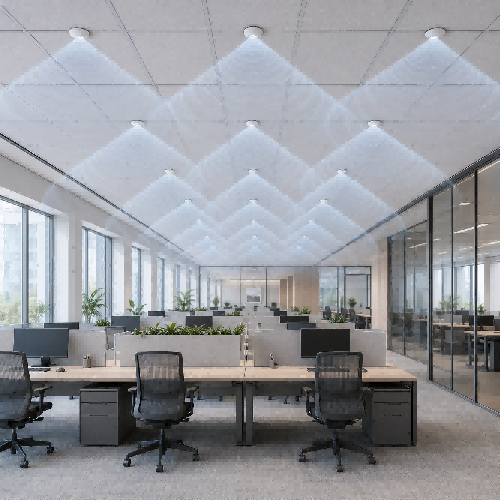
Table of Contents
Acoustic Shielding: Engineering Sound Masking for Commercial Speech Privacy
Modern open-plan corporate offices and healthcare facilities suffer from two major acoustic problems: ambient noise distraction and lack of speech privacy. While soundproofing blocks sound and acoustic panels absorb reflections, Sound Masking Systems actively manage the ambient acoustic floor. By emitting a precisely shaped, non-intrusive sound spectrum tuned to human speech frequencies ($250\text – 8000\text$), sound masking reduces the Speech Transmission Index (STI), rendering distant conversations unintelligible without making the room feel noisy.
The Privacy Paradox: Why Quiet Offices Feel Too Loud
In modern commercial architecture, glass walls, exposed concrete ceilings, and open-plan desk layouts have replaced quiet, enclosed cubicles. This creates a severe acoustic paradox: when a room is extremely quiet ($<35\text$ background noise floor), a person speaking $15\text$ away can be clearly heard and understood.
Human brain architecture is hardwired to focus on intelligible speech. Every distant spoken word acts as a cognitive interruption, reducing worker productivity and compromising confidential medical (HIPAA) or financial conversations.
Trying to solve this by adding louder background music simply causes cognitive fatigue. Sound masking solves this problem by raising the ambient background sound floor to a comfortable, controlled level ($45\text – 48\text$) using engineered, non-repetitive acoustic spectrums.
[Unmasked Open Office] ===> Low Ambient Noise (30dBA) ===> Distant Speech Intelligible & Distracting
[Masked Open Office]   ===> Masked Ambient Floor (47dBA) ===> Distant Speech Unintelligible & Private
1. The Physics of Speech Privacy: Speech Transmission Index (STI)
Speech privacy is measured scientifically using the Speech Transmission Index (STI), a scale ranging from $0.00$ (completely unintelligible) to $1.00$ (perfectly intelligible).
                      [Unmasked Direct Vocal Wave]
                                   │
              ==============[Sound Masking Field]=============
              (Injects Engineered 1/3 Octave Noise Band)
  ====================[Signal-to-Noise Ratio (SNR) Drops]====================
                                   │
                                   ▼
               [STI Rating Drops from 0.85 down to < 0.20]
                                   │
                                   ▼
             [Confidential Speech Privacy Achieved Naturally]
To achieve Confidential Speech Privacy (STI $< 0.20$), a system must lower the Signal-to-Noise Ratio ($SNR$) of spoken words at the listener's ear. Sound masking generators emit a customized noise curve—similar to the gentle sound of rushing airflow—tailored to match the acoustic envelope of human speech ($1/3$-octave bands centered from $200\text$ to $5000\text$). By filling in the "valleys" between spoken words with a uniform sound field, human speech becomes acoustically masked over distance.
2. System Architecture: Direct-Field vs. In-Plenum Indirect Masking
Deploying sound masking across a commercial facility requires selecting between two primary hardware topologies:
[Plenum Indirect Topology]         [Direct-Field Topology]
       [Concrete Deck]                 [Structural Ceiling]
             │                                │
      ▲ (Fires Upward)                        │
     [Plenum Emitter]                         ▼ (Fires Downward)
   =========▼=========               [Direct-Field Micro-Emitter]
     [Acoustic Tile]                 =========[Ceiling Plane]=========
             │                                │
             ▼ (Reflected Down)               ▼ (Direct Uniform Coverage)
      [Workstation]                    [Workstation]
-
In-Plenum Indirect Masking: Emitters are hung inside the open ceiling plenum cavity above acoustic ceiling tiles, firing sound upward against the structural deck. The sound reflects off the deck and filters down through the ceiling tiles into the office below. While budget-friendly, variations in plenum height, ductwork obstructions, and tile density can cause uneven, patchy coverage.
-
Direct-Field Active Masking: Compact micro-emitters are installed directly flush into the ceiling plane, firing sound downward into the occupied space. Direct-field systems deliver a completely uniform $180^\circ$ dispersion field, eliminating plenum obstruction variables and allowing precise, room-by-room volume and spectrum control.
System Topology Comparison: In-Plenum Indirect vs. Direct-Field Masking
| Acoustic Engineering Factor | In-Plenum Indirect Masking | Direct-Field In-Ceiling Masking |
| Acoustic Dispersion Path | Upward into plenum, reflects down | Direct downward $180^\circ$ wide-dispersion |
| Coverage Uniformity | Subject to duct & pipe obstructions | Hyper-uniform ($\pm 1\text$ variance across space) |
| Minimum Ceiling Height | Requires $\ge 0.6\text$ plenum space | Works in any ceiling (Plenum or exposed deck) |
| Spectrum Tuning Precision | Affected by ceiling tile absorption | Direct 1/3 octave DSP tuning per zone |
| Integrated Secondary Audio | Poor background music / paging clarity | Crystal-clear background music & paging support |
3. DSP Spectrum Curve Calibration & Adaptive Masking
A sound masking system is only as effective as its digital signal processing (DSP) equalization. Raw, un-equalized white noise or pink noise sounds harsh, hiss-like, and irritating to occupants.
Commercial sound masking controllers—such as LECOVITA's commercial DSP masking matrix series—use multi-channel $1/3$-octave graphic equalizers to shape the noise spectrum precisely to the room's unique acoustic signature. Furthermore, advanced controllers feature Adaptive Ambient Microphones. As the office gets busier and louder during peak hours, the DSP automatically raises the masking volume in subtle, imperceptible steps ($0.5\text$ increments), maintaining constant speech privacy without annoying workers.
Expert Q&A
Q1: Is sound masking the same thing as active noise cancellation (ANC) used in headphones?
A: No. Active noise cancellation generates anti-phase sound waves to cancel out low-frequency noise (like jet engines) inside a tiny, enclosed space like an ear cup. It cannot cancel sound across an entire open room because wave phases differ at every physical location. Sound masking does not cancel sound waves; instead, it raises the ambient sound floor in a controlled frequency range to cover up human speech over distance.
Q2: How does sound masking help commercial healthcare facilities comply with HIPAA regulations?
A: The Health Insurance Portability and Accountability Act (HIPAA) mandates that healthcare providers take reasonable safeguards to protect patient privacy, including oral communications in reception areas, pharmacy counters, and exam rooms. Installing a calibrated sound masking system around check-in desks and exam corridors lowers the Speech Transmission Index (STI), preventing waiting patients from overhearing private medical discussions.
Q3: Can a sound masking system double as a commercial background music (BGM) and paging system?
A: Yes, provided you select a direct-field or high-quality plenum system. Commercial DSP masking processors feature dedicated audio inputs for paging microphones and background music players. The DSP automatically mixes the audio streams, ducking or lowering the sound masking level slightly when an emergency voice announcement or phone page is broadcast across the building.
