
Precision Geometry: Engineering Angled Architectural Speakers for Dolby Atmos

About Author: Kevin Wu
Founder & Principal Audio Engineer, LECOVITA
Specialize in acoustic engineering, high-fidelity speaker and amplifier design, precision manufacturing, sonic innovation, immersive audio solutions, and premium audio system development.
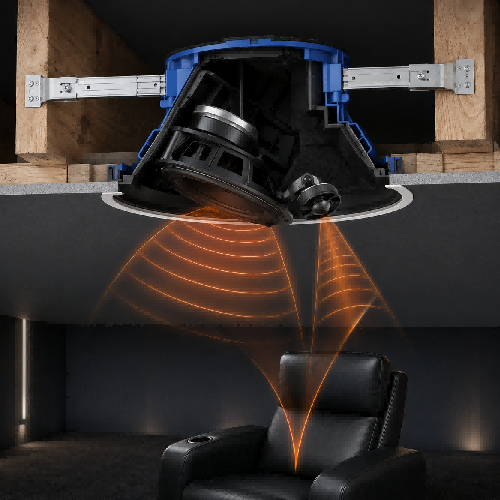
Table of Contents
Precision Geometry: Engineering Angled Architectural Speakers for Dolby Atmos
TL;DR: Deploying immersive spatial audio formats like Dolby Atmos® or DTS:X® with architectural in-ceiling speakers introduces a major positioning challenge: traditional flat in-ceiling speakers fire sound straight down at the floor, placing primary listening seats far off-axis. Achieving pinpoint overhead spatial imaging requires engineering Angled Baffle Assemblies ($15^\circ$ to $30^\circ$ driver tilt) paired with precision pre-construction mounting accessories—such as pre-construction rough-in brackets, mud rings, and anti-vibration backcan adapters—to ensure rock-solid physical placement and optimal phase alignment.
The Off-Axis Dilemma: Why Flat Ceiling Speakers Ruin Spatial Audio
In a high-performance home cinema or immersive media room, object-based spatial audio relies on precise arrival times and frequency responses from overhead height channels.
When a standard, flat-baffle ceiling speaker is installed overhead, its primary acoustic axis points straight down toward the carpet. A listener sitting in the primary seating position is typically positioned at a $30^\circ$ to $50^\circ$ off-axis angle relative to the speaker cutout.
Because high frequencies beam forward in narrow angles, this off-axis misalignment causes severe high-frequency attenuation ($>8\text$ drop above $6\text$), blurring spatial sound objects, ruining voice intelligibility, and collapsing the seamless 3D soundstage overhead.
[Flat Ceiling Speaker]   ===> Sound Fires Down to Floor ===> Listener Seats Suffer 45° Off-Axis Treble Loss
[Angled Baffle Speaker] ===> Sound Directed to Listening Seats ===> Full-Spectrum On-Axis Spatial Imaging
1. Angled Baffle Physics & Waveguide Alignment
To direct high-frequency energy precisely toward the listening area without tilting the outer magnetic grille—which would ruin ceiling aesthetics—architectural acoustic engineers integrate an Internal Angled Baffle.
By slanting the internal woofer basket and tweeter waveguide assembly at an engineered $15^\circ$, $20^\circ$, or $30^\circ$ angle inside a round or square chassis, the speaker's primary dispersion cone is physically steered directly toward the primary seating area.
When paired with a rotating tweeter waveguide, the installer can aim the high-frequency radiation pattern with mathematical precision, ensuring the listener receives direct, un-diffracted acoustic energy for realistic overhead fly-overs and pin-point object panning.
2. Pre-Construction Mounting Hardware & Accessories
Achieving a flawless, acoustically isolated installation in drywall ceilings requires modular pre-construction audio accessories installed during the structural framing phase before plasterboard is hung.
                       [Ceiling Wooden Joist Framework]
                                      │
              ============[Pre-Construction Rough-In Bracket]============
              (Secured via extendable aluminum wing-arms)
  ====================[Plasterboard Drywall Panel Hung]====================
                                      │
              [Mud Ring Edge Seams Sanded & Painted Flush]
                                      │
                                      ▼
            [Angled Architectural Speaker Clipped into Place]
-
Pre-Construction Rough-In Brackets (Snap-Away Wings): High-impact ABS brackets equipped with adjustable aluminum extension arms allow contractors to reserve exact speaker cutout locations across ceiling joists before drywall is installed. The rigid snap-away plastic ring acts as a physical router template for drywall crews, preventing misaligned cutouts and saving hours on job sites.
-
Flush-Mount Mud Rings (Trimless Aesthetics): For luxury residential designs requiring zero visual bezels, specialized perforated polymer mud rings attach to the rough-in bracket. Plaster compound is troweled directly over the ring edge up to the aperture lip, creating a perfectly seamless rim flush with the ceiling plane.
-
Vibration Decoupling Silicone Gaskets: High-output home cinema woofers generate severe kinetic reaction forces. Fitting anti-vibration silicone gaskets between the mounting bracket flange and the drywall dampens mechanical energy transfer, preventing joist rattles during high-volume action sequences.
Architectural Home Theater Comparison: Flat vs. Angled Systems
| System Architecture Factor | Standard Flat In-Ceiling Speaker | Angled Architectural Cinema Speaker |
| Acoustic Targeting Axis | $90^\circ$ straight down to floor | $15^\circ – 30^\circ$ directed angled tilt toward seats |
| Off-Axis High-Frequency Loss | Severe ($>8\text$ drop in treble) | Minimal (Delivers smooth, on-axis response) |
| Spatial Object Precision | Diffuse, smeared, and localized to ceiling | Pinpoint 3D spatial pan placement (Dolby Atmos®) |
| Pre-Construction Accessories | Cutout cut manually during trim-out | Rough-in brackets, mud rings, & backcan adapters |
| Ceiling Visual Profile | Protruding wide plastic bezels | Micro-bezel or completely bezel-less trimless mesh |
3. Step-by-Step Installation & Alignment Workflow
🛡️ Expert Q&A
Q1: Why are $15^\circ$ or $30^\circ$ angled in-ceiling speakers recommended for Dolby Atmos® home theaters over standard flat speakers?
A: Dolby Atmos® spatial audio guidelines specify precise angular windows ($45^\circ$ to $55^\circ$ elevation angle) from the listener's ear to the height channels. Standard flat ceiling speakers fire straight down, meaning the listener sits far outside the driver's primary acoustic cone. Angled in-ceiling speakers tilt the entire driver array toward the seating area, delivering full-bandwidth sound directly to the listener's ears for realistic spatial panning and crisp movie dialogue.
Q2: What is the purpose of a pre-construction rough-in bracket if you can just cut a hole in the drywall later?
A: Pre-construction rough-in brackets reserve exact spatial locations during early building framing, preventing trade conflicts with HVAC ducts, electrical conduits, or plumbing pipes. They act as a physical guide for drywall installers to ensure perfectly round cutouts, eliminate manual measurement errors during trim-out, and provide structural reinforcement around the drywall perimeter for heavy architectural speakers.
Q3: Can angled in-ceiling speakers be used as In-Ceiling LCR (Left, Center, Right) front channels?
A: Yes! In living rooms or multi-purpose spaces where dedicated in-wall or cabinet speakers cannot be installed around a wall-mounted TV screen, high-output $30^\circ$ angled in-ceiling LCR speakers act as front channels. By aiming the drivers at the seating area, the acoustic image "drops" down from the ceiling, creating the convincing illusion that dialogue is coming directly out of the television screen.
