
Weather-Hardened Sound: The Engineering Behind True IP66 All-Weather Speakers

About Author: Kevin Wu
Founder & Principal Audio Engineer, LECOVITA
Specialize in acoustic engineering, high-fidelity speaker and amplifier design, precision manufacturing, sonic innovation, immersive audio solutions, and premium audio system development.
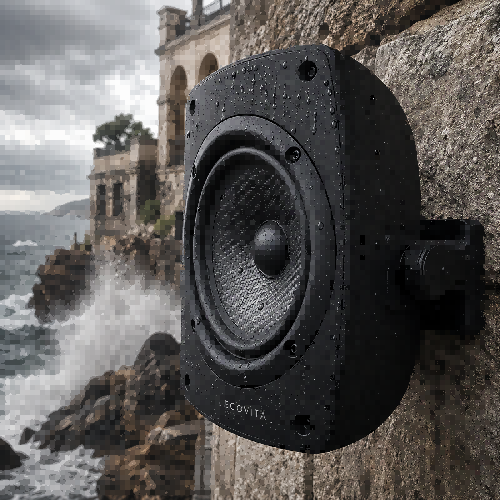
Table of Contents
Weather-Hardened Sound: The Engineering Behind True IP66 All-Weather Speakers
Deploying audio systems outdoors exposes hardware to severe environmental threats: moisture penetration, salt spray corrosion, thermal expansion, and UV polymer degradation. Standard “weather-resistant” speakers quickly suffer from rotted surrounds, rusted grilles, and flooded enclosures. Creating true marine-grade all-weather speakers requires holistic material engineering: hydrophobic cone drivers, Santoprene elastomer surrounds, powder-coated aluminum grilles, and IP66/IP67 liquid-tight cable gland mechanics.
The Environmental Threat: Why Standard Outdoor Speakers Fail
Installing indoor or light-duty patio speakers in harsh outdoor environments sets a clock ticking toward hardware failure. Outdoor environments present four continuous mechanical threats:
-
Moisture Ingress & Humidity: Water droplets penetrate standard paper or unsealed poly cones, softening the suspension and warping the voice coil assembly.
-
UV Radiation Breakdown: Solar ultraviolet rays break down standard plastics, causing speaker cabinets to yellow, crack, and become brittle over time.
-
Salt-Fog Corrosion: In coastal installations, airborne salt accelerates galvanic oxidation, rusting steel grilles, corroding copper terminals, and shorting crossover electronics.
-
Thermal Shock: Extreme daily temperature shifts cause cabinet air pressure changes that suck ambient humidity past loose gaskets directly into the voice coil gap.
[Standard Patio Speaker] ===> UV Cracking + Moisture Penetration ===> Rotted Surround & Corroded Coil
[IP66 Weather-Hardened] ===> Hydrophobic Cone + Sealed IP Gland  ===> Zero Ingress & 10+ Year Durability
1. Advanced Material Science: Hydrophobic Driver Assemblies
The speaker cone is the most exposed component of an outdoor speaker. To withstand continuous rain and high humidity without absorbing moisture, engineers replace standard paper pulp or basic plastics with specialized composite materials.
                         [Heavy Rain / Water Droplets]
                                       │
                  ▼ ▼ ▼ ▼ ▼ ▼ ▼ ▼ ▼ ▼ ▼ ▼ ▼ ▼ ▼ ▼ ▼ ▼ ▼ ▼ ▼
              [Hydrophobic Polypropylene-Mica Composite Cone]
              [UV-Treated Thermo-Plastic Santoprene Surround]
  ======================[Airtight Sealed Baffle]======================
              [Sealed Neodymium Motor & Moisture Barrier]
-
Polypropylene-Mica Composite Cones: High-density mineral-filled polypropylene blends create an inherently hydrophobic cone surface. Water beads up and rolls off instantly without saturating the membrane or altering its moving mass.
-
Santoprene™ Thermoplastic Rubber Surrounds: Traditional foam or rubber surrounds crumble when exposed to UV radiation and ozone. Thermo-Plastic Vulcanizates (TPV) like Santoprene retain their elasticity across extreme temperature ranges (-40°C to +125°C) without cracking or drying out.
-
Silk Dome Tweeters with Hydrophobic Coatings: High-frequency silk dome tweeters are vacuum-infused with a thin, acoustically transparent polyurethane or silicone film, shielding delicate textiles from rain and airborne sea salt while maintaining high-frequency extension up to 20kHz.
2. Cabinet Integrity & Salt-Fog Protection
Protecting the internal driver magnet and crossover board requires an impenetrable, corrosion-resistant outer shell.
-
UV-Stabilized PC-ABS Alloys: Cabinets are molded from high-impact Polycarbonate-ABS blends impregnated with chemical UV-inhibitors. This prevents color fading, chalking, and structural cracking under intense solar exposure.
-
Powder-Coated Aluminum & 316 Stainless Grilles: Standard painted steel grilles rust within months in coastal environments. All-weather enclosures utilize marine-grade 316 stainless steel or electro-statically powder-coated aluminum grilles backed by hydrophobic acoustic scrim cloth.
-
Conformal-Coated Crossover PCBs: The internal crossover circuit board is sprayed with an industrial-grade silicone or acrylic conformal coating. This transparent layer seals electrical traces against moisture condensation, preventing corrosion and short-circuit arcs.
Hardware Specification Comparison: Standard Patio vs. Marine-Grade All-Weather
| Architectural Component | Standard “Weather-Resistant” Speaker | IP66 Marine-Grade All-Weather System |
| Cone Material | Treated paper or standard plastic | Hydrophobic Polypropylene-Mica blend |
| Cone Surround | Standard rubber or foam | UV-stabilized Santoprene TPV elastomer |
| Enclosure Material | Recycled ABS plastic (Unprotected) | UV-inhibited Polycarbonate-ABS alloy |
| Grille & Hardware | Painted sheet steel (Prone to rust) | Powder-coated Aluminum / 316 Stainless |
| Cable Connection | Open spring terminals or push clips | Liquid-tight IP66 PG-gland screw terminals |
| Ingress Rating | Unrated or basic IP44 | Certified IP66 / IP67 dust and water jet proof |
3. Mechanical Water-Sealing: IP66 vs. IP67 Enclosure Ratings
Achieving an International Protection (IP) rating requires precision mechanical engineering around every seam, screw hole, and cable entry point.
                  [Pressurized Heavy Water Jets (100 L/min)]
                                     │
                 ▼ ▼ ▼ ▼ ▼ ▼ ▼ ▼ ▼ ▼ ▼ ▼ ▼ ▼ ▼ ▼ ▼ ▼ ▼ ▼ ▼
              [Dual-O-Ring Silicone Perimetric Gasket]
              [Liquid-Tight Compression Cable Gland (PG-9)]
  ====================[Sealed Rear Terminal Cap]====================
              [Zero Water Ingress into Internal Chamber]
-
IP65 Rating: Protects against dust ingress and low-pressure water sprays from any direction.
-
IP66 Rating: Protects against powerful water jets (100 L/min at 100 kPa pressure from 3 meters). Essential for commercial installations subjected to high-pressure wash-downs or heavy coastal storms.
-
IP67 Rating: Protects against complete dust ingress and temporary immersion in water up to 1 meter depth for 30 minutes. Required for buried subwoofers and ground-level landscape speakers prone to localized flooding.
To maintain an IP66/IP67 seal at the cable entry point, all-weather speakers replace exposed binding posts with compression-nut cable glands (PG glands) or sealed multi-pin connectors that clamp tightly around direct-burial speaker cable, locking out water and gas corrosion completely.
Expert Q&A
Q1: What is the difference between an IP65 speaker and an IP66 marine-grade speaker?
A: An IP65 speaker can handle light rain and low-pressure splashes, making it suitable for covered residential patios. An IP66-rated speaker is built for extreme outdoor exposure. It withstands heavy downpours and high-pressure water jets without letting a single drop enter the enclosure. IP66 speakers also feature marine-grade 316 stainless steel hardware and UV-stabilized materials designed specifically for salt fog and direct solar exposure.
Q2: How do outdoor all-weather speakers maintain proper bass output if the cabinet is completely sealed?
A: Because open bass-reflex ports let water into the cabinet, true all-weather speakers use two closed design approaches: sealed enclosures (acoustic suspension) or auxiliary passive radiators. Passive radiators use a sealed, hydrophobic drone cone that vibrates in phase with the woofer cone. This design matches the deep bass output of a ported speaker without breaking the cabinet’s IP66 watertight seal.
Q3: Why are aluminum or stainless steel grilles necessary instead of standard painted metal?
A: Standard sheet steel contains iron that quickly oxidizes when exposed to moisture and salt air, causing paint to bubble and rust to stain surrounding building walls. Powder-coated aluminum and 316 marine-grade stainless steel contain minimal iron content and form a natural oxide passivation layer that blocks rust, ensuring the speaker maintains its pristine appearance for years.
