
Seamless Airwaves: Mastering Clock Synchronization in Wi-Fi Multi-Room Audio

About Author: Kevin Wu
Founder & Principal Audio Engineer, LECOVITA
Specialize in acoustic engineering, high-fidelity speaker and amplifier design, precision manufacturing, sonic innovation, immersive audio solutions, and premium audio system development.
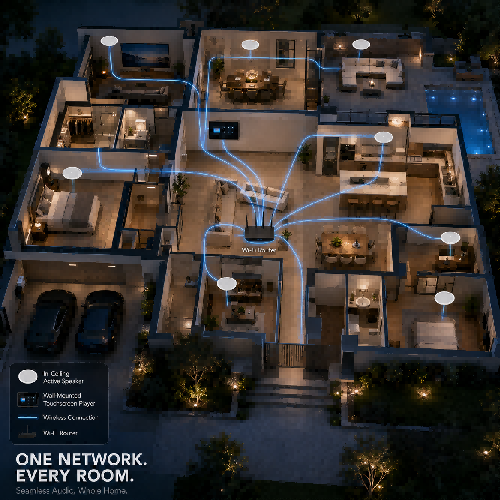
Table of Contents
Seamless Airwaves: Mastering Clock Synchronization in Wi-Fi Multi-Room Audio
Unlike traditional Bluetooth setups that suffer from compressed bandwidth and limited range, wireless Wi-Fi streaming networks transmit lossless, high-resolution audio across vast property footprints. The primary engineering bottleneck in multi-zone streaming is clock jitter—microscopic network timing delays that cause speakers in different rooms to fall out of sync. Resolving this requires hardware-level master-slave clock architectures, high-performance packet buffering, and advanced active DSP integration.
The Timing Dilemma: The Challenge of Wireless Distribution
When a user streams a lossless 24-bit/192kHz audio file to multiple active Wi-Fi speakers or smart amplifiers across a home, millions of data packets traverse the local network every second. If one speaker processes its data packets even 5 milliseconds faster than the speaker in the adjacent hallway, an echo effect occurs.
This timing drift destroys the spatial soundstage, causes phase cancellation that muddies mid-bass response, and creates an unsettling listening environment. Because standard home Wi-Fi routers route data packets using dynamic, unpredictable paths, audio components must possess native hardware-level intelligence to reassemble and play these streams in perfect harmony.
1. Master-Clock Topologies and Jitter Elimination
To achieve absolute synchronization across separate physical hardware zones, premium Wi-Fi audio systems deploy a decentralized Master-Slave Clock Topology.
[Streaming Device] ===(Wi-Fi Packets)===> [Master Unit Speaker] (Generates Timing Beacon)
                                                │
                       ┌────────────────────────┴────────────────────────┐
                       ▼                                                 ▼
             [Zone 2 Active Speaker]                           [Zone 3 Smart Amplifier]
         (Real-Time Buffer Adjustment)                     (Real-Time Buffer Adjustment)
2. High-Bandwidth Wi-Fi Protocols vs. Bluetooth Compression
Many consumers wonder why a dedicated Wi-Fi audio network is necessary when Bluetooth technology is already ubiquitous. The answer comes down to raw bandwidth, transmission distance, and compression limitations.
Bluetooth operates as a lossy, peer-to-peer connection that requires heavy data compression (such as SBC or AAC codecs) to squeeze audio info across a narrow pipeline, maxing out at relatively short physical distances.
By contrast, multi-room Wi-Fi networks operate across standard 2.4GHz and 5GHz dual-band wireless infrastructure. This massive data pipeline supports bit-perfect, uncompressed transmission profiles (like FLAC, WAV, and ALAC) with massive data rates up to 9.2 Mbps. This enables pristine, studio-quality sound playback across expansive estates without dropping connections when a user walks to another floor with their control smartphone.
Topology Comparison: Bluetooth vs. Lossless Wi-Fi Multi-Room Matrix
| Operational Factor | Standard Bluetooth Peer-to-Peer | Premium Multi-Room Wi-Fi Systems |
| Data Bandwidth Limit | Highly restricted (~328 Kbps – 990 Kbps) | Massive (Up to 9.2 Mbps and higher) |
| Audio Compression Profile | Lossy compression (SBC, AAC, aptX) | Bit-Perfect Lossless (FLAC, WAV, ALAC) |
| Max Transmission Distance | Short range (Typically under 10 meters) | Whole-Home Scale (Limited only by network footprint) |
| Multi-Zone Speaker Cap | Single speaker link (Rarely supports dual link) | Virtually infinite synchronized hardware nodes |
| Control Signal Pathway | Interrupted if phone takes a local call | Independent processing; continues playing continuously |
3. Active Architectures: Bi-Amplification and Local DSP Processing
The integration of Wi-Fi streaming directly inside the speaker chassis has sparked a revolutionary shift from passive speaker design to Active Intelligent Architectures.
Inside an active Wi-Fi architectural speaker, the traditional passive copper-wound crossover is completely replaced by an onboard Digital Signal Processor (DSP) and a dual-channel Class-D amplifier module. When a lossless network stream enters the speaker, the DSP splits the high and low frequencies cleanly in the digital domain before any amplification occurs.
The low frequencies are routed to a dedicated woofer amplifier channel, while the high frequencies feed an independent tweeter amplifier channel. This bi-amplified architecture eliminates passive component phase shifts, provides real-time driver excursion protection, and delivers a level of punch, clarity, and authority that traditional passive setups struggle to match.
Expert Q&A
Q1: Will a large multi-room Wi-Fi audio network slow down a home’s internet speed?
A: Not when configured properly. While streaming high-resolution audio across 8 or 12 zones simultaneously does consume local network bandwidth, it primarily impacts internal local area network (LAN) traffic rather than external internet bandwidth. For large custom residential builds, we highly recommend deploying a robust mesh network router system or placing the audio hardware on a dedicated virtual local area network (VLAN) to keep data pipelines clean and efficient.
Q2: What streaming standards do these in-wall and in-ceiling Wi-Fi systems support?
A: Premium hardware modules incorporate open-architecture network cards that support industry-standard protocols like Apple AirPlay 2, DLNA/UPnP, Spotify Connect, and Tidal Connect. This wide-reaching platform integration ensures users can cast gapless, synchronized audio directly from their favorite apps on iOS, Android, macOS, or Windows devices without undergoing complex setup procedures.
Q3: Can passive architectural speakers be integrated into a smart Wi-Fi streaming ecosystem?
A: Absolutely. For clients who prefer traditional passive flush-mount ceiling speakers, integrators mount a Smart Wireless Multi-Zone Streaming Amplifier inside the equipment rack or a local wall enclosure. This smart amplifier handles the Wi-Fi network connectivity and digital processing locally, running high-quality copper speaker wire straight out to the passive drivers to bring classic architectures into the modern cloud streaming era.
