
Surface Tension: Active vs. Passive Tuning in Wall-Mount Speaker Systems

About Author: Kevin Wu
Founder & Principal Audio Engineer, LECOVITA
Specialize in acoustic engineering, high-fidelity speaker and amplifier design, precision manufacturing, sonic innovation, immersive audio solutions, and premium audio system development.
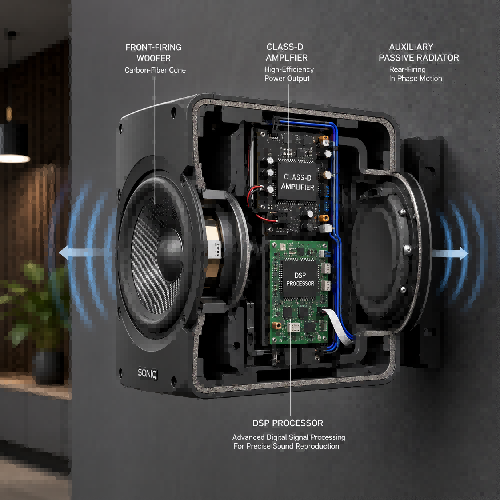
Table of Contents
Surface Tension: Active vs. Passive Tuning in Wall-Mount Speaker Systems
Mounting a speaker cabinet flush against a wall surface drastically alters its acoustic loading, boosting low frequencies by up to $+6\text$ (the wall-gain effect) and muddying vocal clarity. Overcoming this physical boundary barrier requires specialized cabinet engineering: selecting between front-ported reflex ports, sealed enclosures, or rear-facing passive radiators, and deciding whether to correct boundary loading passively via crossover components or actively through digital signal processing (DSP).
The Boundary Trap: The Physics of 2π Space Loading
When a traditional bookshelf speaker is placed on a stand in the middle of a room, it radiates sound in all directions ($4\pi$ steradians) at low frequencies. However, when you mount a speaker flush against a solid wall, the wall acts as an acoustic reflector, folding the backward-radiating sound waves forward.
This acoustic transition shifts the speaker's environment into half-space ($2\pi$ steradians) loading. Low-frequency energy that would normally escape behind the speaker is compressed and forced forward toward the listener. This boundary loading causes an artificial low-frequency boost of $+3\text$ to $+6\text$ below $200\text$.
Without corrective acoustic engineering, this bass hump overpowers the lower mid-range, causing male vocals, acoustic guitars, and dialogue to sound boomy, thick, and physically detached from the rest of the soundstage.
[Free-Space Speaker]  ===> 360-Degree Sound Radiation (Balanced Natural Bass)
[Wall-Mount Speaker]   ===> Wall Compresses Sound Forward (Artificial +6dB Bass Boost)
1. Porting Physics: Front-Ported vs. Sealed vs. Passive Radiators
The physical layout of the speaker cabinet's ventilation system determines how safely it can interface with a wall boundary.
-
Rear-Ported Cabinets (The Wall-Mount Danger Zone): If a speaker features a bass-reflex port on its rear panel, mounting it flush against a wall chokes the airflow. This restriction creates severe port turbulence, whistling wind noises (chuffing), and completely un-tunes the cabinet's Helmholtz resonance, muddying the bass response.
-
Front-Ported Cabinets: Placing the port on the front baffle allows air to move freely into the room without boundary restriction. However, front ports can let high-frequency cabinet resonances leak out, slightly coloring the mid-range.
-
Sealed Cabinets (Acoustic Suspension): Completely sealed cabinets do not rely on moving ports. Instead, the trapped air inside acts as a linear spring, controlling the woofer's excursion. Sealed speakers roll off the low-end gently (at $12\text$ per octave), naturally counteracting the boundary bass boost to provide tight, punchy, and highly accurate transients.
-
Auxiliary Passive Radiators (APR): Premium slim wall-mount lines replace open ports with passive drone cones. The passive radiator matches the bass extension of a ported enclosure without suffering from port wind noise or high-frequency leaks, making it the ideal mechanical solution for ultra-thin wall enclosures.
2. Tuning Methodologies: Passive Crossovers vs. Active DSP
Compensating for the wall-gain effect can be accomplished either electrically in the passive crossover network or digitally via active signal processing.
The Passive Approach: Baffle Step Compensation
Passive wall-mount speakers utilize specialized Baffle Step Compensation (BSC) circuits built directly into their crossover boards. By routing the audio signal through dedicated high-power inductors and parallel resistors, engineers gently shelve down the mid-bass response below $200\text$. This physical attenuation mirrors the anticipated wall-gain curve, so that when the speaker is mounted, the final in-room acoustic response flattens out perfectly.
The Active Approach: Smart DSP Target Filtering
Active wall-mount speakers—such as LECOVITA's modern Wi-Fi and Bluetooth streaming wall monitors—bypass the limitations of passive components. They integrate a dedicated Class-D amplifier channel directly linked to an internal Digital Signal Processor (DSP) for each driver.
By applying precise digital target filters, the DSP can dynamically shape the frequency response, adjusting the low-end roll-off on the fly depending on the speaker's placement setting (e.g., "On-Wall", "Corner", or "Free-Space"). This digital optimization preserves amplifier headroom, eliminates phase shifts, and ensures clean, high-fidelity sound across any mounting configuration.
Wall-Mount Architecture Profiles: Passive vs. Active Systems
| Technical Feature | Passive Wall-Mount Cabinets | Active DSP Wall-Mount Speakers |
| Amplification Source | External amplifier (requires long speaker wire) | Onboard integrated Class-D micro-amps |
| Low-End EQ Correction | Fixed, hardwired Baffle Step Crossover | Dynamic, switchable DSP room EQ profiles |
| Cabinet Configuration | Typically sealed or front-ported reflex | Often sealed with integrated passive radiators |
| System Signal Path | Analog speaker cable run (voltage drop risk) | Lossless digital (Wi-Fi, Bluetooth, optical input) |
| B2B Installer Advantage | Low maintenance; robust and highly reliable | Plug-and-play setup; eliminates rack clutter |
3. Step-by-Step Optimization for Wall-Mount Audio
Achieving clean, distortion-free sound from surface-mount speakers requires a structured calibration approach during the rough-in and physical positioning phase.
Expert Q&A
Q1: Why do active wall-mount speakers sound punchier than passive ones of the same cabinet size?
A: In passive speakers, the physical crossover components (like large inductors) introduce minor electrical resistance and phase delay, which softens the amplifier's damping grip on the woofer. Active speakers connect the internal Class-D amplifier directly to the woofer voice coil with virtually zero wire length. This direct electrical coupling allows the amplifier to control the speaker cone's movement with extreme precision, resulting in faster, tighter, and punchier bass transients.
Q2: Can I paint the cabinet of a commercial wall-mount speaker to match the wall paint?
A: Yes, but you must select the right materials. Many premium commercial cabinets are constructed from UV-stabilized ABS or polycarbonate polymers. To paint them safely, installers must use a high-adhesion plastic primer followed by standard latex or acrylic wall paint. Ensure the delicate driver cones, surrounds, and rubber gaskets are fully masked off, and verify that the metal grille holes remain completely open and un-clogged to preserve acoustic transparency.
Q3: How do passive radiators compare to standard open ports in slim wall speaker designs?
A: Standard ports require physical length inside the cabinet to tune the bass to a low frequency. In a slim, low-profile wall speaker, there isn't enough internal depth to fit a long plastic port tube. A passive radiator replaces the air column inside a port with a tuned physical mass (a cone with no magnet or coil). This allows the speaker to achieve deep, rich bass tuning inside an ultra-slim enclosure that sits less than $10\text$ deep off the wall plane.
