
The Rigid Foundation: How Baffle Density Eliminates Acoustic Warping

About Author: Kevin Wu
Founder & Principal Audio Engineer, LECOVITA
Specialize in acoustic engineering, high-fidelity speaker and amplifier design, precision manufacturing, sonic innovation, immersive audio solutions, and premium audio system development.
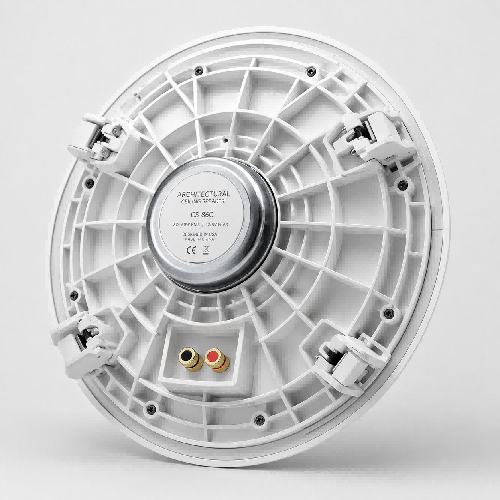
Table of Contents
The Rigid Foundation: How Baffle Density Eliminates Acoustic Warping
High-performance architectural woofers generate massive kinetic reaction forces that travel directly back into the speaker chassis. If the front baffle is thin or flexible, it warps under load, causing severe intermodulation distortion and loss of mid-bass punch. Overcoming this physical limitation requires engineering high-density polymer blends infused with internal geometric ribbing structures to keep the mechanical platform perfectly stationary.
The Mechanical Reaction: Why Strong Drivers Need Rigid Frames
According to Newton's third law of motion, every action has an equal and opposite reaction. When an architectural speaker's voice coil drives a heavy fiberglass cone forward to create a deep bass note, it pushes back against the speaker chassis with identical kinetic force.
In low-cost, entry-level architectural speakers, the front chassis bezel is molded from thin, unreinforced plastics. Under high-volume play conditions, this thin plastic frame physically flexes and twists in opposition to the driver's movement. This mechanical warping alters the precise alignment of the voice coil inside the magnetic gap, causing harmonic distortion, muddy transient response, and a noticeable drop in low-frequency efficiency. Building an elite system requires engineering a sonically dead mounting platform.
[Fleeting Thin Plastic Frame]  ===> Frame Flexes Under Shock ===> Voice Coil Rubbing & Muddy Bass
[Reinforced Structural Ribs]  ===> Chassis Stays Stationary ===> Pure Pistonic Motion & Tight Punch
1. Eliminating Weld Lines via Advanced Injection Molding
During the high-pressure injection molding manufacturing process of plastic speaker frames, liquid polymer flows around mold inserts to form screw holes and clamp tracks. Where these liquid streams meet on the other side of an insert, they form a hidden structural seam known as a weld line.
If the manufacturing process is not tightly controlled, these weld lines become points of structural weakness. Under continuous mechanical stress from heavy bass frequencies, the frame can develop micro-cracks or separation along these seams. Premium architectural speakers utilize advanced thermal profiling and hot-runner molding systems to ensure the polymer chains blend seamlessly across the entire chassis grid, eliminating structural weld lines and guaranteeing long-term durability.
2. The Power of Geometric Radial Ribbing Networks
To maximize rigidity without adding excessive, heavy mass that could crack brittle ceiling drywall, structural engineers deploy geometric reinforcement grids on the rear face of the speaker baffle.
                     [Concentric Outer Rim]
                         /    │    \
              ======[Molded Radial Rib Lines]======  <-- Redirects Mechanical Stress
                         \    │    /
                    [Rigid Central Motor Mount]
These reinforcement frameworks feature a network of molded radial and concentric ribs running along the back of the ABS or polycarbonate chassis structure. The radial lines act like structural bridge trusses, redirecting the mechanical stress lines outward from the heavy central magnet assembly toward the solid outer mounting perimeter. This distribution of energy keeps the speaker frame perfectly planar and stable, allowing the woofer cone to achieve clean, linear pistonic motion even during intense action movie sequences or complex bass passages.
Structural Mass Profiles: Standard Molded vs. Reinforced Anti-Resonant
| Engineering Structural Factor | Standard Commodity Speaker | High-Density Reinforced Chassis |
| Material Composition | Standard thin-wall polypropylene | High-Density ABS / Polycarbonate Blend |
| Weld Line Integrity | Prone to micro-splitting under heavy stress | Seamless hot-runner fusion (Zero split lines) |
| Rear Frame Surface | Flat, unreinforced smooth plastic | Intricate molded radial and concentric rib grids |
| Chassis Torsional Flex | High; warps under heavy low-frequency load | Zero; remains perfectly rigid under maximum SPL |
| Transient Response Profile | Delayed and smeared due to frame movement | Hyper-accurate, sharp, and highly defined |
3. High-Density Polymer Blending for Acoustic Deadness
In addition to shape geometry, the chemical makeup of the plastic compound plays a massive role in damping internal resonance.
Standard plastics have a high resonant signature, meaning they can ring or buzz like a bell when excited by certain frequencies. Premium architectural lines mix raw ABS with high-molecular-weight polycarbonate (PC) or glass-fiber fillers. This specialized compound combination dramatically increases the internal damping factor of the material. The frame absorbs unwanted mechanical vibrations within its molecular structure rather than radiating them out into the room, ensuring you hear only the pure, unaltered sound of the recording.
Expert Q&A
Q1: How does a flexing speaker frame ruin high-frequency tweeter clarity?
A: In a coaxial or integrated speaker design, the tweeter is physically anchored to the same chassis frame as the woofer. If the main baffle is flexing and vibrating due to heavy mid-bass movement, it physically shakes the tweeter assembly back and forth. This mechanical movement introduces high-frequency modulation and phase distortion, making vocals sound smeared and losing pinpoint spatial imaging.
Q2: What is the benefit of adding glass-fiber reinforcement to the plastic blend?
A: Glass-fiber filler strands act like internal steel rebar inside concrete. They mesh within the liquid polymer fluid, multiplying the tensile strength and structural stiffness of the finished speaker frame. This prevents the plastic from creeping, warping, or sagging over decades of exposure to tension from high-torque dog-leg mounting clamps.
Q3: Does a heavier speaker frame require extra structural ceiling support?
A: No. By utilizing high-efficiency geometric ribbing instead of simply piling on raw material thickness, engineers maximize structural stiffness while keeping the weight highly manageable. This allows the speaker to install safely into standard $12\text$ to $15\text$ residential plasterboard layouts using corrugated cardboard or standard internal lining protection without putting dangerous structural strain on the ceiling grid.
