
Unbreakable Sound: Safeguarding Architectural Speakers Against Thermal Overload

About Author: Kevin Wu
Founder & Principal Audio Engineer, LECOVITA
Specialize in acoustic engineering, high-fidelity speaker and amplifier design, precision manufacturing, sonic innovation, immersive audio solutions, and premium audio system development.
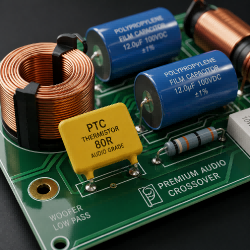
Table of Contents
Unbreakable Sound: Safeguarding Architectural Speakers Against Thermal Overload
In high-power residential theaters and commercial spatial audio systems, unexpected voltage spikes and long hours of high-volume operation put extreme thermal stress on delicate high-frequency drivers. Protecting these components without altering the audio signal requires smart crossover engineering. By using solid-state dynamic current-limiting circuits and self-resetting polymer PTC protection elements, speakers can automatically handle power overloads and maintain reliable operation over a long service life.
The Vulnerability Window: Why High Frequencies Burn First
When an AV system is driven into clipping—either by a user turning the volume up too high during a party or an integration tech miscalculating amplifier gain staging—the smooth audio waveform transforms into a harsh, square wave.
This clipping behavior creates a massive rush of high-frequency distortion energy. While a thick, heavy low-frequency woofer cone can dissipate this excess heat through its massive magnet structure, a lightweight high-frequency tweeter cannot. Its delicate voice coil wires quickly overheat, soften, and melt, resulting in an open circuit and a completely dead driver. Minimizing these failures requires shifting from unprotected circuitry to proactive thermal guarding inside the crossover network.
[Amplifier Clipping Spike] ===> Excessive Thermal Current ===> Unprotected Tweeter Burns out
[PTC Protected Network]    ===> Dynamic Current Limiting  ===> Resistor Absorbs Heat, System Survives
1. Solid-State Smart Protection: The PTC Thermistor
Traditional speaker protection relied on old-fashioned glass fuses. When a system drew too much power, the fuse blew to save the driver. While this protected the hardware, it required an integrator to make an expensive service call to tear down the ceiling speaker just to swap a cheap fuse.
Modern high-reliability architectural speakers replace fuses with solid-state Polymer Positive Temperature Coefficient (PTC) thermistors. Under normal listening conditions, the PTC element remains in a low-resistance state, letting the audio signal flow cleanly through to the tweeter. However, if a dangerous, continuous current surge occurs, the polymer material heats up instantly, causing its electrical resistance to skyrocket. This action safely limits the current flowing to the tweeter voice coil, diverting the excess thermal energy away from the driver.
2. Auto-Resetting Mechanics for Zero-Maintenance Projects
The primary advantage of a solid-state PTC circuit layout is its self-healing mechanical behavior.
                   [Continuous Current Influx]
                               │
       ┌───────────────────────▼───────────────────────┐
       │     [PTC Protection Element Heats Up]         │
       │    (Resistance Automatically Multiplies)      │
       └───────────────────────┬───────────────────────┘
                               ▼
            [Excess Current Absorbed Safely]
                               │
  ================[Amplifier Volume Reduced]================
                               │
                               ▼
        [PTC Cools Down / Resistance Drops to Zero]
Once the user realizes the sound is compressing and lowers the amplifier's volume control, the current spike drops. With the electrical load removed, the internal temperature of the PTC element falls, and its internal molecular structure returns to its original low-resistance state. The speaker seamlessly returns to full output capacity automatically. For custom integration companies, this self-resetting mechanism eliminates post-installation service calls, safeguards system reliability, and keeps project margins intact.
Protection Network Profiles: Standard Entry-Level vs. High-Reliability Engineering
| Engineering Specification | Low-Cost Standard Crossover | High-Reliability Protected Network |
| Overload Protection | None (Direct hardwire connection) | Dynamic Solid-State PTC Thermistor Matrix |
| Component Response | Permanent voice coil failure / burnout | Self-healing, auto-reset thermal protection |
| Resistor Materials | Cheap sand-cast cement resistors | Non-inductive, high-power metal oxide film |
| Capacitor Layout Specs | Polarized electrolytic components | High-voltage metallized polypropylene (MKP) |
| Long-Term Reliability | Low; high warranty replacement rates | Exceptional; engineered for long-term use |
3. Audiophile Component Selection for Intact Linearity
A common criticism of early speaker protection design was that protection circuits could add unwanted distortion or color the high-frequency response.
To maintain pristine audiophile performance, premium lines feature crossovers built with high-voltage metallized polypropylene (MKP) film capacitors and heavy-duty, non-inductive metal oxide resistors. These premium components feature an incredibly low Dissipation Factor ($DF$), ensuring the protection circuit remains completely transparent and sonically invisible during standard operation. Sound waves pass through the network with zero phase shifts, preserving sweet, detailed, and airy high frequencies right up to $20\text$.
Expert Q&A
Q1: Will the PTC protection circuit kick in during normal dynamic spikes in movie tracks?
A: No. PTC thermistors are thermal devices that respond to continuous, integrated heat buildup over time. Short, dynamic peaks—such as a sudden explosion in an action movie or a sharp drum hit—pass through the network instantly and cleanly. The circuit only engages when the amplifier is pushed into continuous, prolonged clipping that poses a real thermal threat to the voice coil.
Q2: What happens to the sound when the protection circuit actively clamps down on power?
A: When the PTC element is triggered by a power surge, it gently limits high-frequency output, causing the tweeter's volume to drop slightly while the woofer continues to play normally. This audible shift acts as a safe warning sign to the listener that the system is being driven too hard, allowing them to lower the master volume before any mechanical damage occurs to the system.
Q3: Does using high-power amplifiers increase the risk of burning out the crossover?
A: Counterintuitively, using an underpowered amplifier is actually more dangerous than using a high-power one. When a low-wattage amplifier is pushed too hard, it runs out of voltage headroom and clips rapidly, creating massive high-frequency distortion energy that destroys drivers. Using a high-power, clean amplifier ensures ample headroom, keeping the signal clean and smooth for the crossover network.
