
Rigid Control: Engineering Out Structural Resonance in Architectural Speakers

About Author: Kevin Wu
Founder & Principal Audio Engineer, LECOVITA
Specialize in acoustic engineering, high-fidelity speaker and amplifier design, precision manufacturing, sonic innovation, immersive audio solutions, and premium audio system development.
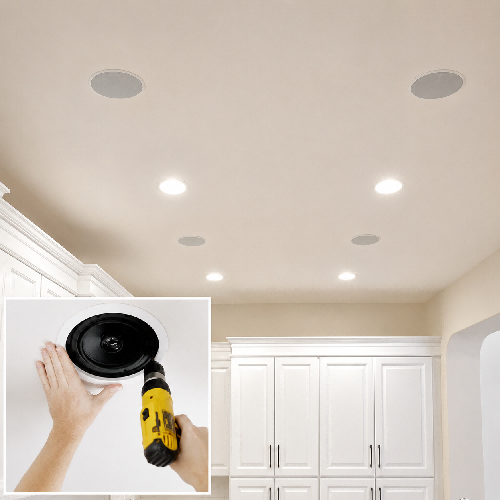
Table of Contents
Rigid Control: Engineering Out Structural Resonance in Architectural Speakers
When a high-power architectural speaker plays deep bass notes, the kinetic energy shifts from the cone to the speaker frame and surrounding ceiling structure, creating unwanted rattles, buzzing, and acoustic distortion. Eliminating these structural colorations requires heavy industrial engineering: thick injection-molded ABS-polycarbonate baffles, deep structural ribbing grids, and high-torque multi-point clamping dog-legs that lock the speaker directly to the drywall matrix.
The Mechanical Enemy: Parasitic Boundary Resonance
In traditional cabinet speaker design, engineers have full control over the structural integrity, mass, and internal damping of the wooden enclosure. In architectural audio, however, the speaker must use the wall or ceiling drywall as its outer boundary.
Drywall ($12\text$ to $15\text$ thick) is highly flexible and acts like a giant passive acoustic radiator. When a low-frequency driver moves rapidly back and forth, the mechanical reaction forces are transferred directly into the speaker's mounting frame. If the frame flexes or the clamping mechanism is weak, this energy travels into the ceiling joists, triggering rattling metal light cans, buzzing air ducts, and structural vibration. This parasitic resonance colors the sound, destroys mid-bass precision, and ruins the high-end luxury audio experience.
[Weak Frame / Clamp]  ===> Kinetic Energy Escapes ===> Vibrates Drywall, Rattles Lights, Muddy Bass
[Anti-Resonant Frame] ===> Energy Contained      ===> Locked to Baffle, Pure Transients, Tight Punch
1. Advanced Material Science: Reinforced Polymer Baffles
The front baffle is the foundation of the speaker assembly; it must remain completely rigid under massive sound pressure levels (SPL). Standard commercial speakers use cheap, thin polypropylene plastics that flex under heavy acoustic loading.
Premium architectural designs substitute these flimsy materials with thick, high-density ABS blended with Polycarbonate (PC) or fiberglass reinforcements. Additionally, the back of the baffle is engineered with an intricate network of radial and concentric structural ribs. These molded ribs dramatically increase the mechanical stiffness-to-weight ratio without adding excessive bulk, pushing the natural resonant frequency of the chassis far above the working range of the woofer, ensuring the frame remains acoustically dead.
2. High-Torque Mechanical Clamping System
The physical connection between the speaker and the ceiling is maintained via swing-out mounting tabs, often called "dog-legs." Standard dog-legs are made of soft plastic that warps when tightened, loosening over time due to constant acoustic vibrations.
                      [Rigid ABS-PC Baffle Frame]
                                   │
  ====================[Ceiling Drywall Plane]====================
                                   │
              [Self-Damping Glass-Reinforced Dog-Legs]
Professional-grade architectural speakers—such as LECOVITA's precision-engineered installation series—utilize heavy-duty, glass-reinforced nylon or die-cast metal dog-legs driven by thick machine-threaded steel screws. These clamps feature an aggressive, self-locking swing angle and specialized ridges that bite firmly into the back of the drywall. This ensures uniform high-torque clamping pressure across the entire mounting perimeter, locking the speaker permanently into the ceiling framework and completely eliminating structural flexing or buzzing over years of high-volume operation.
Structural Integrity Profiles: Low-End Hardware vs. High-End Isolation Engineering
| Mechanical Feature | Standard Commodity Speaker | High-End Architectural Speaker |
| Baffle Material | Unreinforced Thin ABS Plastic | Thick ABS-Polycarbonate with Glass-Fiber Filler |
| Chassis Reinforcement | Smooth backing; prone to twisting | Intricate molded geometric radial/concentric ribs |
| Clamping Mechanism | Thin plastic standard tabs | Heavy-duty glass-reinforced nylon dog-legs |
| Acoustic Seal Integrity | Leak-prone; allows rear-wave phase cancellation | 100% airtight pressure seal preventing boundary leaks |
| Vibration Transfer | High; causes ceiling rattles and muddy bass | Ultra-low; isolates kinetic energy to the driver |
Expert Q&A
Q1: How do I know if a ceiling buzz is coming from the speaker or something else in the room?
A: Run a low-frequency sine wave sweep (from $20\text$ to $200\text$) through the system. If you hear a localized buzzing at a specific frequency, gently press your hand against the speaker frame. If the noise stops, the speaker clamping is loose or uneven. If the buzz continues elsewhere in the ceiling, it is a loose component in the environment, such as a nearby recessed lighting trim, a loose HVAC diffuser, or internal ceiling wiring striking a joist.
Q2: Can overtightening the speaker installation screws cause mechanical problems?
A: Yes, using a high-torque power drill to slam mounting screws can crack the drywall backing or strip the plastic threads of cheap speaker frames. Premium architectural hardware features mechanical torque-limiting stops on the dog-leg paths or uses die-cast zinc columns. Installers should set their clutches to low torque or finish the last few turns with a manual screwdriver to clamp the frame safely and evenly.
Q3: Does adding an acoustic backbox reduce structural ceiling resonance?
A: Absolutely. A solid wood or heavy polymer backbox completely encloses the speaker's rear wave, keeping high sound pressure levels inside a controlled chamber. This prevents acoustic energy from pressuring the open ceiling cavity, significantly reducing sound bleed into upper floors and isolating adjacent drywall panels from acoustic vibration.
