
Precision Projection: The Role of Waveguides in Architectural Audio

About Author: Kevin Wu
Founder & Principal Audio Engineer, LECOVITA
Specialize in acoustic engineering, high-fidelity speaker and amplifier design, precision manufacturing, sonic innovation, immersive audio solutions, and premium audio system development.
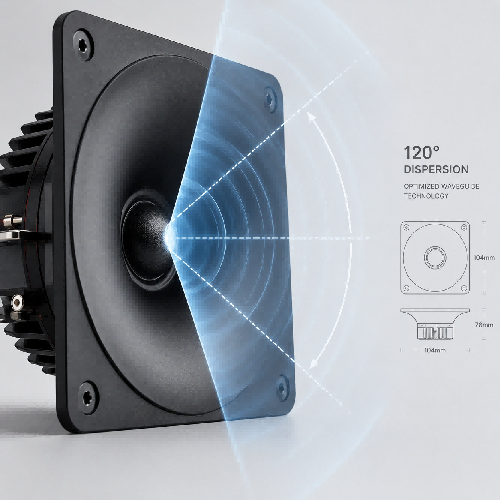
Table of Contents
Precision Projection: The Role of Waveguides in Architectural Audio
High-frequency sound waves are highly directional, behaving more like a laser beam than a floodlight. Without a precision-engineered waveguide, a tweeter's output becomes narrow and harsh, creating a tiny "sweet spot" and leaving the rest of the room sounding dull. Waveguides manage this energy, steering it uniformly across the listening plane to ensure every guest experiences the same clarity, detail, and spatial imaging.
The "Laser" Effect: Why High Frequencies Need Steering
Sound waves below $500\text$ are omnidirectional; they radiate in all directions equally. As frequencies rise into the upper registers—especially above $5\text$—they become increasingly narrow. A raw, un-steered dome tweeter will project sound directly forward in a narrow column, creating a "beaming" effect.
If you are standing directly in the tweeter's path, it sounds shrill. If you move even $30^\circ$ off-axis, you lose almost all high-frequency detail. In luxury home theaters or open-plan commercial spaces, this is unacceptable. Architectural speakers must deliver consistent audio to every listener, not just the one sitting in a single chair. The waveguide is the mechanical solution to this spatial distribution problem.
[Bare Tweeter] ===> Narrow Beam ===> "Beaming" & Harsh On-Axis / Dull Off-Axis
[Waveguide]    ===> Controlled Dispersion ===> Uniform Coverage Across the Listening Area
1. Geometric Boundary Control
A waveguide is essentially a carefully calculated acoustic horn surrounding the tweeter. By shaping the surface of this horn, engineers can precisely dictate the radiation pattern of the sound waves.
Instead of allowing the tweeter to fire into free space, the waveguide forces the wavefronts to expand gradually. This process is called "impedance matching." It slowly transitions the high-pressure air from the tiny tweeter dome into the larger volume of the room. By controlling the flare rate (the expansion of the horn), engineers can achieve a wide, controlled dispersion angle (e.g., $100^\circ$ to $120^\circ$) that remains consistent from $2\text$ up to the limits of human hearing ($20\text$).
2. Eliminating Boundary Reflections
In architectural installs, speakers are often placed near room boundaries—such as corners or close to cabinetry. A bare tweeter will fire high-energy reflections off these surfaces, which arrive at the listener's ear as a delayed, "smeared" version of the original sound, destroying vocal clarity and instrument imaging.
A properly designed waveguide acts as a spatial filter. It concentrates the acoustic energy where it is needed (on the listening area) and minimizes "spill" toward walls and ceiling surfaces. By reducing the sound energy hitting the boundaries, you significantly reduce early reflections, leading to a much cleaner, more accurate soundstage with pinpoint imaging, even in rooms with poor acoustics.
Dispersion Engineering Profiles: Standard vs. Waveguide-Enhanced
| Engineering Factor | Raw Dome Tweeter (No Waveguide) | Waveguide-Integrated Tweeter |
| Dispersion Pattern | Narrow, frequency-dependent "beaming" | Wide, uniform controlled dispersion |
| Sweet Spot | Tiny (Requires perfect alignment) | Expanded (Consistent across the room) |
| Boundary Reflections | High (Energy spills onto walls) | Low (Focused energy on the listening plane) |
| High-End Clarity | Harsh/Fatiguing on-axis; dull off-axis | Smooth, balanced, and articulate everywhere |
| Integration Quality | Budget/Standard commercial hardware | Premium luxury/Cinema-grade performance |
3. Material Rigidity and Diffraction Minimization
The waveguide surface itself must be acoustically "silent." If the surface of the waveguide is resonant, it will vibrate and color the sound, adding an artificial, metallic, or "honky" quality to the treble.
Premium systems—such as the LECOVITA flagship RISF series—use high-mass, non-resonant materials for the waveguide construction. The transition from the dome to the horn flare is finished with a smooth, mathematically optimized curve to prevent diffraction. Diffraction occurs when sound waves hit sharp edges and "bend" or create secondary sound sources, which causes smearing of the audio. By eliminating all sharp transitions in the tweeter housing, the resulting sound is pure, airy, and incredibly transparent.
Expert Q&A
Q1: Do all waveguides look the same?
A: No. Waveguides are highly specific to the crossover frequency of the tweeter. A waveguide designed for a tweeter that crosses over at $2\text$ will look very different (larger/deeper) than one crossing over at $4\text$. Each design is mathematically modeled using Finite Element Analysis (FEA) to achieve a specific target dispersion pattern for that specific driver.
Q2: Can a waveguide be used with a silk dome tweeter, or only metal ones?
A: Waveguides can be used with any tweeter material—silk, titanium, or aluminum. The material of the dome affects the internal sound signature of the tweeter (warm vs. sharp), while the material and geometry of the waveguide determine where that sound goes. Combining a silk dome with a precision waveguide gives you the best of both worlds: smooth, non-fatiguing high frequencies and wide, consistent room coverage.
Q3: How does a waveguide affect the volume of the tweeter?
A: It actually increases efficiency. By focusing the high-frequency sound energy forward rather than letting it disperse into useless directions, the waveguide acts like a megaphone. This allows the tweeter to play louder and cleaner with less power input, reducing the distortion that naturally occurs at higher excursion levels.
