
Centered Perfection: Why Coaxial Architecture Defines Premium Ceiling Audio

About Author: Kevin Wu
Founder & Principal Audio Engineer, LECOVITA
Specialize in acoustic engineering, high-fidelity speaker and amplifier design, precision manufacturing, sonic innovation, immersive audio solutions, and premium audio system development.
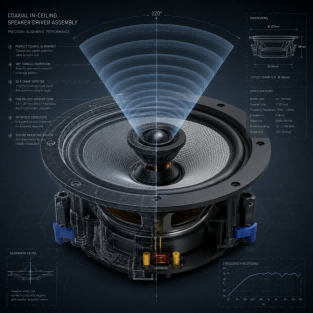
Table of Contents
Centered Perfection: Why Coaxial Architecture Defines Premium Ceiling Audio
Traditional multi-driver architectural speakers place the tweeter next to the woofer, causing uneven sound paths, off-axis phase cancellations, and localized “dead zones.” Coaxial engineering stacks the tweeter directly at the acoustic center of the woofer. This concentric layout creates a single, unified point-source of sound, ensuring uniform multi-angle frequency response and a vastly expanded optimal listening zone.
The Lobing Problem: The Downside of Separated Components
When an audio system projects sound, mid-bass frequencies from the large woofer and high frequencies from the small tweeter must arrive at the listener’s ears simultaneously. In standard, non-coaxial ceiling speakers where the components are mounted side-by-side, the distance between the two sound sources creates a physical offset.
This separation introduces a phenomenon known as acoustic lobing. At the specific crossover frequencies where both drivers are playing the same note, their sound waves can interfere with each other. If a listener stands directly beneath the speaker, it sounds clear. But if they take two steps to the left or right, the path length from one driver becomes slightly longer than the other, causing the waves to cancel each other out. This produces noticeable dips in the mid-range and leaves rooms with uneven, patchy sound coverage.
[Side-by-Side Setup] ===> Uneven Sound Paths ===> Phase Interference & Off-Axis Dead Zones
[Coaxial Alignment]  ===> Concentric Center ===> Perfect Point-Source & Wide Uniform Coverage
1. The Coaxial Solution: Concentric Point-Source Physics
Coaxial engineering solves phase alignment issues through structural geometry. By mounting a high-frequency tweeter directly over the physical center of a low-frequency woofer, engineers create a true acoustic point-source.
                       [High-Frequency Tweeter]
                                  │
         ┌────────────────────────▼────────────────────────┐
         │              [Acoustic Point-Source]            │
         └───────────┬─────────────────────────┬───────────┘
                     ▼                         ▼
              [Woofer Cone]             [Woofer Cone]
In this concentric configuration, sound waves across the entire frequency spectrum—from deep bass up to sparkling treble—originate from the exact same point in space. Because the sound paths remain identical regardless of the listener’s location in the room, phase anomalies and lobing are structurally eliminated. The result is an incredibly smooth, natural frequency response that maintains its sonic balance even when you are listening off-axis.
2. Waveguides and Boundary Optimization
Simply placing a tweeter in front of a woofer can introduce a new technical challenge: the bulky rear structure of the tweeter can block or distort the mid-bass waves radiating outward from the woofer cone beneath it.
To counteract this, premium systems utilize specialized acoustic waveguides. The housing of the centrally mounted tweeter is contoured to serve as a high-frequency horn, while the curve of the surrounding woofer cone acts as a natural extension of that horn. This integrated geometric design ensures that high-frequency energy is distributed evenly across a wide $100^\circ$ to $120^\circ$ conical pattern, preventing harsh sound beam concentration and providing smooth, wide coverage across large spaces.
Performance Comparison: Component-Separated vs. Concentric Coaxial
| Acoustic Characteristic | Side-by-Side Component Layout | Concentric Coaxial Architecture |
| Acoustic Origin | Dual separated points (Time-delayed) | Single unified point-source (Time-aligned) |
| Off-Axis Phase Lobing | Severe; creates unpredictable acoustic nulls | Virtually eliminated; highly symmetrical response |
| Dispersion Symmetry | Asymmetrical; sounds different left vs. right | Perfect $360^\circ$ uniform conical coverage |
| Soundstage Imaging | Diffuse and localized to specific drivers | Pinpoint accuracy with realistic spatial depth |
| Structural Footprint | Requires large baffle surface area | Compact and highly optimized chassis geometry |
3. Crossover Network Integration and Phase Correction
Achieving acoustic alignment requires more than just physical positioning; it demands precision electrical engineering within the internal crossover network.
Because the tweeter sits slightly forward from the woofer voice coil along the vertical axis, a subtle physical time offset remains. To correct this, premium coaxial crossovers incorporate multi-pole Linkwitz-Riley filter topologies. These circuits adjust the electrical phase slope, slowing down the arrival of the high-frequency signals by a fraction of a millisecond so they snap into perfect alignment with the lower frequencies. This technical precision yields pristine vocal intelligibility, tight acoustic transients, and highly detailed instrument separation.
Expert Q&A
Q1: Why is coaxial alignment especially critical for in-ceiling speakers compared to floor-standing ones?
A: Floor-standing speakers are positioned vertically at ear level, meaning listeners generally stay aligned with the primary axis. In contrast, ceiling speakers are mounted overhead, and listeners constantly move around underneath them. This means ceiling audio relies heavily on off-axis performance. Coaxial architecture guarantees that the speaker sounds balanced no matter where you walk in the room.
Q2: Does the movement of the woofer cone affect the performance of the tweeter mounted inside it?
A: In poorly designed systems, heavy woofer excursions can cause minor intermodulation distortion. However, in professional architectural lines, the tweeter is decoupled via a rigid, isolated central post anchored to the back of the magnet. The tweeter remains completely stationary, allowing the woofer cone to pump air freely without transferring mechanical vibrations to the high-frequency driver.
Q3: Can a coaxial speaker cover a wide room with fewer total units?
A: Yes. Because coaxial designs provide a wide, symmetrical $360^\circ$ conical dispersion pattern without localized dead zones, the sound energy spreads much more predictably across a floor plan. This uniform distribution allows system designers to space units farther apart while maintaining smooth audio coverage, saving on overall equipment and installation costs.
