
Ultimate Guide for Ceiling Speaker

About Author: Kevin Wu
Founder & Principal Audio Engineer, LECOVITA
Specialize in acoustic engineering, high-fidelity speaker and amplifier design, precision manufacturing, sonic innovation, immersive audio solutions, and premium audio system development.
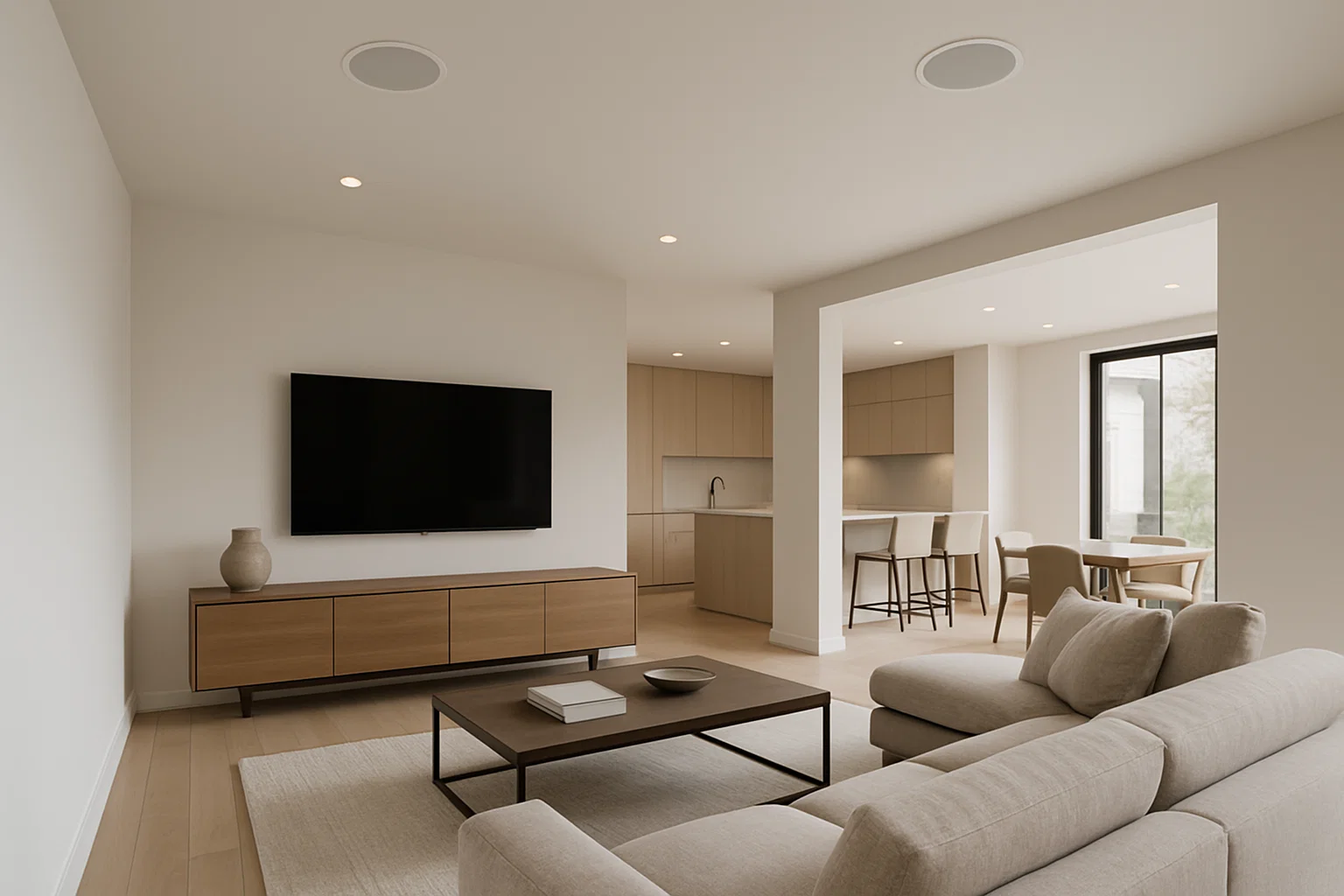
Table of Contents
- What This Guide Covers
- Pros & Cons: Should You Install Ceiling Speakers at Home?
- Types of Ceiling Speakers: Choose What Fits Your Needs
- Room Layout Planning: How Many Ceiling Speakers Do You Need & Where to Place Them?
- Ceiling Speaker Buying Guide: What to Look for Before You Buy
- Installation Guide: How to Install Ceiling Speakers Step-by-Step
- Tuning, Smart Control & System Optimization
- Customer Use Cases & Real-Life Applications
- Ceiling Speaker FAQ: Answers to Common Questions
- Final Thoughts & Next Steps: Design Your Audio System with Confidence
Whether you’re upgrading your home theater, building a whole-house audio system, or simply tired of cluttered shelves and bulky speaker boxes, ceiling speakers offer a sleek, space-saving solution without sacrificing sound quality. In-ceiling audio systems are becoming increasingly popular among homeowners, audiophiles, interior designers, and builders for one key reason: they blend high-performance sound with clean aesthetics.
But are ceiling speakers right for you?
This ultimate guide is designed to answer that question—and many more. Whether you’re a complete beginner or an experienced DIYer planning your next project, we’ve packed this guide with everything you need to know: from types and layouts to installation techniques and product selection tips.
As a professional manufacturer and system solution provider with years of hands-on industry experience, LECOVITA brings a unique perspective: not only do we understand what users want, we also engineer and deliver solutions for audio professionals, resellers, and homeowners around the globe.
What This Guide Covers
In the sections ahead, you’ll discover:
-
The pros and cons of in-ceiling speakers
-
How to choose the right type for your needs
-
Planning speaker layout for different room sizes
-
Installation tips for both DIY and professional jobs
-
Best practices for tuning and smart system integration
-
Buying guides, product recommendations, and FAQs
Whether you’re wiring up a small kitchen or designing a multi-zone audio system, this guide will help you do it right—from the ground up (or in this case, from the ceiling down).
Who Should Read This
This guide is written for:
-
Homeowners planning new builds, remodels, or upgrades
-
Interior designers & contractors seeking clean audio solutions
-
Retailers & resellers looking to offer informed advice
-
Audio enthusiasts who want to better understand ceiling speaker systems
Pros & Cons: Should You Install Ceiling Speakers at Home?
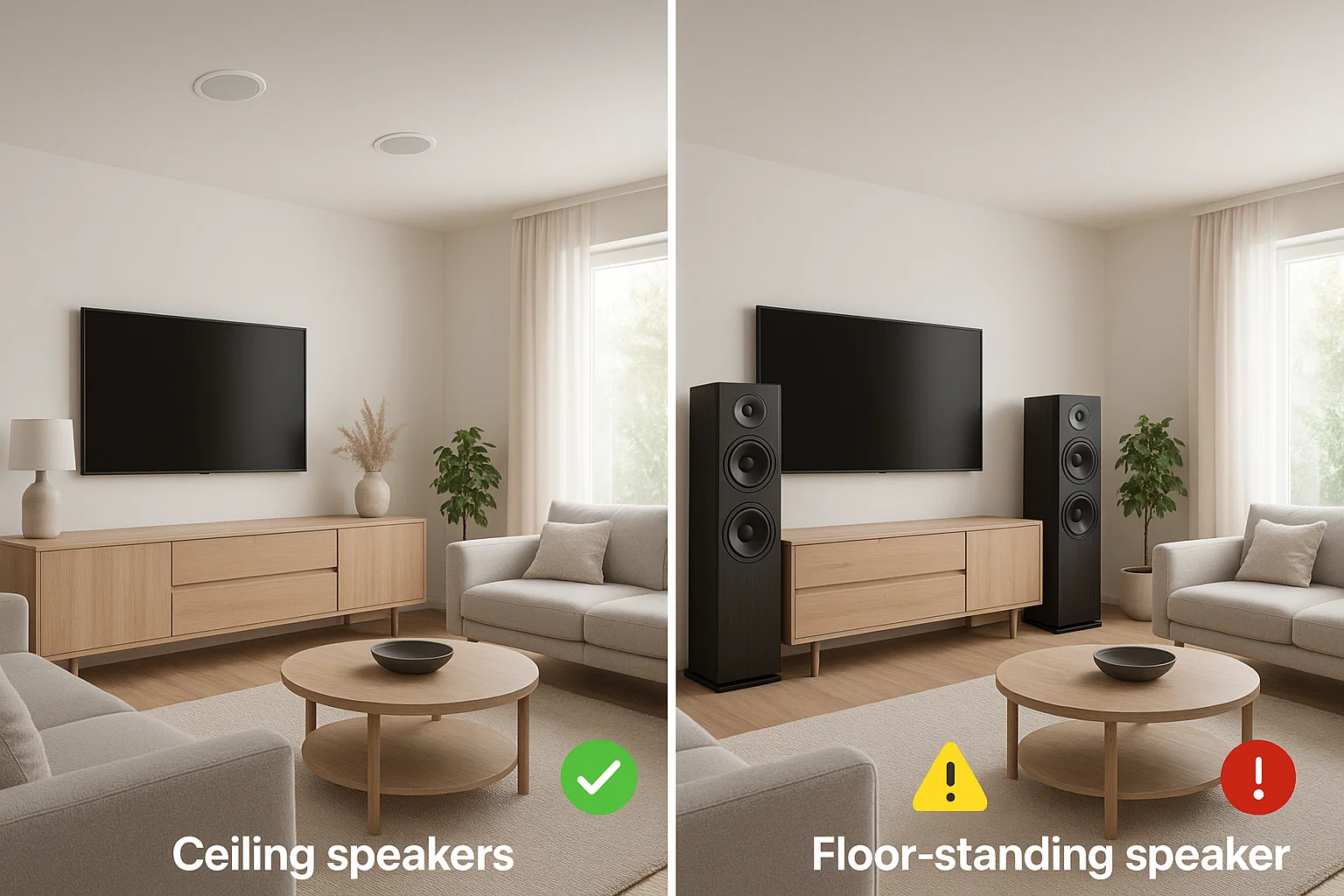
Ceiling speakers are not just about aesthetics—they offer serious performance when properly planned and installed. But like any audio solution, they come with trade-offs. In this section, we’ll break down the most important pros and cons to help you decide if in-ceiling audio is right for your space.
✅ The Key Benefits of Ceiling Speakers
1. Space-Saving Design
Unlike traditional floor-standing or bookshelf speakers, ceiling speakers are completely recessed. That means no visible wires, no bulky enclosures, and no need to rearrange your furniture or decor. Perfect for minimalists and modern interiors.
2. Clean, Seamless Aesthetics
With paintable grills that match your ceiling, these speakers virtually disappear into the architecture. They’re the ideal solution when you want immersive sound without visual clutter—especially in living rooms, kitchens, and bathrooms.
3. Wide, Even Sound Distribution
Properly placed ceiling speakers can deliver 360-degree ambient sound that fills the room evenly. They’re ideal for background music in multi-room setups or creating an enveloping experience in home theaters (as Atmos or rear channels).
4. High Customizability
Many ceiling speakers come in different sizes (e.g. 4”, 6.5”, 8”) and feature options like pivoting tweeters and stereo-in-one drivers. This allows you to tailor your system to your room shape, size, and acoustics.
5. Ideal for Multi-Room Audio
Ceiling speakers are a top choice for whole-home music systems. Whether you’re hosting guests or just want relaxing music throughout your home, they integrate well with multi-zone audio setups.
⚠️ Potential Drawbacks to Consider
1. Fixed Installation
Once installed, ceiling speakers are hard to move. That means your layout needs to be well planned. If you frequently rearrange rooms, you might prefer more flexible speaker types.
2. More Complex Setup
Unlike plug-and-play Bluetooth speakers, most ceiling speakers are passive and require external amplifiers and in-wall wiring. This makes DIY installation more involved and may require a professional.
3. Ceiling Height Matters
In rooms with very high ceilings, sound can get dispersed and lose detail before reaching your ears. You may need higher-powered speakers, lower mounting angles, or alternative placements to compensate.
4. Not Ideal for Precision Listening
For critical stereo imaging or audiophile listening, ceiling speakers may not place sound at ideal ear height. That said, pairing them with in-wall or floor speakers can create a more complete soundstage.
5. Possible Building Code Requirements
In some regions, especially in multi-level buildings, you may need fire hoods or other installation materials to comply with local codes. Always check regulations before starting your project.
🛠️ Lecovita’s Professional Perspective
As a manufacturer with years of project experience, Lecovita has seen firsthand how ceiling speakers can transform a room’s acoustics and aesthetics—when installed correctly.
We help clients avoid common pitfalls through:
-
Free layout consultations
-
Custom-matched amplifier systems
-
Compact and high-efficiency speaker designs for both residential and commercial use
-
Professional installation support and technical advice
If you’re unsure whether ceiling speakers are right for your space, our team is happy to help assess your layout, budget, and audio goals.
📌 Want a customized speaker plan for your home?
Types of Ceiling Speakers: Choose What Fits Your Needs
Not all ceiling speakers are created equal—and that’s a good thing. Whether you’re building a luxury home theater or simply want background music in the kitchen, choosing the right type of ceiling speaker makes all the difference in performance, cost, and installation complexity.
Let’s break down the most common categories so you can find the best match for your space.
🔌 Passive vs Active Ceiling Speakers
Passive Speakers are the most common. They require a separate amplifier and speaker wire to operate. This allows for more control, better power handling, and easier integration into whole-home systems. Most in-ceiling speakers—including professional-grade models—fall into this category.
Active Speakers (also called powered speakers) come with a built-in amplifier and often support Bluetooth or Wi-Fi. These are typically easier to install—just connect them to power and a source. However, they offer less flexibility and are often limited in sound quality and scalability.
Lecovita Recommends: For permanent installations and high-performance setups, passive speakers paired with the right amplifier offer superior value and audio control.
🎵 Mono vs Stereo Input Speakers
Mono Speakers reproduce a single audio channel. You’ll need to install them in pairs to get full stereo sound (left + right). This is ideal for larger spaces or rooms where you can place two speakers evenly.
Stereo Input Speakers (also called stereo-in-one or dual voice coil speakers) combine both left and right channels into one unit. Perfect for small rooms, hallways, or bathrooms, where there’s only space for one ceiling speaker.
⚠️ Tip: Stereo input speakers have four wire terminals—make sure to connect both left and right channel inputs from your amplifier properly.
📏 Size Matters: 4″, 6.5″, or 8″ Drivers?
Speaker size affects sound coverage and bass response:
-
4″ Speakers – Compact and discreet, best for small rooms or low-volume areas
-
6.5″ Speakers – The most popular size; good balance of clarity and depth
-
8″ Speakers – Bigger drivers mean deeper bass and louder output, ideal for large or open spaces
🔧 Important: All speakers in the same zone should be the same size to ensure consistent sound tuning—especially if your amp uses DSP or room calibration.
🌧️ Specialty Models: Moisture-Resistant, Ultra-Thin, Invisible
Modern ceiling speakers now go beyond just size and sound:
-
Moisture-Resistant Speakers: Designed for bathrooms, saunas, kitchens, and covered outdoor areas. Look for sealed drivers and corrosion-resistant materials.
-
Ultra-Thin Depth Speakers: Perfect for shallow ceilings or retrofit projects with limited cavity space. Lecovita offers several models with depth under 3 inches.
-
Invisible Speakers: These use vibrating flat panels hidden behind drywall or plaster. Great for high-end design projects, though at a premium cost.
Need help picking the right model? Lecovita offers expert matching based on your room type and installation conditions.
📌 Not sure what type fits your project?
Room Layout Planning: How Many Ceiling Speakers Do You Need & Where to Place Them?
Knowing how many ceiling speakers you need—and exactly where to place them—is critical to getting great sound. A poorly planned layout can leave you with dead zones, weak bass, or uneven audio coverage.
This section provides practical guidelines for speaker quantity and placement, tailored to different room sizes and use cases.
🔢 Speaker Quantity: General Rules by Room Size
A good starting point is the room’s area and purpose:
| Room Size (m² / ft²) | Recommended Speaker Count |
|---|---|
| < 10 m² / 100 ft² | 1 stereo input or 2 mono |
| 10–20 m² / 100–215 ft² | 2 mono speakers |
| 20–40 m² / 215–430 ft² | 4 mono speakers |
| > 40 m² / 430+ ft² | 4–6+ mono speakers |
-
For background music, fewer speakers spaced further apart may be sufficient.
-
For immersive or home theater use, more speakers = more even coverage and clarity.
-
Always place speakers in even-numbered pairs (unless using stereo-in-one units).
📐 Placement Guidelines: Distance, Symmetry & Listening Area
To ensure balanced sound coverage:
-
Spacing between speakers: 1.8 to 2.5 meters (6–8 feet) is ideal
-
Distance from walls: ≥ 0.5 meters (1.5 feet) away from walls and corners
-
Listening position: Ideally centered between two speakers (for stereo effect)
-
Ceiling height: If over 3 meters (10 ft), consider 8″ speakers or directional tweeters
✅ Pro tip: For stereo audio, make sure left and right channels are symmetrical across the listening zone. Asymmetry leads to unbalanced sound.
🏠 Common Layouts by Room Type
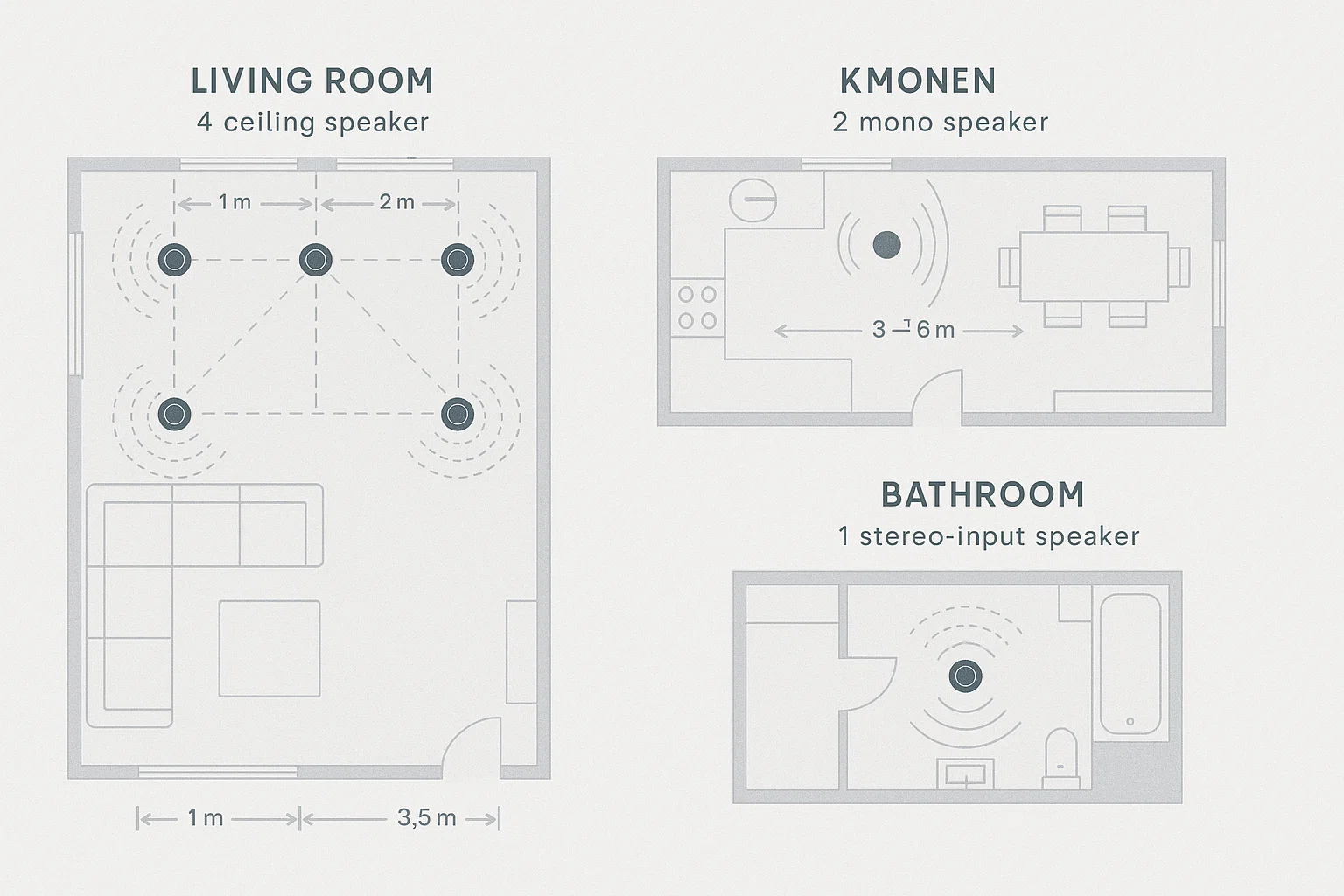
Each space has its own acoustic needs:
-
Living Room: 2–4 speakers, placed over seating area. Consider additional rear speakers for home theater.
-
Kitchen: 1 stereo speaker near center or 2 mono speakers on each side.
-
Bedroom: 2 mono speakers over bed or across ceiling for immersive ambiance.
-
Bathroom: 1 stereo input speaker is usually enough. Must be moisture-resistant.
-
Hallways / Corridors: Use multiple mono speakers evenly spaced to avoid echo or gaps.
-
Outdoor Patio (covered): 2–4 moisture-resistant speakers near sitting zones.
Need layout feedback? Lecovita’s engineers can design speaker maps based on your floor plan—free of charge.
🛠️ Pro Tips from Lecovita Engineers
-
Avoid placing speakers directly above noisy fixtures like AC vents or ceiling fans.
-
In open-plan rooms, use zoning to split areas (e.g., kitchen zone, lounge zone).
-
For rooms with irregular shapes, use more speakers at lower volume rather than fewer speakers cranked up.
-
Combine ceiling speakers with in-wall units or subwoofers for full-range sound.
📌 Want expert help with your speaker layout?
Ceiling Speaker Buying Guide: What to Look for Before You Buy
Choosing the right ceiling speakers isn’t just about price or brand—it’s about finding the best fit for your room, your sound preferences, and your system setup. In this section, we’ll walk you through everything you should evaluate before making a purchase.
📊 Key Technical Specs to Understand
Before you click “buy,” take a moment to check the specs:
-
Power Handling (Wattage): How much power the speaker can handle continuously without distortion. Match this with your amplifier’s output.
-
Impedance (Ohms): Most home audio speakers are 8Ω. Ensure your amp matches to avoid overload.
-
Frequency Response: A wider range (e.g. 50Hz–20kHz) means more complete sound—especially important if you don’t have a subwoofer.
-
Sensitivity (dB): The higher the sensitivity, the louder the speaker plays at a given power level. Look for 88dB+ for efficient setups.
-
Driver Materials: Woofer cones made of woven Kevlar or polypropylene offer durability and clean mid-bass. Soft dome tweeters provide smooth highs.
🛠️ Need help reading specs? Lecovita’s team is happy to walk you through product datasheets and help you compare models.
🔌 Amplifier Compatibility & Wiring Needs
Most ceiling speakers are passive—they need an external amplifier. Here’s what you need to know:
-
Use speaker wire (16 AWG or 14 AWG recommended for most home installs).
-
For stereo setups, wire left and right channels to two mono speakers or one stereo-input unit.
-
Ensure your amp has enough channels and power to drive your speakers.
-
Consider multi-zone amplifiers for whole-home audio.
🔧 Lecovita offers amp-matching guidance for any speaker configuration.
🔍 Popular Brands Compared: Strengths & Trade-Offs
Here’s a quick overview of some well-known ceiling speaker brands:
| Brand | Strengths | Considerations |
|---|---|---|
| Sonos | Easy smart integration, Trueplay tuning | Expensive, limited customization |
| KEF | Uni-Q driver tech, great imaging | Premium pricing |
| Bowers & Wilkins | Audiophile-grade clarity | Needs powerful amps |
| JBL | Reliable, good value | Basic design, fewer premium models |
| Lecovita | Custom solutions, pro-grade specs | Direct-from-manufacturer model |
✅ Lecovita speakers are designed with installers in mind: optimized sensitivity, wide dispersion, and matched amps for residential and commercial setups.
💰 Budget Breakdown: Best Picks by Price Range
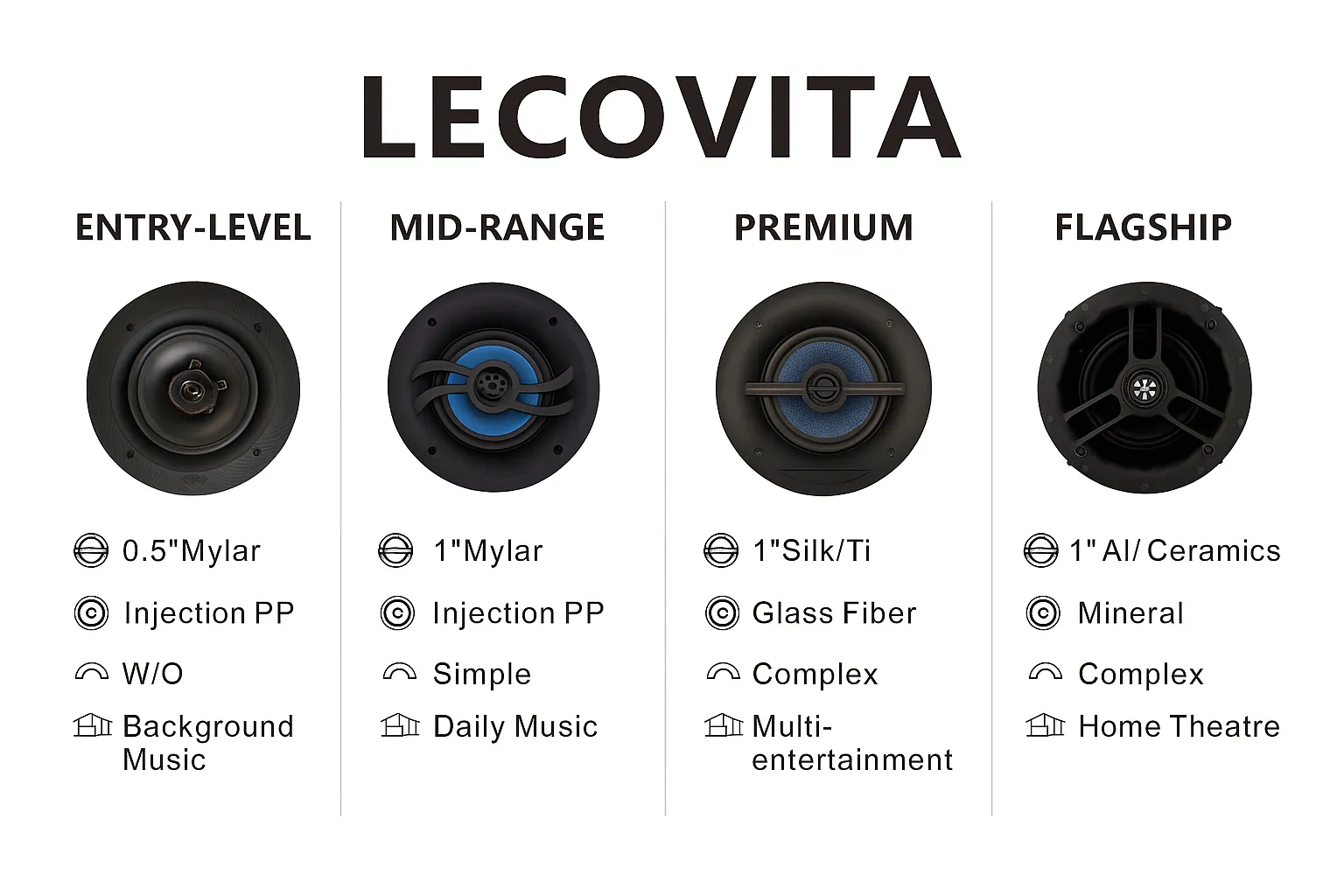
Here’s how to shop based on your budget:
-
Entry-level models: Great for background music or small rooms. Look for 6.5″ drivers and basic tweeters.
-
Mid-range: better bass, pivoting tweeters, and smoother mids. Ideal for living rooms and master bedrooms.
-
Premium: audiophile-grade clarity, advanced crossovers, and superior build quality. Great for home theaters.
-
Flagship models: superior dispersion, bi-amp capabilities, and luxury finishes.
💡 Lecovita offers models in every category—with the added benefit of customization and factory-direct pricing.
🌟 Lecovita’s Expert Product Recommendations
Based on real installation scenarios, here are our top picks:
-
Best All-Around Performance: Lecovita V6 Pro – 6.5″ 2-way with Kevlar cone and 92dB sensitivity
-
Best for Bathrooms & Kitchens: Lecovita AquaGuard 6 – Moisture-resistant with IP65 rating
-
Best for Home Theater Use: Lecovita Atmos 8 – 8″ driver, angled tweeter, and deep bass response
-
Best Value Pick: Lecovita Core 5.25 – Compact size, budget-friendly, easy to install
📌 Want help matching speakers to your amp or room size?
Installation Guide: How to Install Ceiling Speakers Step-by-Step
Installing ceiling speakers may sound intimidating, but with the right preparation and tools, it’s a manageable project for most DIYers. That said, some situations—like complex multi-room systems or retrofitting older ceilings—are best left to the pros.
This guide walks you through the standard installation process, so you’ll know exactly what to expect (or what to ask your installer to do).
🧰 Tools & Materials You’ll Need
Before you begin, gather these:
-
Drywall saw or hole-cutting template
-
Measuring tape & stud finder
-
Speaker wire (16 or 14 AWG)
-
Power drill & driver
-
Wire stripper & screwdriver
-
Ladder or scaffolding
-
Ceiling speaker template (usually included with speakers)
-
Amplifier & speaker terminal blocks
-
Optional: Fire hoods (for code compliance in some regions)
🔧 Lecovita provides pre-sized cutout templates and installation guides with all in-ceiling models.
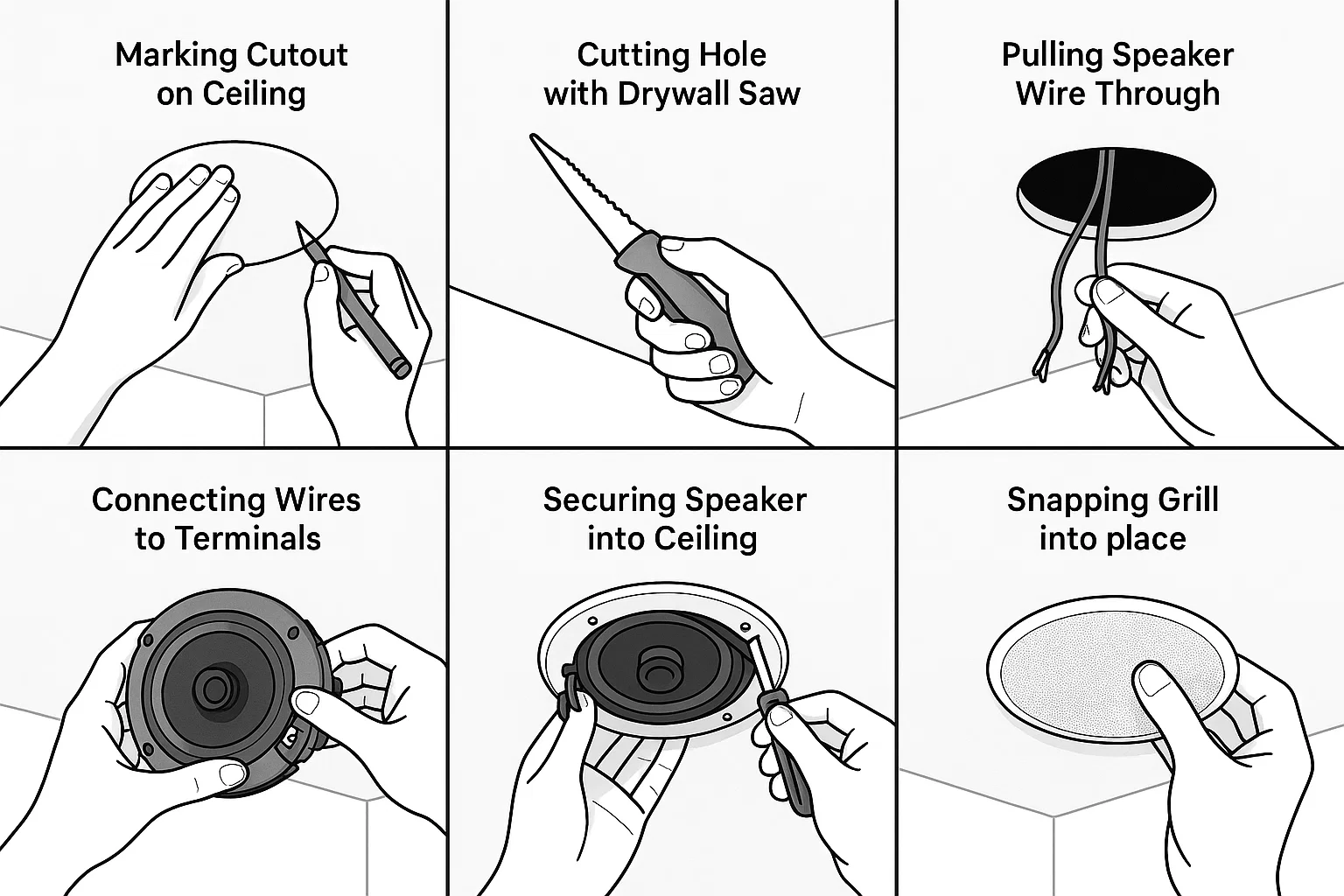
🪛 Step-by-Step Installation Process
Step 1: Plan Your Layout
Use your room plan to mark the speaker positions on the ceiling. Ensure spacing is symmetrical and avoid AC ducts or ceiling joists.
Step 2: Trace & Cut Holes
Use the provided template to outline each cutout. Double-check spacing before cutting. Use a drywall saw or hole cutter for clean edges.
Step 3: Run the Speaker Wire
Feed wire from your amplifier or AV receiver to each speaker location. Try to keep cables away from power lines to avoid interference.
Step 4: Connect the Speakers
Strip the wire ends and connect to the speaker terminals. Observe correct polarity (positive to positive, negative to negative).
Step 5: Insert & Secure the Speakers
Fit the speaker into the hole and tighten the mounting clamps or dog-ear tabs. Do not overtighten.
Step 6: Test the System
Before replacing grills, play music to check for sound from all speakers. Make adjustments as needed.
Step 7: Attach Grills
Once everything works, attach the magnetic or snap-on grills. Many can be painted to match your ceiling.
✅ Tips for a Smooth Installation
-
Label your wires before cutting to avoid confusion later.
-
If your ceiling has insulation, use back boxes or insulation guards.
-
For rooms with high humidity, use moisture-resistant models with sealed enclosures.
-
Avoid placing speakers directly above light fixtures or AC vents.
-
Use a tone generator or tester if you’re unsure which wire goes where.
🛠️ Pro tip: Don’t rely solely on your amp’s auto-calibration. Fine-tuning volume levels and speaker balance manually often yields better results.
🤔 DIY or Professional Help? Lecovita’s Recommendation
If you’re installing:
-
1–2 speakers in a single room with open ceiling access → DIY is very doable.
-
4+ speakers across multiple zones or complex ceilings → Hire a licensed installer.
-
Home theater configurations with Dolby Atmos or surround channels → Consider a professional to ensure proper speaker angles and alignment.
📌 Need an installer? Lecovita partners with certified technicians worldwide
Tuning, Smart Control & System Optimization
Once your ceiling speakers are installed, the final step is fine-tuning your system for optimal performance and modern convenience. Whether you’re an audiophile chasing perfect tonal balance or a homeowner looking to sync music with your smart home, this section will help you get the most out of your setup.
🎛️ Speaker Calibration & Equalization Tips
Even high-end speakers won’t perform their best without tuning. Here are ways to improve clarity and balance:
-
Manual EQ: Use your amplifier’s bass, treble, or parametric EQ settings to smooth out harsh frequencies or enhance warmth.
-
Room Calibration Tools: Some AV receivers offer auto-calibration using a microphone (e.g., Audyssey, YPAO, Dirac). Place the mic where you usually sit for accurate results.
-
Balance Levels: Set speaker volumes individually so each zone or speaker pair sounds consistent in your space.
-
Adjust Tweeter Angles (if available): Pivoting tweeters should point toward the primary listening position.
🎯 Lecovita speakers are engineered with balanced response curves—great out of the box, even better when calibrated.
🏠 Multi-Room Audio Integration
Ceiling speakers shine in multi-room setups, where you want background music throughout your home:
-
Use multi-zone amplifiers or matrix systems to control audio in different rooms.
-
Pair with systems like Sonos Port, Denon HEOS, Yamaha MusicCast, or wired distribution systems.
-
Some amps allow independent source control, so the kitchen can play jazz while the living room plays podcasts.
🧩 Lecovita systems are compatible with both wired and wireless zone control architectures.
🎙️ Voice Control & Smart Home Compatibility
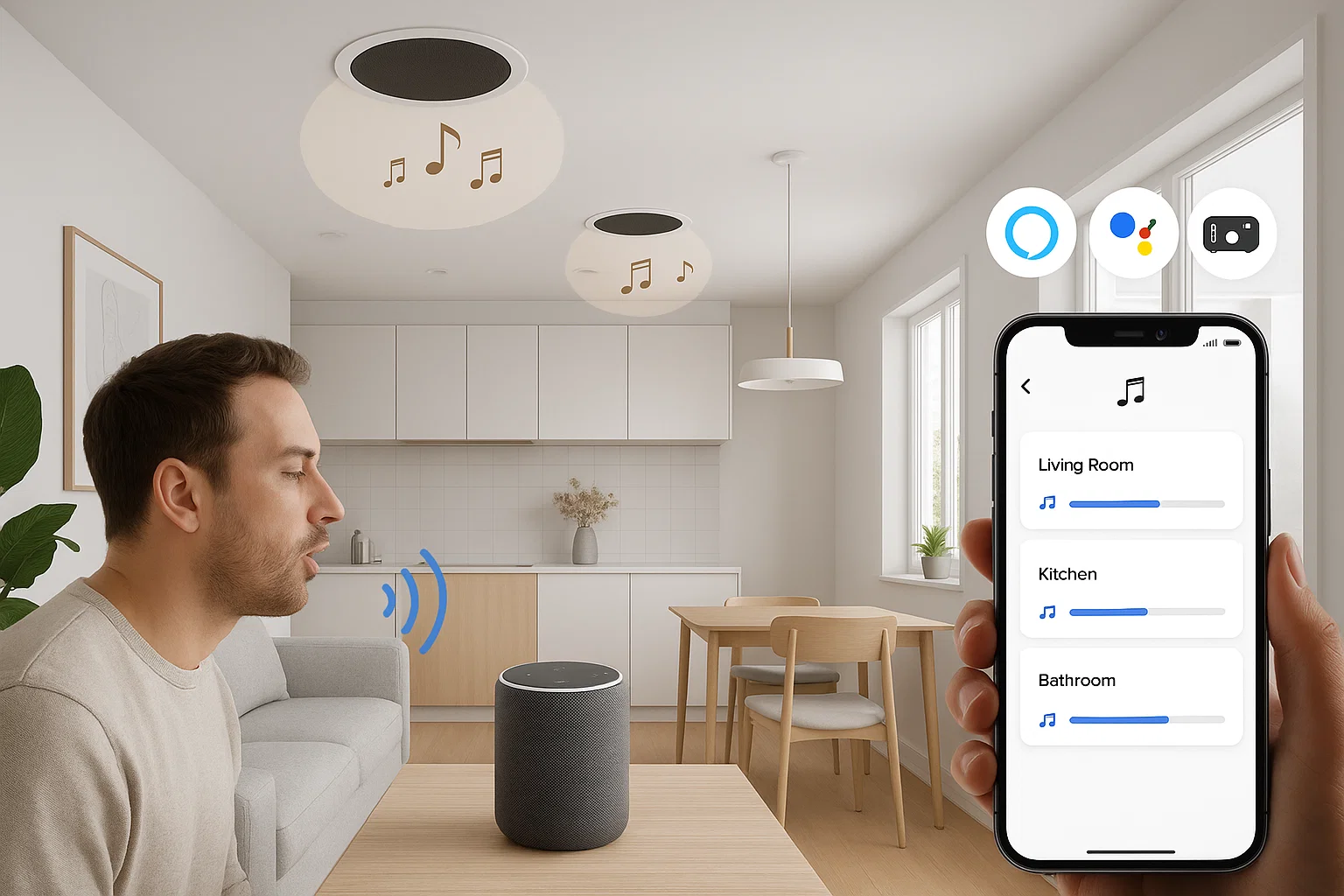
Want to ask Alexa to play your favorite song in the dining room? It’s possible—with the right gear:
-
Use smart amplifiers like Sonos Amp or Google Chromecast-enabled receivers to add voice control.
-
Connect with Alexa, Google Assistant, or Apple HomeKit via smart hubs or compatible amps.
-
Control volume, playlists, and sources with voice commands, mobile apps, or wall panels.
🗣️ Lecovita’s passive ceiling speakers can be paired with most smart amps to seamlessly integrate into voice-controlled ecosystems.
💡 Lecovita’s Smart Audio Solutions
We don’t just build speakers—we design systems.
-
DSP-Ready Models: Tuned for use with advanced digital processing (ideal for cinema rooms and conference spaces)
-
Commercial Integration: 70V/100V options for hospitality or office environments
-
Pre-Wired Control Boxes: Easy setup for builders or integrators
📌 Need help designing your smart speaker system?
Customer Use Cases & Real-Life Applications
From modern apartments to high-end villas, from boutique hotels to large-scale office spaces—Lecovita ceiling speaker systems are trusted across diverse projects worldwide. Here’s how our clients turn ideas into immersive experiences.
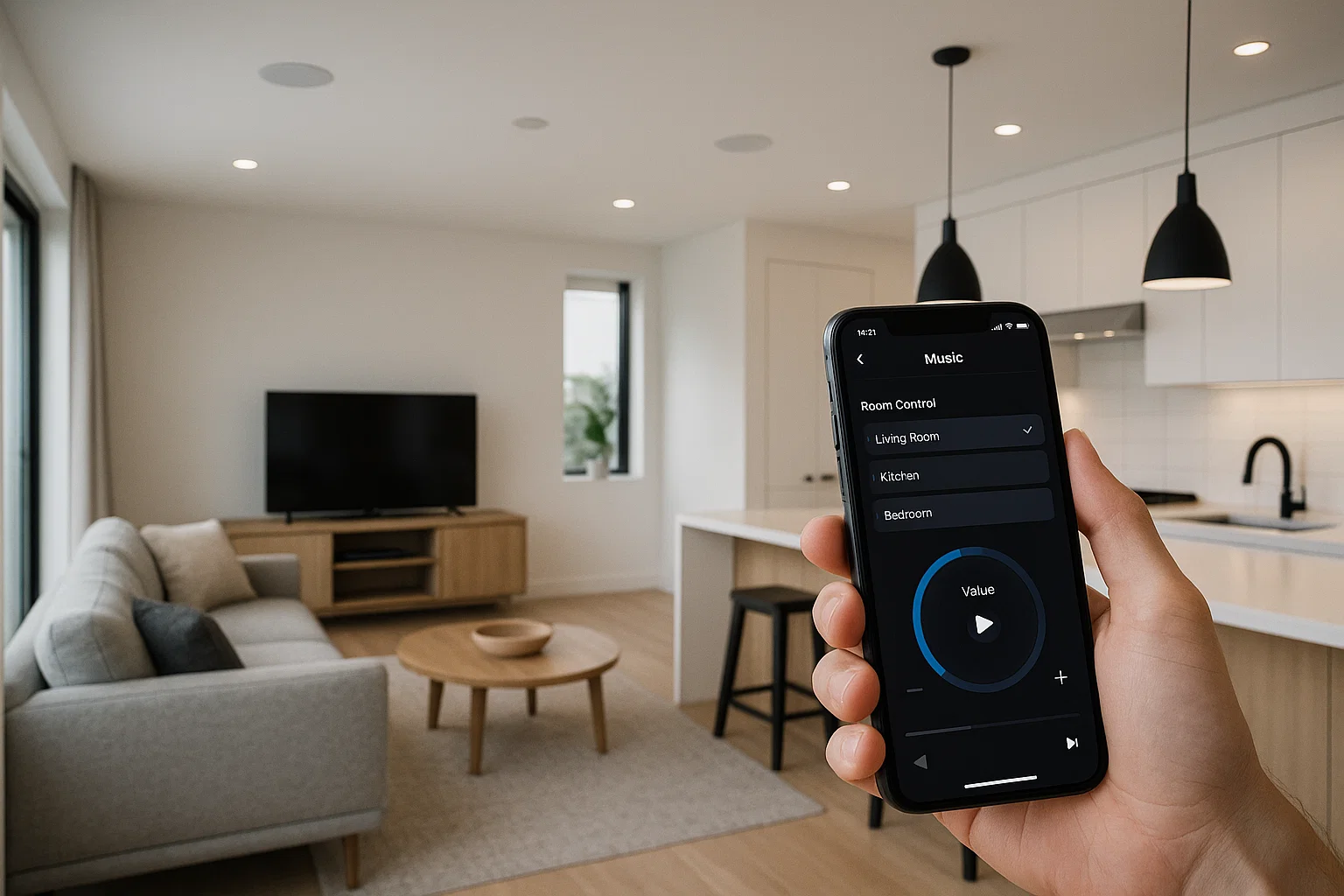
🏡 Residential: Whole-Home Audio with a Minimalist Look
Client: Homeowner in San Diego, CA
Project: 2-story 5-bedroom house with open-plan kitchen and patio
Solution:
-
12 Lecovita V6 Pro 6.5″ speakers across living spaces and bedrooms
-
Stereo-input AquaGuard 6 units in bathrooms
-
Sonos Amp integration for smart control + Spotify streaming
-
Painted grills to match ceiling finishes
🎧 Result: Discreet design, full-house music control via phone or voice, and seamless sound without a single visible cable.
🏢 Commercial: Restaurants, Offices & Hospitality
Client: Upscale Italian restaurant in Singapore
Challenge: Even background music across dining zones, bar area, and outdoor seating
Solution:
-
16 Lecovita Core 5.25″ speakers in three zones
-
Moisture-resistant models outdoors
-
100V commercial amplifier with 3-zone source control
-
Wall-mounted control panels + central streaming server
🍽️ Result: Elegant ambient sound across all areas with effortless zone management—patrons enjoy music, staff focus on service.
🎬 Custom Theater Setup with Lecovita Atmos Speakers
Client: Audiophile homeowner in Melbourne, Australia
Goal: Build a Dolby Atmos 5.1.2 system with in-ceiling surround
Solution:
-
Lecovita Atmos 8 directional ceiling speakers as overhead channels
-
Paired with wall-mounted front and surround units
-
Matched Lecovita amplifier with DSP calibration
-
Treated room with acoustic panels + subwoofer integration
🎬 Result: Precise sound placement, stunning vertical immersion, and a cinematic experience rivaling professional theaters.
🌟 Why Clients Choose Lecovita: Results That Speak
-
Custom System Planning: From rough sketches to speaker maps
-
Tailored Product Selection: Moisture-proof, ultra-thin, or angled drivers—your needs, your specs
-
Seamless Integration: Works with Sonos, Denon, Control4, and more
-
Manufacturer Support: Dedicated project managers and technical advisors
📌 Want your space featured in our next success story?
Ceiling Speaker FAQ: Answers to Common Questions
Still have questions? You’re not alone. Here are some of the most frequently asked questions we hear from clients—along with expert answers to help you make the best decisions for your audio setup.

❓ Can ceiling speakers be used in bathrooms or outdoors?
Yes, but you’ll need moisture-resistant or weatherproof models. These speakers are designed with sealed enclosures and corrosion-resistant components.
✅ Lecovita’s AquaGuard series is ideal for bathrooms, kitchens, saunas, and covered patios.
❓ Do I need a subwoofer with ceiling speakers?
It depends on your expectations. For background music, ceiling speakers alone are often sufficient. But for home theaters or bass-heavy content, a subwoofer is highly recommended to handle low-frequency output and complete the sound spectrum.
❓ Can I paint the speaker grills to match my ceiling?
Absolutely. Most ceiling speaker grills are paintable. Use light coats of spray paint or latex, and be careful not to clog the holes or damage the mesh.
🖌️ Lecovita provides paint-ready magnetic grills with all models.
❓ What kind of amplifier should I use?
Look for an amplifier that matches your speaker impedance (typically 8 ohms) and provides enough power per channel. For multi-room systems, consider multi-zone amps or smart streaming amps (like Sonos Amp).
💡 Lecovita offers pre-matched amp bundles for optimal performance.
❓ Is it possible to install ceiling speakers in an existing ceiling?
Yes. This is called a retrofit installation. You’ll need access above the ceiling or through adjacent walls to run wiring. A stud finder and a drywall saw are essential tools.
🧰 Tip: Shallow-mount speakers are available for tight ceiling spaces.
❓ Can ceiling speakers work with Alexa or Google Assistant?
Indirectly—yes. While passive ceiling speakers don’t have built-in voice assistants, you can integrate them through smart amplifiers or voice-enabled receivers. Once connected, you can control playback, volume, and grouping via voice.
🔊 Lecovita systems are fully compatible with Sonos, Denon HEOS, Google Chromecast Audio, and more.
📌 Still unsure? Contact our support team or check our full installation guide above.
Final Thoughts & Next Steps: Design Your Audio System with Confidence
Whether you’re installing a pair of ceiling speakers in your kitchen or designing a full home theater system, the right planning and components make all the difference. With clean aesthetics, space efficiency, and wide audio coverage, ceiling speakers are one of the most powerful ways to elevate your living or working space.
At Lecovita, we don’t just sell products—we build solutions. With years of experience manufacturing and supplying high-quality audio systems, we offer:
-
Tailored speaker recommendations based on your room and budget
-
Free ceiling speaker layout consulting
-
Matching amplifiers and accessories
-
Moisture-proof and architectural-grade models
-
Support from project design to post-install optimization
🎯 Ready to take the next step?
Choose how you want to move forward:
🔍 Get a Free Consultation
Let our engineers review your floor plan and design your ideal speaker layout.
🛒 Browse Lecovita Speaker Collections
Explore our full lineup of ceiling speakers for residential, commercial, and theater use.
📄 Download a Complete Planning Toolkit
Cutout templates, installation checklists, and wiring diagrams in one zip file.
🤝 Become a Lecovita Reseller
Are you an installer, contractor, or retailer? Join our global partner program.