
Defeating Thermal Shutdown: Engineering Low-Impedance Stability in Multi-Zone Amplifiers

About Author: Kevin Wu
Founder & Principal Audio Engineer, LECOVITA
Specialize in acoustic engineering, high-fidelity speaker and amplifier design, precision manufacturing, sonic innovation, immersive audio solutions, and premium audio system development.
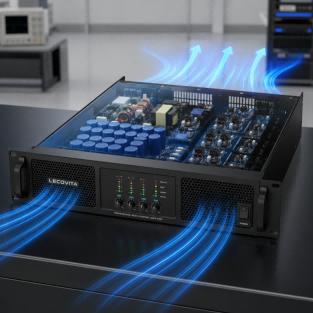
Table of Contents
Defeating Thermal Shutdown: Engineering Low-Impedance Stability in Multi-Zone Amplifiers
Distributed architectural audio systems require amplifiers to run continuously for hours, often driving complex multi-speaker loads. When standard amplifiers face low-impedance drops ($4\,\Omega$ or lower), they overheat and trigger thermal shutdown. Overcoming this structural challenge requires ultra-efficient Class-D topologies, active intelligent cooling grids, and dynamic current-limiting protection circuits to maintain stable, high-fidelity audio across massive zones.
The Integration Backfield: The Danger of Hidden Heat
In large residential or commercial audio configurations, multi-channel amplifiers are typically stacked together inside enclosed equipment racks. These racks often have restricted airflow, turning the utility closet into a thermal trap.
The structural strain multiplies when integrators wire multiple in-ceiling speakers in parallel to a single channel to save budget. This wiring choice drops the total system impedance from a standard $8\,\Omega$ down to a demanding $4\,\Omega$ or even $2\,\Omega$. Under these low-impedance conditions, the amplifier is forced to deliver massive amounts of current. If the hardware is not engineered to handle this high current load, it creates an intense thermal spike, leading to clipping, audio distortion, or complete system shutdown right in the middle of a client’s event.
1. Class-D Topology: Maximizing Efficiency, Minimizing Thermal Footprint
Traditional Class-A/B amplifiers are notoriously inefficient, converting up to 50% of their incoming electrical energy directly into wasted heat rather than sound waves. For a multi-zone matrix driving 12 to 24 channels simultaneously, Class-A/B design is a liability in an enclosed server rack.
[Class-A/B Amp] ===> 50% Audio Output / 50% Wasted Heat (High Risk of Shutdown)
[LECOVITA Class-D] => 90%+ Audio Output / <10% Thermal Waste (Cool-Running Stability)
Advanced multi-zone systems—such as LECOVITA’s high-current distribution amplifiers—utilize optimized Class-D switching topologies. By operating high-speed switching transistors that are either fully “on” or fully “off,” energy waste is minimized. This architecture achieves an energy efficiency rating exceeding 90%. By converting almost all incoming current directly into pristine audio power, the internal chassis temperatures remain incredibly low, eliminating the need for bulky, heavy internal heatsinks.
2. Safeguarding Against the $2\,\Omega$ Drop: Heavy-Duty Power Rails
Impedance is not a flat line; it fluctuates based on the audio frequencies being played. A speaker rated at $8\,\Omega$ can easily dip down to $4.2\,\Omega$ during heavy mid-bass or sub-bass reproduction.
When multiple speakers dip simultaneously, standard power supplies choke under the sudden demand for high current, causing the voltage rails to sag. Premium multi-channel engineering deploys oversized toroidal or high-frequency switch-mode power supplies (SMPS) backed by high-capacity smoothing capacitor banks. This ensures that even when a zone drops to a bruising low-impedance load, the voltage rails stay perfectly stable. The amplifier delivers a clean, unclipped current flow, keeping the audio punchy, tight, and completely undistorted.
Thermal & Electrical Stability Matrix
| Performance Factor | Standard Multi-Channel Amps | LECOVITA High-Current Solutions |
| Amplifier Topology | Standard Class-A/B (High heat generation) | Ultra-Efficient Class-D (Cool operation) |
| Low-Impedance Stability | Unstable at $4\,\Omega$; high risk of shutdown | Stable down to $4\,\Omega / 2\,\Omega$ continuous loads |
| Thermal Management | Passive convection only (Relies on open air) | Intelligent forced-air cooling paths |
| Protection Systems | Hard-clipping fuses (Cuts off audio completely) | Smart dynamic current-limiting circuits |
| Rack Density | High spacing required (Takes up massive rack units) | Compact 1U/2U high-density configurations |
3. Intelligent Active Cooling and Dynamic Protection
Relying entirely on passive airflow inside an AV rack is an operational risk. True professional-grade gear implements intelligent active cooling grids. Internal micro-sensors constantly monitor the temperature of the output transistors. If the thermal threshold climbs, ultra-quiet, variable-speed internal cooling fans engage smoothly, pulling cool air from the front panel and venting the thermal buildup out the back.
Furthermore, if an installer accidentally short-circuits a speaker wire during construction, a smart dynamic current-limiting circuit instantly detects the surge. Instead of blowing a catastrophic internal fuse or destroying the channel, the circuit temporarily restricts the output current or safely isolates the single affected zone, leaving the remaining zones playing perfectly without interruption.
Expert Q&A
Q1: Can I safely connect four $8\,\Omega$ in-ceiling speakers to a single amplifier channel?
A: Wiring four $8\,\Omega$ speakers in a standard parallel configuration drops the total impedance down to an extreme $2\,\Omega$. Most standard amplifiers will overheat or enter protection mode under this load. To do this safely, you must use an amplifier explicitly rated for $2\,\Omega$ stability, or wire them in a series-parallel combination to maintain a safe $8\,\Omega$ load at the terminal.
Q2: How does high amplifier heat affect the lifespan of surrounding rack equipment?
A: Heat rises. If an inefficient amplifier sits at the bottom of a sealed server rack generating excessive heat, it bakes the gear sitting directly above it. This thermal bleeding drastically shortens the lifespan of sensitive source devices, control processors, and network switches. Using cool-running Class-D amplifiers preserves the operational health of the entire system rack.
Q3: Does a high-efficiency Class-D amplifier compromise audiophile sound quality?
A: Not anymore. While early Class-D designs suffered from high-frequency switching noise, modern premium Class-D modules feature high-order feedback loops and advanced filtering networks. This yields an exceptionally flat frequency response, an ultra-low noise floor, and a high damping factor that rivals or exceeds the acoustic fidelity of traditional Class-A/B architecture.
