
Understanding 70V/100V Distributed Speaker Systems

About Author: Kevin Wu
Founder & Principal Audio Engineer, LECOVITA
Specialize in acoustic engineering, high-fidelity speaker and amplifier design, precision manufacturing, sonic innovation, immersive audio solutions, and premium audio system development.
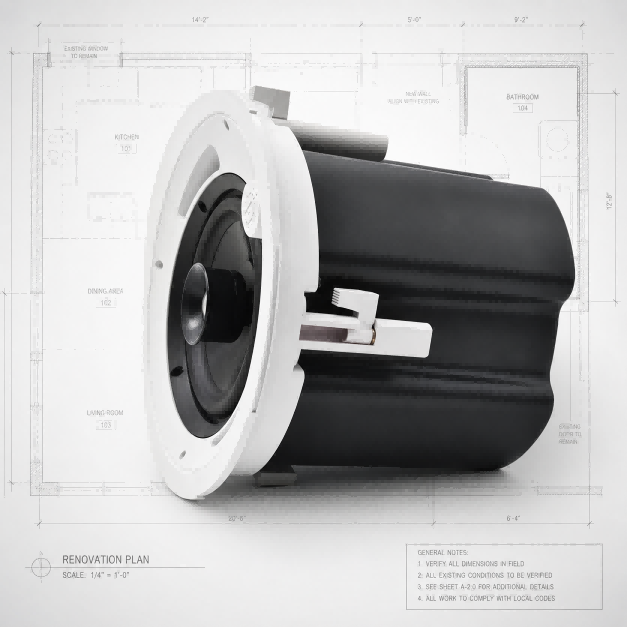
Table of Contents
Commercial Audio 101: Understanding 70V/100V Distributed Speaker Systems
TL;DR: For large-scale commercial spaces, traditional low-impedance ($8\,\Omega$) audio wiring falls short due to signal drop-off over long distances and strict amplifier channel limitations. Constant-voltage networks (70V/100V) solve this problem by utilizing step-up and step-down transformers. This allows installers to chain dozens of speakers along a single cable run and customize individual volume levels using local wattage taps.
The Infrastructure Challenge: The Long-Distance Drop
If you try to wire ten standard $8\,\Omega$ speakers to a traditional amplifier in a large retail store, you will instantly hit two major roadblocks: math and physics.
First, connecting multiple speakers in parallel drops the overall system impedance down to dangerous levels, which triggers amplifier protection mode or causes hardware damage. Second, copper speaker wire naturally resists electrical current. Over long cable runs—such as running wire across a 100-meter showroom floor—the wire itself eats up the audio energy. By the time the signal reaches the furthest speaker, the sound is noticeably quiet, thin, and muffled.
To overcome these long-distance wiring restrictions, commercial audio engineering relies on constant-voltage distributed systems.
1. The Physics of Constant Voltage: Power Grid Efficiency
The concept behind a 70V or 100V audio system is identical to how municipal power grids distribute electricity across cities. Power plants step up the voltage to thousands of volts to move electricity across long distances with minimal loss, and then step it back down at local neighborhood transformers.
[70V/100V Amplifier] ===(High Voltage / Low Current)===> [Speaker Transformer] ===> [8-Ohm Driver]
   (Steps Voltage UP)             (Long Cable Run)              (Steps Voltage DOWN)
A commercial 70V/100V amplifier features an internal step-up transformer that raises the audio output voltage while keeping the current low. Because the current is low, signal loss across long distances becomes negligible. At each speaker location, a small step-down transformer receives this high-voltage signal and converts it back into a safe, low-voltage, low-impedance current that drives the speaker cone cleanly.
2. The Power of Wattage Tappings: Individual Volume Control
In a standard low-impedance setup, all speakers connected to a channel share the same power equally. If you want one speaker to be quieter, you have to add external volume controls that generate excess heat.
Distributed systems replace this limitation with multi-tap transformers. On the back of a commercial speaker—such as the LECOVITA commercial integration series—you will find a rotary switch or a set of wired terminals labeled with different wattage settings (e.g., 2.5W, 5W, 10W, 20W).
-
The Entryway: Tap a speaker near a noisy main entrance at 20W so it plays loudly enough to cut through crowd noise.
-
The Restrooms: Tap a speaker in a quiet hallway or restroom at 2.5W so it provides subtle background ambiance.
As long as the combined sum of all speaker wattage taps does not exceed the total wattage capacity of the amplifier (leaving a safe 20% performance cushion), you can mix and match settings along the exact same wire run.
Architectural Grid Profiles: Low-Impedance vs. Constant-Voltage
| Operational Factor | Low-Impedance (8Ω) | Constant-Voltage (70V/100V) |
| Max Cable Distance | Short (Typically under 15–20 meters) | Extreme (Hundreds of meters with zero signal loss) |
| Wiring Topology | Complex series/parallel calculations | Simple daisy-chain wiring (Positive to positive) |
| Speaker Quantities | Highly limited per amplifier channel | Scalable (Limited only by total amplifier wattage) |
| Volume Flexibility | Uniform volume across the channel | Individual adjustment via wattage taps |
| Best Application | High-fidelity home theaters & stereo zones | Retail, corporate offices, airports & schools |
3. Simplified Daisy-Chain Installations
In an architectural 70V/100V installation, you do not need to run individual speaker home-runs all the way back to the main equipment rack. Instead, you can use a single continuous two-conductor cable to daisy-chain from the first speaker to the second, the second to the third, and so on.
This simple layout drastically reduces the amount of copper wire required for a project, lowers labor costs for installation teams, and makes it incredibly easy to cut into an existing line and add more speakers later if a venue decides to expand its layout.
Expert Q&A
Q1: Can I use standard speaker wire for a 70V or 100V commercial installation?
A: Yes. Standard two-conductor speaker wire works perfectly for constant-voltage setups. However, because these systems run at higher voltages, local building codes often require you to use Class 2 or Class 3 plenum-rated cables if the wires are running through air ducts or drop-ceiling ventilation spaces.
Q2: What happens if the total wattage of my tapped speakers exceeds the amplifier’s power rating?
A: If the total speaker draw exceeds the amplifier’s capabilities, the power supply will become overloaded. This causes the audio to distort, makes the amplifier run dangerously hot, and will eventually trigger the built-in protection fuses or trip thermal shutdown. Always calculate your layout to leave a 20% power headroom margin.
Q3: Does adding a transformer to a speaker hurt the overall audio quality?
A: Standard transformers can introduce slight bass roll-off or saturation at extremely low frequencies, which is why 70V systems are traditionally used for background music and voice paging rather than sub-bass heavy home cinemas. However, by using high-grade magnetic cores and premium copper windings, premium commercial lines deliver clean, crisp audio that is ideal for luxury retail environments.
