
Cardioid vs. Supercardioid vs. Omnidirectional Microphones for Commercial Audio

About Author: Kevin Wu
Founder & Principal Audio Engineer, LECOVITA
Specialize in acoustic engineering, high-fidelity speaker and amplifier design, precision manufacturing, sonic innovation, immersive audio solutions, and premium audio system development.
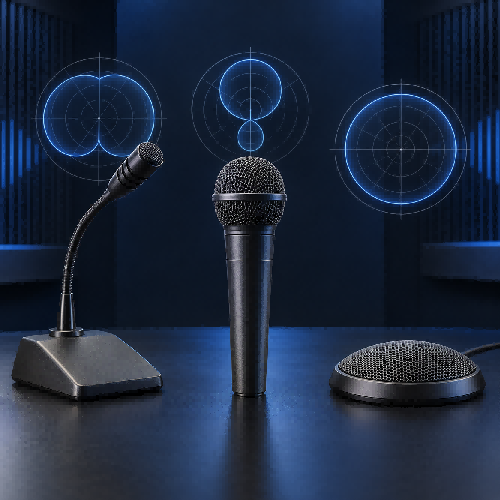
Table of Contents
- What Is a Microphone Polar Pattern?
- Quick Comparison
- When Should You Use a Cardioid Microphone?
- When Is a Supercardioid Microphone Better?
- When Should You Use an Omnidirectional Microphone?
- Polar Pattern Is Only Part of Feedback Control
- Match the Microphone to the Application
- Installation Checklist
- Final Recommendation
- FAQ
Cardioid vs. Supercardioid vs. Omnidirectional Microphones for Commercial Audio
TL;DR: Cardioid microphones are the safest general-purpose choice for paging, presentations and live speech. Supercardioid microphones offer tighter pickup and potentially more gain before feedback, but their rear pickup requires careful loudspeaker placement. Omnidirectional microphones provide natural, consistent coverage around the microphone, but they also capture more room sound and are usually more difficult to use near a PA system.
Choosing a microphone for a commercial audio system is not simply a matter of selecting a wired or wireless model. The microphone’s polar pattern determines which directions it hears most clearly—and which sounds it attempts to reject.
That decision directly affects speech intelligibility, background-noise pickup and the risk of acoustic feedback.
What Is a Microphone Polar Pattern?
A microphone polar pattern describes how sensitive a microphone is to sound arriving from different directions.
A polar diagram normally places the front of the microphone at 0 degrees. The shape of the diagram shows how sensitivity changes as the sound source moves around the microphone.
According to microphone manufacturer LEWITT, the pattern influences unwanted sound pickup, the balance between direct and reflected sound, frequency response and proximity effect. Its technical guide also explains that cardioid microphones are least sensitive at the rear, while supercardioid designs provide narrower forward pickup with some rear sensitivity. See LEWITT’s microphone polar-pattern guide.
Quick Comparison
| Polar pattern | Main advantage | Main limitation | Typical commercial use |
|---|---|---|---|
| Cardioid | Good front pickup and rear rejection | Speaker must remain within the useful pickup area | Paging desks, lecterns, presentations and handheld speech |
| Supercardioid | Tighter forward coverage and stronger side rejection | Has a rear pickup lobe and requires accurate aiming | Stages, houses of worship and noisy venues |
| Omnidirectional | Consistent pickup around the microphone | Captures more room noise and PA sound | Conference tables, discussion rooms and ambient recording |
When Should You Use a Cardioid Microphone?
A cardioid microphone is most sensitive to sound from the front and least sensitive to sound from directly behind it. This makes it a practical choice when one person speaks into a microphone while background noise or a loudspeaker is located behind the microphone.
Common applications include:
- Paging and announcement desks
- Lecterns and podiums
- Handheld presentation microphones
- Training rooms
- Houses of worship
- Small performance spaces
Cardioid microphones are relatively forgiving when a presenter moves slightly from side to side. They also allow the installer to aim the microphone’s rear rejection toward an unwanted sound source.
For example, Shure specifies a uniform cardioid pickup pattern for its SM58 vocal microphone, stating that it helps isolate the primary sound source and reduce background noise. View the official Shure specification.
A cardioid model is therefore a sensible default when the system must support several types of users and the operator cannot control every speaker’s technique.
When Is a Supercardioid Microphone Better?
A supercardioid microphone has a narrower forward pickup area than a conventional cardioid microphone. It rejects more sound from the sides, which can be useful in noisy venues or when greater separation between sound sources is required.
Typical applications include:
- Live stages
- Houses of worship
- Conference platforms with nearby participants
- Industrial announcements
- High-noise entertainment venues
The important limitation is its small rear pickup lobe. A supercardioid microphone does not provide its maximum rejection directly behind the microphone.
This means that placing a stage monitor or PA loudspeaker directly behind the microphone may produce worse results than expected. The installer should consult the manufacturer’s polar plot and place loudspeakers within the microphone’s actual rejection zones.
Supercardioid does not automatically mean “feedback-proof.” Its benefit depends on microphone orientation, loudspeaker position, room reflections and how closely the user speaks into it.
When Should You Use an Omnidirectional Microphone?
An omnidirectional microphone responds to sound arriving from all directions. It can capture several people around a conference table without requiring each participant to speak directly into the microphone.
It is useful for:
- Small discussion tables
- Meeting-room recording
- Ambient sound collection
- Voice pickup where users cannot remain on-axis
- Applications without nearby sound reinforcement
However, an omnidirectional microphone also captures more reverberation, ventilation noise and sound from nearby loudspeakers. In a reflective room connected to a live PA system, this can reduce intelligibility and available gain before feedback.
An omnidirectional microphone is therefore not automatically the best choice simply because several people need to speak. Multiple well-positioned directional microphones may provide clearer results in a large or noisy meeting room.
Polar Pattern Is Only Part of Feedback Control
Acoustic feedback occurs when sound from a loudspeaker returns to a microphone, is amplified again and continues circulating through the system.
Selecting an appropriate polar pattern helps, but installers must also consider:
- Microphone-to-speaker distance: Keep microphones away from and behind the main loudspeaker coverage whenever possible.
- Talker-to-microphone distance: A closer talker produces a stronger direct signal, so less system gain is required.
- Microphone orientation: Point the least-sensitive area toward the main unwanted sound source.
- Room acoustics: Hard walls, glass and low ceilings can return amplified sound to the microphone.
- Open microphone count: Every unnecessary open channel adds room noise and can reduce system stability.
- Equalization: Use EQ to correct specific problems, not to compensate for fundamentally poor placement.
- High-pass filtering: Removing unnecessary low-frequency energy can improve speech clarity and reduce rumble.
Directional microphones also exhibit proximity effect: low-frequency response increases as the speaker moves closer. Neumann explains that this effect can make a voice sound fuller but can also reduce clarity if the result becomes excessively bass-heavy. Pure omnidirectional microphones do not exhibit the same proximity effect. Read Neumann’s technical explanation.
Match the Microphone to the Application
Retail and Public Paging
A cardioid paging microphone is usually the most practical option. Position it close to the operator and away from ceiling speakers. The paging signal can then be routed through a properly designed 70V/100V distributed speaker system.
Conference Rooms
Use an omnidirectional boundary microphone only when the room is quiet and loudspeaker interaction can be controlled. For larger rooms, multiple directional microphones with automatic mixing may provide better speech clarity.
Lecterns and Houses of Worship
Cardioid gooseneck microphones offer flexibility for different speakers. Supercardioid models may improve isolation, but only when the loudspeaker positions match the microphone’s rejection angles.
Live Performance
Cardioid and supercardioid handheld microphones are normally more suitable than omnidirectional models. The final choice should be tested with the actual stage monitors, performer position and room acoustics.
Installation Checklist
Before commissioning a commercial microphone system:
- Confirm the polar pattern from the manufacturer’s data sheet.
- Identify the front, rear and minimum-sensitivity angles.
- Mark the intended speaking position.
- Check the distance between the user and microphone.
- Verify loudspeaker and monitor locations.
- Test the system with all required microphone channels open.
- Listen for excessive room reverberation and HVAC noise.
- Confirm speech clarity at representative listener positions.
- Save the final mixer gain, filter and EQ settings.
- Document microphone orientation for future maintenance.
Final Recommendation
For most commercial paging and presentation systems, start with a cardioid microphone. Choose a supercardioid model when tighter pickup is required and loudspeaker placement can be carefully controlled. Use an omnidirectional microphone when natural all-around pickup is more important than acoustic isolation—and when the room and sound-reinforcement design can support it.
The correct microphone is the one whose pickup pattern, placement and electrical characteristics work together with the complete audio system.
FAQ
Which microphone pattern is best for public speaking?
Cardioid is usually the safest choice because it captures the speaker from the front while reducing sound arriving from behind.
Is supercardioid always better at preventing feedback?
No. It can provide greater isolation in the correct layout, but its rear pickup lobe may capture a loudspeaker positioned directly behind the microphone.
Are omnidirectional microphones suitable for conference rooms?
Yes, particularly for small, quiet rooms. In larger or reverberant spaces, several directional microphones may provide clearer speech and better system stability.
Does moving closer to a microphone reduce feedback?
It often helps. A stronger direct voice signal allows the system to operate with less microphone gain. However, very close use of a directional microphone can increase bass through proximity effect.
Can EQ completely eliminate microphone feedback?
No. EQ can control specific resonant frequencies, but it cannot fully correct poor microphone positioning, excessive gain or unsuitable loudspeaker placement.
