
Salt, Spray & SPL: The Physics of Marine Architectural Audio Engineering

About Author: Kevin Wu
Founder & Principal Audio Engineer, LECOVITA
Specialize in acoustic engineering, high-fidelity speaker and amplifier design, precision manufacturing, sonic innovation, immersive audio solutions, and premium audio system development.
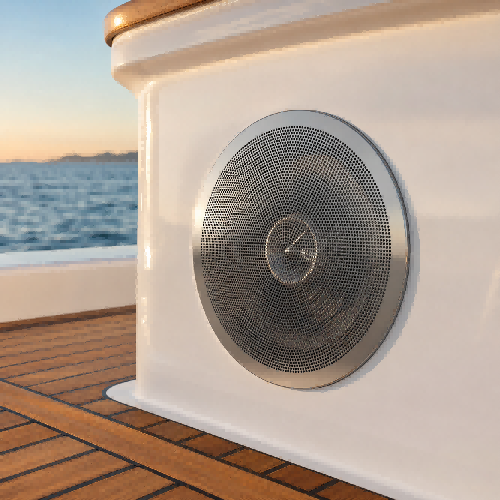
Table of Contents
Salt, Spray & SPL: The Physics of Marine Architectural Audio Engineering
TL;DR: Marine and luxury yacht audio environments present the harshest operational conditions in architectural sound: constant salt-fog exposure, violent UV radiation, continuous hull vibration, and high ambient wind/engine noise floors ($>75\text$). Standard outdoor speakers corrode within months due to galvanic reactions and electrolyte bridging. Engineering true marine-grade flush-mount audio requires 316L Marine Stainless Steel Alloys, ASTM B117 Salt-Fog Passivated Grilles, silicone-sealed perimeter flanges, and Galvanically Isolated 12V/24V DC High-Current Class-D Marine Amplifiers.
The Marine Dilemma: Galvanic Corrosion and Electrolyte Bridging
When two dissimilar metals (such as a standard steel screw and an aluminum bracket) are brought together in the presence of salt water—a conductive electrolyte—an electrochemical battery is formed.
This process, known as Galvanic Corrosion, strips electrons from the more active metal (anode), dissolving structural brackets, rusting internal driver baskets, and seizing voice coils.
Furthermore, salt-crust deposits accumulate on driver cones over time, stiffening the spider suspension and altering the fundamental resonant frequency ($f_s$). To maintain acoustic performance on open-air yacht flybridges and teak cockpits, every component must be chemically passivated and mechanically decoupled from the vessel's hull.
[Standard Outdoor Speaker on Boat] ===> Electrolyte Salt-Bridge ===> Rapid Galvanic Corrosion & Seized Coils
[316L Marine Isolated Speaker]     ===> Passivated Metallurgy  ===> 1,000+ Hr Salt-Fog Survival & Pure Sound
1. Metallurgy & Chemical Passivation: 316L Stainless vs. 304 Alloys
Not all stainless steels survive marine environments. Standard commercial speakers often use Grade 304 stainless steel, which rapidly pits and stains when exposed to oceanic chloride ions.
                       [Ocean Chloride Spray & Salt Fog]
                                       │
              ▼ ▼ ▼ ▼ ▼ ▼ ▼ ▼ ▼ ▼ ▼ ▼ ▼ ▼ ▼ ▼ ▼ ▼ ▼ ▼ ▼
              [ASTM B117 Passivated 316L Stainless Mesh]
              [Santoprene UV/Ozone-Shielded Suspension]
  ====================[Fiberglass Hull Bulkhead]====================
              [Gold-Plated Sealed Terminal Chamber with O-Rings]
-
316L Austenitic Stainless Steel: Incorporates $2\% – 3\%$ Molybdenum, creating high resistance to chloride pitting and crevice corrosion. Grilles and mounting fasteners are electro-polished to strip free iron from the surface, forming a self-healing Chromium Oxide ($\text_2\text_3$) passive layer.
-
ASTM B117 & ASTM G154 Compliance: Certified marine drivers undergo upwards of 1,000 hours of continuous salt-spray testing and 500 hours of concentrated UV-C radiation exposure without mechanical degradation or cosmetic discoloration.
-
Sealed Center-Pole Pieces: High-flux Neodymium magnet motors are encapsulated inside an airtight, nickel-plated composite cup, preventing airborne saltwater from entering the voice coil gap.
2. High-Efficiency Marine Amplification: 12V/24V DC Topologies
Power delivery on maritime vessels relies on isolated battery banks rather than standard municipal AC grids. Supplying clean, transient audio power in this environment requires specialized marine amplifier architecture.
                     [12V / 24V Vessel DC Battery Bank]
                                     │
              ==========[Galvanic DC-to-DC Power Converter]==========
              (Isolates Chassis Ground to Prevent Hull Electrolysis)
  ====================[High-Efficiency Class-D Rails]====================
                                     │
                                     ▼
             [Clean High-Current Multi-Zone Audio Output]
-
Galvanic Ground Isolation: Marine Class-D amplifiers incorporate opto-isolated DC-to-DC converters. This separates the audio signal ground from the boat's negative battery terminal, preventing ground loops and eliminating catastrophic hull electrolytic pitting caused by DC current leakage into metal or carbon-fiber vessel hulls.
-
Conformal-Coated Multi-Layer PCBs: Circuit boards receive dual-layer potting or hydrophobic silicone conformal dips, locking out airborne humidity and protecting surface-mount components from thermal condensation cycles.
-
High-Current 2-Ohm Stability: Because marine setups often parallel multiple deck speakers per zone, marine amplifiers are engineered to drive continuous $2\,\Omega$ loads safely, maintaining high thermal efficiency ($>90\%$) inside unventilated engine rooms or cockpit lockers.
Marine Architectural Comparison: Standard Outdoor vs. Yacht-Grade Marine Systems
| Engineering Parameter | Standard Outdoor / Patio Speaker | Marine-Grade 316L Architectural System |
| Grille & Screw Material | Powder-coated 304 steel or zinc | Electro-polished 316L Marine Stainless Steel |
| Salt-Fog Certification | Unrated / Light splash (IPX4) | ASTM B117 ($1,000\text$) / IP67 Fully Sealed |
| Cone Composition | Standard Polypropylene | Carbon-infused Poly-Mica with UV inhibitors |
| Amplifier Power Supply | Fixed $110\text/230\text$ AC Mains | Isolated $12\text/24\text$ DC with Galvanic Protection |
| Enclosure Sealing | Open-mesh water weep holes | Closed-cell silicone compression gaskets |
| Acoustic Directivity Tuning | Standard $90^\circ$ dome dispersion | Controlled-directivity waveguides to fight wind loss |
3. Open-Air Marine Acoustic Directivity Tuning
Overcoming the acoustic challenges of an open-air yacht deck requires a structured acoustic calibration workflow during installation.
🛡️ Expert Q&A
Q1: Why can't I just use standard powder-coated aluminum outdoor speakers on a luxury yacht?
A: Aluminum naturally forms an oxide layer, but in high-salinity marine environments with salt accumulation and humidity, aluminum undergoes severe galvanic corrosion if it contacts other metals like stainless steel mounting screws. Marine-grade systems utilize passivated 316L stainless steel or composite polymers that are completely immune to saltwater pitting, preventing structural breakdown and rust streaks on white gel-coat hulls.
Q2: How does a marine amplifier prevent electrical corrosion of a boat's metal hull?
A: Standard car or home amplifiers share a common ground between signal input and chassis power. On a boat, any small DC voltage leak through the audio ground wire into the water will turn the vessel into a galvanic anode, rapidly corroding underwater running gear (propellers, shafts, rudders). Marine amplifiers utilize fully isolated DC-to-DC power supplies that isolate the audio ground completely, eliminating stray electrical current paths.
Q3: How do you achieve deep sub-bass on an open yacht deck without a large wooden cabinet?
A: Open teak decks lack structural walls to produce room boundary gain. Marine integrators deploy Infinite-Baffle Marine Subwoofers or Rotomolded Polyethylene Sealed Enclosures mounted inside existing fiberglass deck seat lockers. These subwoofers feature extra-heavy spiders, specialized voice-coil cooling vents, and ultra-high excursion ($X_ > 15\text$) to move large air volumes directly into free space without requiring a sealed wooden box.
