
Underground Authority: The Physics of Direct-Burial Landscape Subwoofers

About Author: Kevin Wu
Founder & Principal Audio Engineer, LECOVITA
Specialize in acoustic engineering, high-fidelity speaker and amplifier design, precision manufacturing, sonic innovation, immersive audio solutions, and premium audio system development.
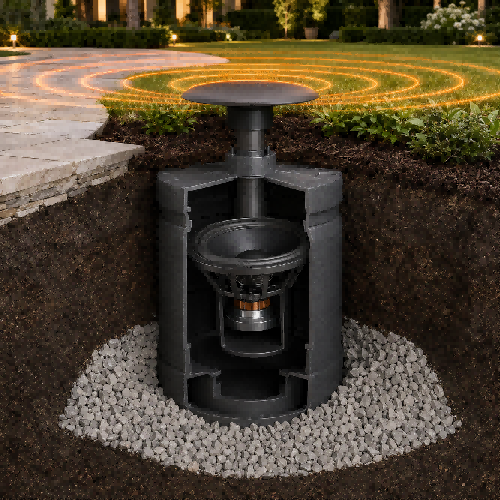
Table of Contents
Underground Authority: The Physics of Direct-Burial Landscape Subwoofers
TL;DR: Generating authoritative sub-bass ($<35\text$) outdoors is notoriously difficult because open landscapes lack room boundaries, causing low-frequency sound energy to dissipate rapidly in an unconfined $4\pi$ steradian acoustic void. Direct-burial subterranean subwoofers solve this by burying a massive, rotomolded enclosure beneath the soil. This technique harnesses the surrounding earth as an infinite mechanical mass damper, eliminating cabinet resonance while venting low frequencies through an above-ground $360^\circ$ radial canopy port.
The Outdoor Acoustic Dilemma: The $4\pi$ Free-Space Energy Drain
In an enclosed home cinema or living room, room boundaries (walls, ceiling, floor) create boundary loading that boosts low frequencies by $+6\text$ to $+12\text$. In an open outdoor yard, there are no reflective walls.
Sound waves propagate outward in a full sphere ($4\pi$ steradians), causing sound pressure levels to drop by $6\text$ for every doubling of distance (the Inverse Square Law).
To achieve physical bass impact in an outdoor living space, standard surface-mount speakers must be driven past their linear excursion limits ($X_$), causing driver distortion, thermal compression, and neighbor-disturbing localized "hot spots." Direct-burial subwoofers overcome this by moving the acoustic transducer below ground level.
[Surface Patio Subwoofer]     ===> Open-Air Dissipation ===> Rapid SPL Falloff & Resonant Cabinet Rattle
[Direct-Burial Subterranean]  ===> Soil Mass Dampens Box ===> 360° Omnidirectional Uniform Wavefront
1. Soil Coupling Physics: Earth as an Infinite Mass Damper
When a high-power subwoofer driver moves violently back and forth, it exerts internal air pressure against the cabinet walls. In traditional free-standing plastic rock speakers, the cabinet walls flex, absorbing energy and muddying transient response.
                       [Exposed Radial Canopy Port]
                                     │
                 ▲ ▲ ▲ ▲ ▲ ▲ ▲ ▲ ▲ ▲ ▲ ▲ ▲ ▲ ▲ ▲ ▲ ▲ ▲ ▲ ▲
                 [Ground Mulch / Turf Surface Layer]
  ====================[Compacted Soil & Earth Fill]====================
                 │                                   │
                 ▼ (Compresses Soil Mass)            ▼ (Infinite Damping)
              [Heavy-Wall Rotomolded HDPE Subterranean Canister]
              [Down-Firing Long-Throw Poly-Mica Subwoofer Driver]
  ====================[Coarse Gravel Drainage Base]====================
-
Subterranean Inertial Clamping: By burying a heavy-wall Rotomolded High-Density Polyethylene (HDPE) enclosure inside compacted soil, thousands of kilograms of surrounding earth clamp against the exterior shell. This physical mass damps cabinet wall vibration to near zero, ensuring that $100\%$ of the driver's kinetic energy is converted into acoustic air displacement through the port.
-
Rotomolded Seamless Enclosures: Rotational molding creates a continuous, single-piece structural polymer shell with zero seams, glue joints, or mechanical welds. This guarantees absolute moisture impermeability and protects internal components from subterranean root growth, acidic soil chemistry, and burrowing pests.
-
Hydrophobic Down-Firing Drivers: The active woofer is positioned in a downward-firing or sealed push-pull alignment inside the lower chamber, shielded from direct sunlight and falling moisture.
2. Radial Port Mechanics & Hydrostatic Environmental Protection
Venting low-frequency air from below ground to the surface requires specialized port geometry that survives all weather conditions:
-
$360^\circ$ Radial Canopy Dispersion: The exposed above-ground port tube terminates in a downward-deflecting curved canopy (mushroom cap). Low-frequency air columns radiate horizontally across the lawn in a uniform $360^\circ$ pattern, eliminating directional hot spots and seamlessly blending with surrounding landscape satellite speakers.
-
Internal Drainage & Weep Pathing: To prevent rainwater and irrigation spray from pooling inside the sound tube, the internal port incorporates an angled splash-guard baffle paired with one-way hydrophobic weep drains that guide incidental condensation out through the bottom gravel base.
-
Freeze-Thaw Expansion Compliance: In cold climates, moisture in the ground freezes and expands, exerting crushing lateral pressure. The cylindrical, ribbed profile of HDPE burial canisters distributes freeze-thaw ground stress evenly across its circumference, preventing structural cracking.
Landscape Audio Topology: Surface Rock Subwoofers vs. Direct-Burial Subterranean Systems
| Engineering Parameter | Surface-Mount Rock Subwoofer | Direct-Burial Subterranean Subwoofer |
| Acoustic Wavefront | Directional / Localized hot spots | $360^\circ$ Omnidirectional radial dispersion |
| Cabinet Resonance | High (Thin resin walls flex under load) | Zero (Damped by surrounding earth mass) |
| Visual Landscape Impact | Artificial rock box cluttering garden | Hidden underground; only small canopy visible |
| Weather & UV Degradation | High (Direct exposure to sun & rain) | Protected (Enclosure insulated below frost line) |
| Low-Frequency Extension | Limited ($45\text-60\text$ typical roll-off) | Deep, physical, and linear ($25\text-35\text$) |
| Power Handling Modes | Typically $8\,\Omega$ low-impedance only | High-power 70V/100V taps or dedicated low-Z lines |
3. Step-by-Step Subterranean Subwoofer Installation Sequence
🛡️ Expert Q&A
Q1: How do you wire multiple direct-burial subwoofers across a massive residential estate without losing bass power?
A: For large properties with runs exceeding $50\text$, traditional $4\,\Omega$ or $8\,\Omega$ wiring causes significant line resistance loss. Professional integrators utilize 70V/100V high-capacity distributed subwoofers equipped with low-loss $100\text-200\text$ toroid transformers, or run heavy-gauge (12 AWG or 10 AWG) direct-burial copper cables directly from dedicated high-current multi-channel DSP amplifiers located in the main equipment room.
Q2: Will water from lawn sprinklers damage the internal driver inside a direct-burial subwoofer?
A: No, provided the unit is engineered correctly. The mushroom canopy port curves downward to physically deflect sprinkler spray and rain. In addition, internal splash deflectors and hydrophobic cone materials (such as carbon-infused polypropylene with Santoprene surrounds) prevent water absorption. Any ambient condensation that enters the port is automatically routed down past the motor structure into the sub-grade gravel bed via internal drainage channels.
Q3: How many satellite speakers should be paired with one direct-burial landscape subwoofer?
A: The standard acoustic ratio for balanced outdoor sound coverage is one direct-burial subwoofer for every 4 to 8 landscape satellite speakers. Placing satellite speakers along the perimeter facing inward toward the listening patio—with the direct-burial subwoofer centrally anchored in the garden bed—creates an even sound field that eliminates dead zones without disturbing neighboring properties.
