
To Backbox or Not? Optimizing Architectural Speakers with Acoustic Enclosures

About Author: Kevin Wu
Founder & Principal Audio Engineer, LECOVITA
Specialize in acoustic engineering, high-fidelity speaker and amplifier design, precision manufacturing, sonic innovation, immersive audio solutions, and premium audio system development.
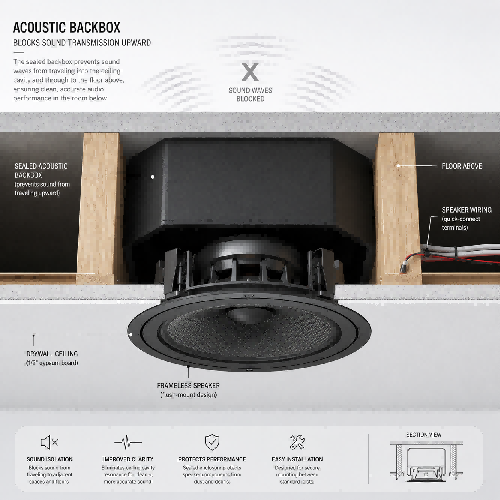
Table of Contents
To Backbox or Not? Optimizing Architectural Speakers with Acoustic Enclosures
TL;DR: Installing architectural speakers “open-air” inside a ceiling cavity uses the drywall as an infinite baffle, which is highly cost-effective but prone to acoustic bleeding and inconsistent bass response. Integrating a dedicated, sealed acoustic backbox controls air volume, tightens low-end frequency response, and provides critical fire-rated sound isolation between floors.
The Hidden Acoustic Variable: The Ceiling Cavity
When a standard or premium architectural speaker is flush-mounted into a plasterboard ceiling, the rear of the speaker driver fires directly into the structural floor cavity. In audio engineering, this is known as an Open-Air or Infinite Baffle installation.
While this method is incredibly popular due to its installation speed and low hardware overhead, it introduces a major wildcard: uncontrolled air volume. Every room’s ceiling cavity has a different depth, varying insulation density, and unique structural resonant frequencies. To achieve predictable, pristine audio reproduction—especially for premium or flagship speaker models—system integrators must evaluate the benefits of a sealed acoustic backbox.
1. Acoustic Predictability: Stabilizing the Low End
A speaker driver creates sound by moving its cone forward and backward. The backward movement creates rear pressure waves inside the ceiling.
-
Without a Backbox: The rear air waves travel infinitely through the ceiling grid. If the cavity is too large or leaks air, the air suspension behind the speaker drops, leading to boomy, loose, or muddy bass frequencies.
-
With a Sealed Backbox: The internal air volume is mathematically fixed. This structural air cushion acts as a precise mechanical spring, perfectly balancing cone movement. This results in incredibly tight, punchy low-end transients and enhanced midrange vocal presence.
2. Sound Isolation: Stopping the Bleed Between Floors
In luxury multi-story residential homes or modern corporate office complexes, sound bleeding through structural ceilings into the rooms above is a frequent tenant complaint.
[Image showing a cutaway of a ceiling structure with an in-ceiling speaker enclosed in a protective acoustic backbox, stopping sound transmission to the upper floor]
An open-air speaker acts as a direct megaphone into the structural joists, sending acoustic energy through the floorboards of the room directly upstairs. A high-density ABS, wood, or metal backbox acts as a heavy physical sound barrier, absorbing rear acoustic energy and preventing sound transmission between building levels.
Installation Architecture Comparison
| Engineering Factor | Open-Air / Infinite Baffle Setup | Sealed Acoustic Backbox Setup |
| Bass Control | Variable (Dependent on random ceiling cavity size) | Predictable & Linear (Tuned to factory driver specs) |
| Sound Bleeding | High (Acoustic waves freely migrate between floors) | Extremely Low (Rear energy is trapped and damped) |
| Debris Protection | Exposed to falling insulation, dust, and rodents | Fully Shielded (Sealed enclosure protects voice coils) |
| Installation Profile | Ultra-shallow mounting depth; fast deployment | Requires structural clearance and box placement planning |
| Best Used For | High-volume commercial BGM (e.g., RISC Series) | Premium home cinema & audiophile zones (e.g., RISF/RISD) |
3. Protecting the Mechanical Components
Ceiling cavities are inherently hostile environments for delicate electronic circuitry. Over years of continuous operation, loose fiberglass insulation, drywall dust, atmospheric moisture, and even pests can settle directly onto the speaker’s crossover network, wire terminal blocks, and voice coil gaps. Enclosing your mainstream frameless or flagship hardware inside a dedicated backbox completely shields these premium components from debris, guaranteeing decades of reliable, deterioration-free operation.
Expert Q&A
Q1: Does using a backbox reduce the absolute volume output of an in-ceiling speaker?
A: A backbox does not reduce overall volume; rather, it shapes the acoustic profile. By constraining the rear air volume, it slightly rolls off the uncontrolled ultra-low sub-bass frequencies while significantly boosting efficiency and punch in the mid-bass regions (60Hz–120Hz), which is critical for clean, intelligible music playback.
Q2: Can I build my own custom backboxes on-site out of MDF or plywood?
A: Yes, custom-built wooden enclosures work beautifully as long as they are completely airtight and packed lightly with dampening material like acoustic wool. However, for massive commercial rollouts or quick turnarounds, utilizing pre-fabricated, factory-tested ABS or fire-rated metal backenclosures saves substantial custom carpentry labor on the job site.
Q3: Which LECOVITA lines benefit the most from an acoustic enclosure setup?
A: While your project volume lines—like the RISC coaxial standard series—are intentionally voiced to perform admirably in open-air commercial ceiling spaces, your premium frameless lines (RISD/RISE) and signature flagship systems (RISF) thrive when paired with a backbox. The high structural rigidity of woven fiberglass woofers performs at its maximum potential when backed by a stable, predictable air cushion.
