
Bridging the Digital Divide: Integrating Dante and AES67 in Large-Scale Audio Networks

About Author: Kevin Wu
Founder & Principal Audio Engineer, LECOVITA
Specialize in acoustic engineering, high-fidelity speaker and amplifier design, precision manufacturing, sonic innovation, immersive audio solutions, and premium audio system development.
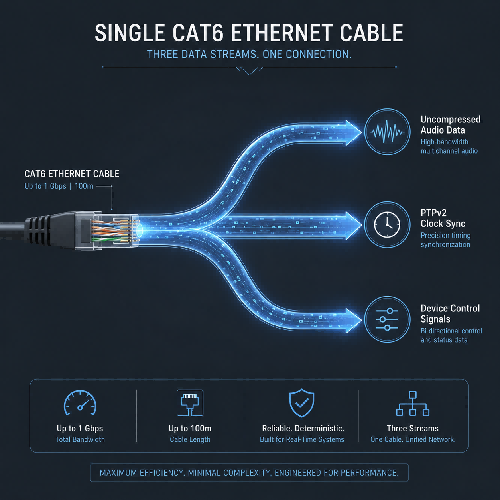
Table of Contents
Bridging the Digital Divide: Integrating Dante and AES67 in Large-Scale Audio Networks
TL;DR: Modern commercial and luxury residential projects demand scalable, future-proof signal routing. While Audinate’s proprietary Dante platform remains the dominant standard for daily AV workflows, activating its integrated AES67 mode unlocks critical cross-vendor open interoperability across complex corporate and broadcast network infrastructures.
The Reality of Modern Audio Infrastructure
The days of pulling thick, expensive, analog copper cables through walls to link multi-room speaker systems are officially behind us. In 2026, high-fidelity infrastructure means moving uncompressed, multi-channel digital audio over standard, cost-effective Ethernet setups.
However, as systems scale across corporate campuses, convention centers, or high-end mixed-use properties, integration teams frequently encounter a significant roadblock: ecosystem fragmentation. A project may feature a digital mixing matrix running on one networked audio protocol, a wireless microphone rack running on another, and distribution hardware on a third. To prevent complete network failure, engineers must understand how to deploy native protocols alongside open bridging standards.
Dante: The Benchmark for On-Site Device Management
With massive market adoption across thousands of components globally, Audinate’s Dante platform is the undisputed industry workhorse for standard AV integration.
The core advantage of native Dante operation is its plug-and-play simplicity. Devices automatically broadcast their identity, appearing inside a unified software interface (Dante Controller) where routing is executed via simple, drag-and-drop matrix patching. Dante manages its own synchronization and device discovery natively, allowing installation teams to deploy complex multi-zone systems rapidly without manual IP configuration bottlenecks.
AES67: The Global Language of Interoperability
While Dante excels within its vast ecosystem, high-tier projects—such as broadcasting facilities, public sector tenders, or custom enterprise structures—frequently mandate open, non-proprietary standards. This is where AES67 steps in.
Developed by the Audio Engineering Society, AES67 is not a competing product, but an open interoperability standard. It acts as a universal language translator. By defining a common technical baseline for clock synchronization (using PTPv2 Precision Time Protocol) and data packet sizes, AES67 allows otherwise incompatible network protocols—such as Dante, Ravenna, and Q-LAN—to seamlessly exchange audio streams directly.
AoIP Integration Comparison: Native vs. Open Bridge
| Engineering Metric | Native Dante Mode | AES67 Interoperability Mode |
| Protocol Type | Proprietary Platform (Audinate) | Open International Standard (AES) |
| Primary Advantage | Rapid software configuration, mature device discovery | Seamless cross-vendor hardware bridging |
| Clock Synchronization | Internal automated master clocking | Strict IEEE 1588 PTPv2 Precision Protocol |
| Configuration Style | Instant click-to-route software matrix | Manual session data (SDP) configuration or tools |
| System Application | Mainstream commercial retail and premium residential audio | Broadcast studios, public sector tenders, mixed-vendor systems |
Achieving Hardware Synergy at the Endpoint
Whether routing audio over a proprietary Dante grid or an open AES67 bridge, the digital signal must ultimately convert back to pure, undistorted analog sound at the acoustic endpoint.
To protect sound quality across massive network zones, contractors must deploy endpoints engineered for broad dispersion and linear response. Utilizing standardized residential coaxial speakers for multi-room home zones, or highly efficient mainstream frameless lines for premium storefronts, guarantees that the precision timing delivered by the network network layers is beautifully realized as clear, natural sound inside the physical space.
Expert Q&A
Q1: Does activating AES67 mode on a Dante device disable its native Dante functionality? A: No. Modern Dante-enabled hardware can operate in a hybrid state. The device continues to communicate normally with other native Dante units using standard software tools, while simultaneously broadcasting or receiving customized AES67 multicast streams to bridge into outside networks.
Q2: Why do cheap, unmanaged network switches fail when AES67 mode is turned on? A: Native Dante handles basic clocking invisibly, but AES67 relies strictly on IEEE 1588 PTPv2 (Precision Time Protocol) for microsecond-accurate clock syncing. Cheap unmanaged switches cannot handle or prioritize this high-precision timing data, which causes subtle audio dropouts and synchronization drift without ever triggering a physical connection light error.
Q3: How do multi-zone digital amplifiers integrate into an Audio-over-IP framework? A: Network-enabled amplifiers (like advanced multi-zone smart controllers) act as direct network endpoints. They ingest the multi-channel digital network streams directly over an Ethernet cable, handle the digital-to-analog conversion internally, and distribute power across independent physical zones—such as separate rooms or patios—minimizing analog rack overhead completely.
