
How to Calculate In-Ceiling Speaker Spacing for Perfect Sound Coverage

About Author: Kevin Wu
Founder & Principal Audio Engineer, LECOVITA
Specialize in acoustic engineering, high-fidelity speaker and amplifier design, precision manufacturing, sonic innovation, immersive audio solutions, and premium audio system development.
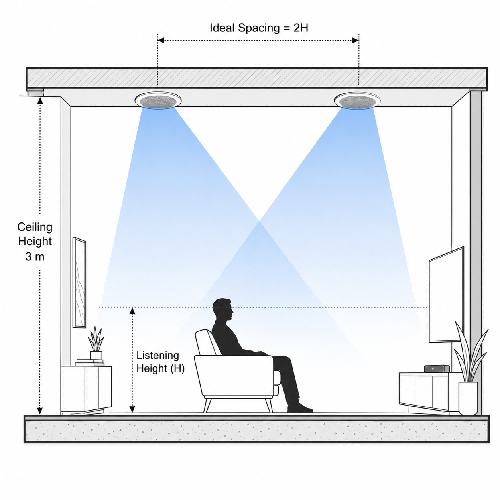
Table of Contents
How to Calculate In-Ceiling Speaker Spacing for Perfect Sound Coverage
TL;DR: Proper spacing ensures even sound distribution and eliminates acoustic "dead zones." The golden rule for background music (BGM) is to space your in-ceiling speakers at a distance equal to two times the listening height (the distance from the ceiling to the listener's ear level).
The Problem with Poor Spacing
When planning a commercial audio layout or a high-end residential multi-room system, guess-work leads to two major issues:
-
Hot Spots: Areas directly under a speaker where the volume is uncomfortably loud.
-
Dead Zones: Gaps between speakers where the high frequencies fade out, making music sound muddy and speech unintelligible.
To achieve that seamless, luxury "invisible sound" experience, the sound overlapping must be calculated precisely.
Step 1: Determine Your Coverage Pattern (Cone of Dispersion)
Sound drops from an in-ceiling speaker in a cone shape. Most standard architectural speakers have a dispersion angle of roughly 90 degrees for optimal high-frequency clarity.
-
Background Music (BGM): Requires a comfortable, ambient soundstage. A slight overlap at the edges of the sound cones is sufficient.
-
Foreground Music / Paging Systems: Requires maximum speech intelligibility and energy. This demands a tighter grid with significant overlap.
Step 2: The Core Calculation (The 2X Rule)
To calculate the perfect distance between two speakers, you need to find the Listening Height (H), which is the physical distance between the ceiling and the average person's ear level.
The Formula:
Example Scenario:
-
Ceiling Height: 3.0 meters
-
Average Ear Level (Seated patrons in a restaurant): 1.2 meters
-
Listening Height (H): 3.0m-1.2m=1.8m
Using our 2X rule for background music, the ideal distance between your LECOVITA in-ceiling speakers should be:
Note: For standing environments like retail store corridors, adjust the average ear level to 1.6 meters.
Step 3: Edge-to-Center Layout Strategy
To map a room completely, use a grid layout. The distance from the perimeter walls to the first row of speakers should always be half the distance of the internal speaker spacing.
Following the example above:
-
Distance between speakers: 3.6 meters
-
Distance from wall to first speaker: 1.8 meters
Technical Placement Matrix
| Environment | Avg. Ear Level | Rec. Overlap Type | Spacing Factor |
| Boutique Retail (Standing) | 1.6 m | Edge-to-Edge | 2.0 x H |
| Restaurant / Cafe (Seated) | 1.2 m | Minimum Overlap | 1.8 x H |
| High-End Home Theater | 1.0 m | Center-to-Center (Dense) | 1.4 x H |
Expert Q&A
Q1: How does a 2-way coaxial design affect speaker spacing? A: Speakers with a pivoting or bridge-mounted tweeter (like the LECOVITA series) allow you to aim the high frequencies toward targeted seating areas. This can slightly widen your flexible spacing margins without creating dead zones.
Q2: What happens if the ceilings are exceptionally high (above 4 meters)? A: As ceiling height increases, the coverage cone expands, but sound energy drops. For high ceilings, keep the 2X spacing rule but select speakers with higher sensitivity or tap them at higher wattages to maintain volume.
Q3: Should I choose a square or hexagonal grid layout? A: A hexagonal layout provides the most uniform coverage with the fewest dead zones. However, a square layout is much easier to align with rectangular architectural tiles and structural ceiling grids.
