
Audio 101: Understanding Speaker Impedance — 8Ω vs. 100V Systems

About Author: Kevin Wu
Founder & Principal Audio Engineer, LECOVITA
Specialize in acoustic engineering, high-fidelity speaker and amplifier design, precision manufacturing, sonic innovation, immersive audio solutions, and premium audio system development.
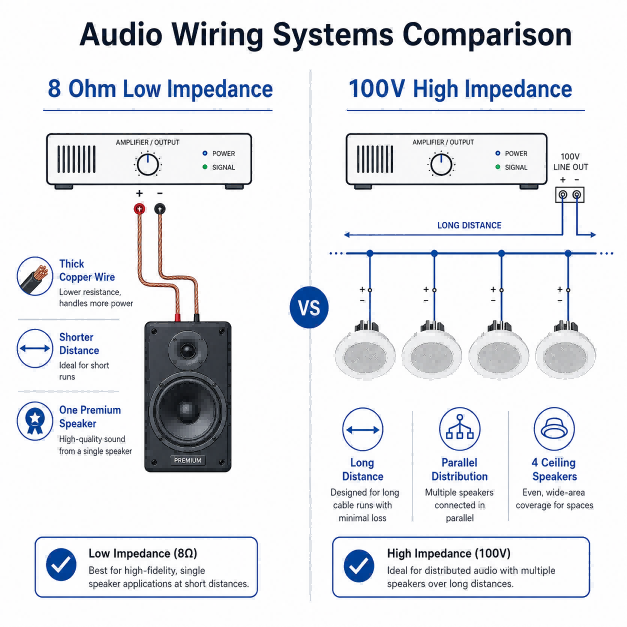
Table of Contents
Audio 101: Understanding Speaker Impedance — 8Ω vs. 100V Systems
TL;DR: Impedance determines how a speaker consumes power from an amplifier. While 8Ω Low-Impedance systems are favored for high-fidelity sound in residential setups, 100V High-Impedance systems are the gold standard for commercial projects requiring long-distance transmission and multiple speaker connections.
What is Impedance? (The Water Pipe Analogy)
To simplify a complex acoustic concept, imagine electricity as water flowing through a pipe:
-
Voltage is the water pressure.
-
Current is the speed of the water flow.
-
Impedance is the diameter of the pipe. A narrower pipe (higher impedance) restricts the flow of water. In an audio system, matching the right “pressure” and “pipe size” is crucial to ensure clear sound and prevent equipment damage.
8Ω Low-Impedance Systems: The Pursuit of Fidelity
8 Ohm (8Ω) is the standard for most architectural and home theater speakers.
-
The Advantage: It provides a direct signal path with a wider frequency response and punchier bass.
-
The Limitation: High current leads to significant power loss over long wire runs. Therefore, cable length is typically limited to 10-15 meters.
-
Best For: Private cinemas, high-end living rooms, and small boutique cafes.
100V High-Impedance Systems: The Commercial King
In large-scale projects like malls or hotels, where dozens of speakers are needed across hundreds of square meters, 8Ω systems fall short.
-
How it Works: A transformer steps up the voltage to 100V for transmission (similar to a high-voltage power grid). Each speaker then has its own transformer to step the voltage back down.
-
The Advantage: 1. Long-Distance: Minimal signal loss even with cable runs exceeding 100 meters. 2. Easy Scalability: Speakers are connected in parallel (daisy-chain), making it easy to add more units as long as the total wattage doesn’t exceed the amplifier’s capacity.
-
Best For: Hotel corridors, shopping centers, office buildings, and outdoor garden audio.
Technical Comparison Table
| Feature | 8Ω Low-Impedance (Low-Z) | 100V High-Impedance (High-Z) |
| Signal Loss | Increases rapidly with distance | Extremely Low |
| Wiring Complexity | High (Requires series/parallel calculation) | Simple (Parallel/Daisy-chain) |
| Sound Quality | High-Fidelity (Critical Listening) | Standard (Background Music & Paging) |
| Expandability | Limited | Highly Scalable |
Expert Q&A
Q1: Can I connect an 8Ω speaker directly to a 100V amplifier?
A: No. This would create an impedance mismatch, drawing excessive current and likely burning out your amplifier. You must use a matching transformer at the speaker end.
Q2: Which system do LECOVITA speakers support?
A: Many of our architectural speakers feature a Transformer Switch (Power Tap). This allows a single product to switch between 8Ω and various 70V/100V settings, making them versatile for any project.
Q3: How do I calculate the required amplifier power for a 100V system?
A: Simply add up the selected wattage (taps) of all speakers in the chain. Ensure your amplifier’s total power is at least 20% higher than this sum to provide a safe “headroom.”
