
24 kHz vs 48 kHz Auracast Audio: A Practical Design Guide

About Author: Kevin Wu
Founder & Principal Audio Engineer, LECOVITA
Specialize in acoustic engineering, high-fidelity speaker and amplifier design, precision manufacturing, sonic innovation, immersive audio solutions, and premium audio system development.
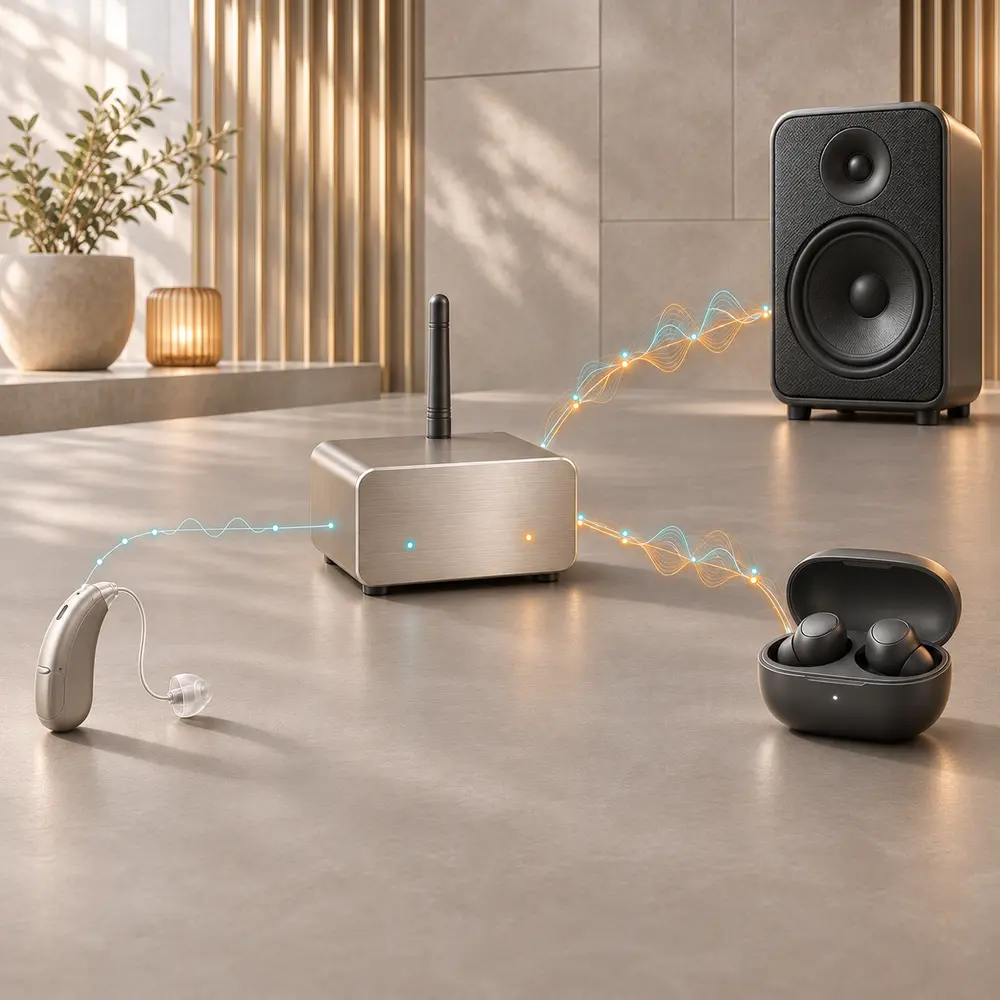
Table of Contents
Auracast™ product development often raises a practical question: should the system broadcast LC3 audio at 24 kHz or 48 kHz?
The answer depends on the product’s intended receivers and use cases. A public-address transmitter designed for broad compatibility has different priorities from a wireless speaker system intended for high-quality music.
For many commercial products, the best solution is not to choose one sample rate permanently. The product should support both Standard Quality and High Quality configurations, allowing installers or users to select the appropriate mode.
Quick Answer
Use 24 kHz LC3 audio when compatibility with a broad range of Auracast receivers—including hearing devices—is the priority.
Use 48 kHz LC3 audio when higher perceived music quality is required and the intended receivers are confirmed to support the High Quality configuration.
A transmitter intended for mixed public and consumer applications should ideally offer:
-
A 24 kHz compatibility mode
-
A 48 kHz high-quality mode
-
Clear selection in the app or setup interface
-
Simultaneous SQ and HQ broadcasts only when the hardware resources and application justify them
The Bluetooth SIG identifies 16 kHz and 24 kHz streams as Standard Quality public broadcast configurations. High Quality public broadcasts use 48 kHz, but receiver support for these configurations is not mandatory.
What Does the Sample Rate Control?
The sample rate describes how many times per second the audio waveform is sampled before encoding.
LC3 supports several sample rates, including:
- 8 kHz
- 16 kHz
- 24 kHz
- 32 kHz
- 44.1 kHz
- 48 kHz
LC3 can encode both speech and music, using either 7.5 ms or 10 ms frame intervals. The codec gives manufacturers flexibility to balance audio quality, power consumption, data rate and product compatibility.
A higher sample rate does not automatically make the complete system better. Receiver support, LC3 bitrate, packet-loss behavior, loudspeaker response, radio reliability and the listening environment also affect the result.
Why 24 kHz Matters for Auracast Compatibility
Standard Quality Auracast audio uses LC3 configurations based on 16 kHz or 24 kHz sampling.
The 16 kHz option is mainly suitable for voice applications. For music, announcements and mixed program material, 24 kHz is normally the more practical Standard Quality choice.
According to Bluetooth SIG guidance, every Auracast receiver is expected to support the applicable Standard Quality configurations. This makes 24 kHz particularly important for:
-
Assistive-listening systems
-
Hearing devices
-
Airport and railway announcements
-
Conference interpretation
-
Museum tours
-
Houses of worship
-
Public television audio
-
Mixed-device public venues
In these applications, reliable access is usually more important than advertising the highest possible sample-rate number.
Bluetooth SIG material describes 24 kHz as suitable for music in imperfect listening conditions, including locations with background noise or listeners with hearing impairment.
When 48 kHz Is the Better Choice
A 48 kHz LC3 stream can provide higher perceived quality for focused music listening, provided that the receiver supports the selected configuration.
Typical applications include:
-
Auracast-enabled wireless speakers
-
Home audio systems
-
Premium headphones and earbuds
-
Television audio
-
High-quality music demonstrations
-
Personal transmitters
-
Commercial entertainment systems with controlled receiver compatibility
However, 48 kHz High Quality support is not mandatory for every Auracast receiver. A transmitter that broadcasts only at 48 kHz may therefore exclude compatible products that can receive Standard Quality broadcasts but cannot render the High Quality stream.
This distinction is especially important when a product must work with both consumer audio devices and hearing devices.
Should an Auracast Product Support Both?
For a flexible commercial product, supporting both 24 kHz and 48 kHz is generally the strongest design direction.
A practical interface could provide two modes:
Compatibility Mode
-
24 kHz LC3
-
Intended for public broadcasting and assistive listening
-
Prioritizes receiver interoperability
-
Suitable for speech and background music
High Quality Mode
-
48 kHz LC3
-
Intended for compatible speakers, earbuds and headphones
-
Prioritizes music quality
-
Requires confirmation that the receivers support HQ streams
Bluetooth SIG guidance allows a transmitter to provide a user-selectable switch between Standard Quality and High Quality. Alternatively, suitably capable hardware may transmit both configurations.
Can 24 kHz Auracast Audio Be Converted to 48 kHz?
Yes, a receiver can resample decoded 24 kHz audio to the 48 kHz rate required by its internal DSP or amplifier signal path.
For example:
24 kHz LC3 broadcast → LC3 decoder → sample-rate converter → 48 kHz DSP → DAC or digital amplifier
This conversion can make the signal compatible with a DSP or amplifier that operates internally at 48 kHz. However, it does not recreate high-frequency information that was absent from the original 24 kHz broadcast.
Resampling solves a hardware-interface requirement; it does not turn the original stream into true 48 kHz source audio.
Designers should also verify:
-
Sample-rate-converter quality
-
Added processing latency
-
Clock-domain management
-
Buffer behavior
-
DSP input requirements
-
Mute handling during mode changes
-
Audible clicks during stream switching
Is Simultaneous 24 kHz and 48 kHz Broadcasting Necessary?
Simultaneously transmitting Standard Quality and High Quality streams can offer broad compatibility without forcing users to change modes.
However, it can also require:
-
Additional LC3 encoder instances
-
More controller and memory resources
-
Greater radio airtime
-
More complex BIG and BIS configuration
-
Additional firmware testing
-
Clear broadcast naming and user selection
Bluetooth SIG’s transmitter guidance illustrates a stereo implementation using separate 24 kHz and 48 kHz streams, requiring four LC3 codec instances for the two stereo configurations.
For many products, selectable modes are simpler and more economical. Simultaneous transmission is most valuable when hearing-device users and high-quality consumer receivers must use the system at the same time.
Recommended Product Strategy
For an Auracast amplifier, transmitter or active speaker, consider the following architecture:
-
Support 24 kHz Standard Quality as the compatibility baseline.
-
Add selectable 48 kHz High Quality for compatible receivers.
-
Use internal sample-rate conversion when the downstream DSP or amplifier requires 48 kHz.
-
Display the active mode clearly in the app.
-
Test with hearing devices, consumer earbuds and Auracast speakers.
-
Validate protected and open broadcasts separately.
-
Confirm switching behavior without clicks, excessive delay or loss of control.
-
Consider simultaneous SQ and HQ only when the hardware and user scenario justify the added complexity.
Conclusion
The choice between 24 kHz and 48 kHz Auracast audio is not simply a comparison between lower and higher sound quality.
24 kHz is the compatibility-focused choice, especially for public broadcasting, speech, assistive listening and hearing-device support.
48 kHz is the quality-focused choice for compatible speakers, headphones, earbuds and music-oriented products.
A well-designed Auracast product should therefore avoid being permanently limited to only one mode. Supporting selectable 24 kHz and 48 kHz configurations gives manufacturers and system integrators a practical balance between interoperability and audio performance.
For an introduction to the complete broadcast architecture, read Auracast Broadcast Audio: What Commercial Audio Installers Need to Know.
LECOVITA develops OEM and ODM audio products including Auracast amplifiers, wireless audio systems, ceiling speakers and commercial installed-audio solutions. Contact LECOVITA to discuss a customized wireless audio project.
FAQ
Is 48 kHz mandatory for Auracast receivers?
No. Standard Quality configurations provide the broader compatibility baseline. High Quality 48 kHz rendering is not mandatory for every receiver.
Is 24 kHz suitable for music?
Yes. It is suitable for background music, public audio and listening environments where compatibility is more important than maximum bandwidth.
Can a 24 kHz broadcast work with a 48 kHz amplifier?
Yes. The decoded signal can be resampled to 48 kHz before entering the DSP or digital amplifier.
Does resampling improve the original audio quality?
No. It changes the processing rate but cannot restore audio information that was not present in the original 24 kHz stream.
Should an Auracast speaker support both rates?
Supporting both is recommended when the product targets public broadcasts, assistive listening and high-quality consumer audio.
