
Do In-Wall and In-Ceiling Speakers Need a Backbox?

About Author: Kevin Wu
Founder & Principal Audio Engineer, LECOVITA
Specialize in acoustic engineering, high-fidelity speaker and amplifier design, precision manufacturing, sonic innovation, immersive audio solutions, and premium audio system development.
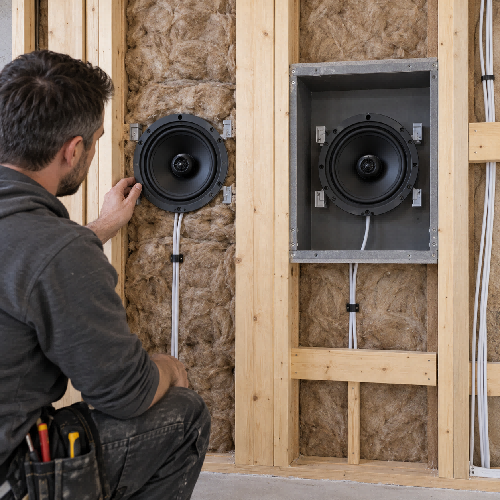
Table of Contents
- Quick Answer
- What Is a Speaker Backbox?
- Why Open-Back Speakers Can Work Without a Box
- How Enclosure Volume Affects the Speaker
- Why an Arbitrary Small Box Can Cause Problems
- Benefits of a Purpose-Designed Backbox
- Backbox Versus Preconstruction Bracket
- In-Wall Speaker Backboxes for Home Theater
- In-Ceiling Speaker Backboxes
- A Backbox Does Not Automatically Restore a Fire Rating
- Acoustic Backboxes and Fire Hoods Are Not the Same
- Insulation Around the Speaker
- Moisture, Condensation, and Vapor Control
- Cable Entry and Serviceability
- Practical Example: Three Identical Bedroom Speakers
- Backbox Selection Checklist
- Installation Procedure
- Common Mistakes
- Conclusion
- FAQ
Do In-Wall and In-Ceiling Speakers Need a Backbox?
An in-wall or in-ceiling speaker needs a backbox when the manufacturer requires one, when its acoustic design depends on a defined enclosure, or when the project needs controlled cavity volume, reduced sound transfer, physical protection, or coordination with insulation and building services.
Not every architectural speaker requires a backbox. Many products are engineered to operate in an open wall or ceiling cavity. Installing an arbitrary enclosure behind one of these speakers can change its bass response, impedance behavior, thermal conditions, and maximum usable output.
The correct rule is:
Use the exact manufacturer-approved enclosure—or design from verified electroacoustic data. Do not assume that any box behind a speaker is beneficial.
Quick Answer
Use or specify a speaker backbox when:
- The speaker manufacturer requires it.
- The published performance is based on that enclosure.
- Consistent enclosure volume is needed across multiple locations.
- Rearward sound transfer must be reduced.
- The speaker requires protection from loose insulation, debris, or building services.
- A listed commercial assembly includes a specific backcan.
- Preconstruction coordination makes a defined enclosure practical.
Do not add a generic backbox without checking:
- Required internal volume
- Sealed, vented, or open design
- Internal dimensions
- Enclosure material and stiffness
- Damping material
- Cable-entry sealing
- Driver clearance
- Thermal requirements
- Structural attachment
- Fire, smoke, acoustic, or environmental assembly requirements
A backbox is not automatically a fire enclosure, smoke barrier, vapor barrier, or soundproofing system.
What Is a Speaker Backbox?
A speaker backbox is an enclosure installed behind an architectural loudspeaker.
Depending on the product, it may be:
- Integrated into the loudspeaker
- Supplied as an optional manufacturer accessory
- Installed before drywall
- Retrofitted through an opening
- Made from metal, molded polymer, wood-based panels, or composite material
- Sealed, vented, or acoustically resistive
- Lined with approved damping material
Commercial ceiling speakers often use the term backcan, particularly when a metal housing forms part of the complete loudspeaker assembly.
Construction alone does not establish performance. Two enclosures of the same external size can have different internal volume, leakage, stiffness, damping, connector arrangements, and fire behavior.
Why Open-Back Speakers Can Work Without a Box
Many architectural speakers are designed to use the wall or ceiling cavity as their rear acoustic environment.
The cavity may be relatively large compared with a conventional cabinet. The speaker’s driver, crossover, suspension, and equalization can be selected for that condition.
Manufacturer documentation may specify:
- Minimum cavity depth
- Recommended cavity volume
- Stud-bay width
- Use of insulation
- Required clearance around the driver
- Whether a backbox is optional
- Whether a preconstruction bracket is needed
“Open back” does not mean the speaker has no enclosure conditions. The building cavity itself becomes part of the acoustic system.
How Enclosure Volume Affects the Speaker
A loudspeaker driver’s rear radiation interacts with the enclosed air behind it.
Reducing enclosure volume generally increases the stiffness of the trapped air. Depending on the driver and alignment, this can change:
- Low-frequency resonance
- Bass extension
- Response shape
- Cone excursion
- Electrical impedance
- Power compression
- Distortion
- Required equalization
A larger enclosure does not automatically produce better results. A leaking enclosure is not automatically equivalent to either a properly sealed or intentionally vented design.
The effect cannot be predicted responsibly from external dimensions alone. Accurate design requires the driver’s parameters, displacement, intended alignment, leakage, damping, and crossover or DSP behavior.
Why an Arbitrary Small Box Can Cause Problems
A common installation mistake is building the smallest box that physically fits behind the speaker.
Possible consequences include:
- Reduced low-frequency extension
- An upper-bass peak
- Greater variation between installed and published response
- Increased driver excursion in some frequency ranges
- Mechanical contact between the driver and enclosure
- Rattling panels
- Cable noise
- Blocked vents
- Inadequate cooling for active electronics
- Difficulty servicing the speaker
Do not infer the required enclosure from the cutout dimensions. Obtain the approved internal volume and construction details.
Benefits of a Purpose-Designed Backbox
More consistent performance
Open cavities may vary because of:
- Stud spacing
- Blocking
- joists
- ducts
- insulation
- pipes
- electrical boxes
- fire stopping
- cavity openings
- adjacent construction
A defined enclosure can give multiple speakers more similar acoustic conditions.
Reduced rearward sound transfer
A rigid, sealed, damped enclosure can reduce some sound radiated into an adjoining room or floor.
It will not make the installation soundproof. Sound can still travel through:
- Wallboard
- Studs and joists
- Fasteners
- Gaps
- Flanking paths
- Ducts
- Doors
- The speaker grille and listening room
Low-frequency isolation is especially demanding. Published laboratory data for the complete construction should be used when isolation performance is critical.
Physical protection
A backbox can keep loose material and building services away from the driver and terminals. It may also provide a defined location for cable entry and strain relief.
Preconstruction coordination
An enclosure installed before drywall can establish:
- Speaker position
- Required cavity
- Cable termination point
- Mounting support
- Separation from other services
- Future cutout location
This can reduce uncertainty during final installation.
Backbox Versus Preconstruction Bracket
These parts perform different functions.
A preconstruction bracket normally establishes the speaker position and cutout before drywall installation. It may not enclose the back of the speaker.
A backbox creates an acoustic and physical enclosure. Some systems combine the bracket and backbox, while others use separate components.
Check the exact part number and installation drawing rather than treating the terms as interchangeable.
In-Wall Speaker Backboxes for Home Theater
In-wall speakers behind a screen or around a listening area benefit from consistent acoustic conditions.
If one speaker is installed in a full-height open stud bay while another is surrounded by blocking or plumbing, their response may differ even when the models are identical.
A manufacturer-matched in-wall speaker backbox can help control this variable. Some enclosed architectural speakers incorporate their own cabinet for the same reason.
Sonance describes certain architectural home-theater products as using integrated enclosures for predictable performance and reduced disturbance to adjoining rooms. This is a product-specific example, not proof that every in-wall speaker should be enclosed. Sonance architectural speaker information
In-Ceiling Speaker Backboxes
Ceiling installations introduce additional coordination issues:
- Insulation
- HVAC ducts
- plumbing
- lighting
- sprinklers
- joists
- resilient channels
- suspended-ceiling tiles
- vapor-control layers
- fire-resistance assemblies
- access requirements
A backbox may reduce direct rear radiation into the floor above, but it can also create mechanical coupling if attached incorrectly.
For suspended ceilings, speaker assemblies may require tile bridges, support rails, safety attachments, or independent support. The ceiling tile should not be assumed capable of carrying the complete load.
JBL Professional’s Control 24CT-BK provides a manufacturer example of a commercial ceiling speaker packaged with a backcan, grille, and tile rails. The included parts illustrate an engineered assembly; they should not be generalized to unrelated products. JBL Control 24CT-BK
A Backbox Does Not Automatically Restore a Fire Rating
Cutting a hole in a fire-resistance-rated wall or ceiling can affect the tested assembly.
An ordinary metal or wooden speaker box must not be described as:
- Fire-rated
- Fireproof
- UL compliant
- Smoke-sealing
- Maintaining a one-hour or two-hour rating
unless suitable evidence covers the exact product and installation assembly.
Relevant evidence may involve:
- A listed or classified system
- A tested fire-resistance assembly
- An approved protective enclosure
- A recognized firestop system
- Instructions covering opening size and placement
- Approval from the responsible code authority
The loudspeaker, backcan, protective cover, fasteners, ceiling or wall construction, penetrations, and installation method may all affect compliance.
Do not use acoustic insulation as an improvised firestop.
Acoustic Backboxes and Fire Hoods Are Not the Same
An acoustic backbox is primarily intended to create or control the speaker’s rear acoustic environment.
A fire hood or protective cover may be intended to address a building fire requirement. Its acoustic effect, ventilation, clearances, and compatibility must also be evaluated.
One product may perform both functions only when its documentation supports both functions for the intended assembly.
Do not place a fire hood tightly around a speaker if the manufacturer requires a larger acoustic volume or ventilation clearance.
Insulation Around the Speaker
Insulation can affect sound transmission and cavity behavior, but installation must follow product and building requirements.
Before placing insulation around or inside an enclosure, verify:
- Material type
- Combustibility requirements
- Whether contact with the speaker is permitted
- Required clearance from active electronics
- Whether vents may be covered
- Whether fibers can enter the mechanism
- Specified quantity and position
- Vapor-control requirements
- Local code
Do not tightly pack insulation behind a driver unless directed by the design documentation.
Moisture, Condensation, and Vapor Control
A backbox is not automatically a vapor barrier.
In exterior walls, bathrooms, kitchens, roof spaces, and humid climates, an enclosure can interact with vapor-control and air-sealing layers. Poor detailing may create condensation or air leakage.
Coordinate penetrations with the architect or building professional. Do not pierce or reseal membranes using an improvised method.
Speaker environmental suitability and enclosure acoustic suitability are separate questions.
Cable Entry and Serviceability
A backbox should provide a documented cable route that does not create noise or air leakage.
Check:
- Approved cable-entry location
- Grommet or gland
- Strain relief
- Cable bend radius
- Separation from mains wiring
- Terminal clearance
- Protection from sharp metal edges
- Service loop
- Ability to remove the speaker
- Access to transformer-tap or configuration controls
Seal an enclosure only using materials and methods compatible with its design and required assembly.
Practical Example: Three Identical Bedroom Speakers
Assume three hypothetical bedrooms use the same open-back in-ceiling speaker.
- Bedroom A has a large unobstructed joist bay.
- Bedroom B has blocking close to the speaker.
- Bedroom C has a duct occupying much of the cavity.
Even with identical amplifiers and settings, the different rear volumes and obstructions can produce different results.
Possible responses include:
- Relocate the speakers to comparable cavities.
- Use manufacturer-approved backboxes.
- Select an enclosed speaker system.
- Measure and commission each room individually.
- Avoid relying on equalization to correct a severe mechanical difference.
This example is an engineering scenario, not a product-performance claim.
Backbox Selection Checklist
Before ordering, confirm:
| Question | Required evidence |
|---|---|
| Is a backbox required? | Exact speaker manual |
| What internal volume is needed? | Manufacturer drawing or engineered design |
| Is it sealed or vented? | Construction specification |
| Does it fit the driver? | Depth and clearance drawing |
| Is damping required? | Material and placement instructions |
| How does cable enter? | Approved gland or grommet detail |
| How is it supported? | Structural installation instructions |
| Does it alter published response? | Manufacturer acoustic data |
| Is fire performance claimed? | Valid listing, classification, or assembly evidence |
| Is sound isolation quantified? | Complete wall/ceiling laboratory data |
| Can insulation touch it? | Product and building instructions |
| Can the speaker be serviced? | Access and removal plan |
Installation Procedure
- Confirm the speaker and backbox part numbers.
- Obtain current drawings and manuals.
- Verify internal volume, not just external dimensions.
- Coordinate studs, joists, ducts, pipes, lighting, and wiring.
- Review fire, smoke, acoustic, and vapor-control requirements.
- Provide approved structural support.
- Install the enclosure in its required orientation.
- Seal only the specified joints and cable entries.
- Add only approved damping or insulation.
- Protect the enclosure during construction.
- Inspect for screws, debris, or loose cables.
- Install the speaker without damaging its gasket or frame.
- Test polarity and channel assignment.
- Listen for rattles at controlled levels.
- Document the concealed installation before closure.
Common Mistakes
Assuming every speaker sounds better with a box
A mismatched enclosure can reduce performance.
Copying a box size from another model
Drivers with similar diameters can require different alignments and volumes.
Using the wall cavity as a predictable enclosure
Its volume and leakage may vary substantially across locations.
Claiming soundproofing
A backbox can reduce rear radiation without providing complete building sound isolation.
Claiming a fire rating from metal construction
Material alone does not establish the fire performance of the installed assembly.
Blocking an active speaker’s ventilation
Active architectural products may have thermal requirements.
Forgetting driver displacement
Internal braces, the driver, transformer, connectors, and damping reduce usable internal volume.
Attaching the enclosure to a weak ceiling tile
Suspended-ceiling installations may require rails or independent support.
Closing the wall without photographs
Concealed documentation is valuable for commissioning and future service.
Conclusion
An architectural speaker does not automatically need a backbox, but the space behind it always matters.
Use a speaker backbox when it is required by the manufacturer or justified by acoustic consistency, rear-sound control, physical protection, or building coordination. Match the enclosure’s volume, construction, damping, and cable entry to verified documentation.
Most importantly:
An acoustic enclosure is not automatically a fire, smoke, vapor, or sound-isolation system. Each function requires separate evidence.
For projects involving in-wall home-theater speakers, Hi-Fi in-ceiling speakers, or commercial ceiling speakers, Lecovita can provide available installation information for model comparison. The final enclosure and building assembly should be reviewed against the exact speaker documentation and project requirements.
FAQ
Does every in-wall speaker need a backbox?
No. Many are designed for open cavities. Use a backbox only when required or supported by the manufacturer or an engineered design.
Will a backbox improve bass?
Not automatically. The result depends on the driver, enclosure volume, leakage, damping, and intended alignment.
Can a backbox make several speakers sound more consistent?
Yes, a defined enclosure can reduce variation caused by different cavity volumes and obstructions.
Does a backbox stop sound entering the next room?
It may reduce rearward radiation, but complete sound isolation depends on the entire wall or ceiling assembly and its flanking paths.
Can I build a speaker backbox from MDF or plywood?
Only when an engineered or manufacturer-approved design defines the volume, construction, sealing, damping, and building suitability.
Is a metal speaker backcan fire-rated?
Not automatically. Fire performance requires applicable evidence for the exact product and installed assembly.
Is a fire hood the same as an acoustic backbox?
No. Their primary functions differ. A product performs both roles only when its documentation supports both.
Can insulation touch an in-ceiling speaker?
Only when the speaker and building documentation permit it. Maintain required thermal, acoustic, and fire clearances.
Should a backbox be airtight?
Only if the design requires a sealed enclosure. Some systems are vented or intentionally resistive.
Does enclosure volume include the speaker itself?
The useful net volume normally excludes space displaced by the driver, braces, transformers, and other internal parts.
Can an enclosure be added after drywall?
Some retrofit enclosures exist, but access and available opening size are model-specific.
What should be documented before closing the wall?
Record enclosure dimensions, speaker location, cable route, structural support, seals, insulation, nearby services, and photographs.
