
Silent Power: Thermal Management & GaN FET Physics in High-Density Class-D Amplifiers

About Author: Kevin Wu
Founder & Principal Audio Engineer, LECOVITA
Specialize in acoustic engineering, high-fidelity speaker and amplifier design, precision manufacturing, sonic innovation, immersive audio solutions, and premium audio system development.
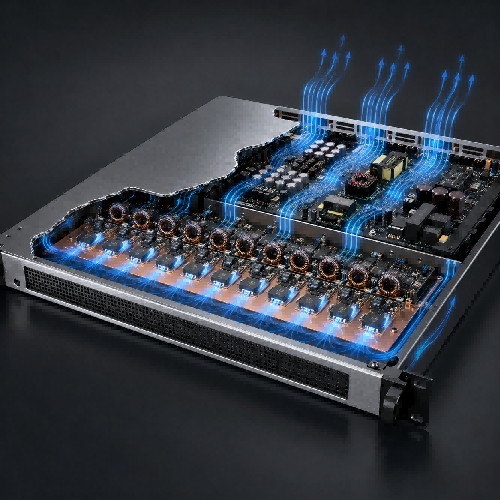
Table of Contents
Silent Power: Thermal Management & GaN FET Physics in High-Density Class-D Amplifiers
Cramming 8 to 16 channels of high-power amplification ($>150\text$ per channel) into a slim 1U rack chassis creates an extreme thermal bottleneck. Traditional Class-AB and early Silicon MOSFET Class-D amplifiers generate excess wasted heat, requiring loud forced-air fans that disrupt quiet residential media closets and corporate boardroom racks. Modern architectural amplification solves this through Gallium Nitride (GaN) High-Electron-Mobility Transistors (HEMTs), which achieve switching efficiencies exceeding $96\%$, eliminate reverse recovery losses ($Q_ = 0$), and enable completely fanless, pure convection-cooled 1U amplifier architectures.
The Rack-Density Dilemma: Thermal Dissipation in 1U Enclosures
In multi-room distributed audio systems and high-channel-count home theaters, equipment rack space is at a premium. Integrators must drive multiple audio zones from a single centralized equipment rack.
When stacking multiple traditional multi-channel amplifiers in an enclosed rack, thermal energy accumulates rapidly. In a legacy Class-AB amplifier operating at $50\%$ to $60\%$ efficiency, nearly half of the electrical power pulled from the wall is converted directly into heat:
Even standard Silicon-based Class-D amplifiers ($85\% – 90\%$ efficiency) generate significant thermal load when all 8 or 12 channels are driven simultaneously during continuous high-SPL playback.
To prevent internal power transistors from exceeding their maximum junction temperature ($T_j > 150^\circ\text$), manufacturers traditionally install miniature high-RPM cooling fans. However, these fans pull airborne dust into internal circuit boards, suffer mechanical bearing failures over time, and introduce an audible high-frequency whine ($>40\text$) into nearby living spaces.
[Legacy Class-AB Amp]  ===> 50% Efficiency ===> Heavy Heatsinks + Loud Internal Exhaust Fans Required
[Silicon Class-D Amp]  ===> 88% Efficiency ===> Moderate Heat + Fan Cycling under Heavy Multi-Zone Loads
[GaN FET Class-D Amp]   ===> 96% Efficiency ===> Ultra-Low Heat + 100% Silent Passive Convection Cooling
1. The Semiconductor Leap: Gallium Nitride (GaN) vs. Silicon MOSFETs
The efficiency ceiling of traditional Class-D amplifiers is limited by the physical material properties of Silicon.
               [PWM Audio Switching Signal (400kHz - 1MHz+)]
                                     │
    ┌────────────────────────────────┴────────────────────────────────┐
    │          [Gallium Nitride (GaN) HEMT Output Stage]              │
    │  - Zero Reverse Recovery Charge (Q_rr = 0)                      │
    │  - Ultra-Low Gate Charge (Q_g) & Nanosecond Slew Rates (<5ns)   │
    │  - Near-Zero Dead-Time (Distortion Elimination)                 │
    └────────────────────────────────┬────────────────────────────────┘
                                     │
                                     ▼
        [96%+ Electrical-to-Acoustic Power Conversion Efficiency]
Class-D amplifiers reproduce analog audio by rapidly switching power transistors on and off using high-frequency Pulse Width Modulation (PWM). Silicon MOSFETs suffer from fundamental physical limitations during these switching transitions:
-
Zero Reverse Recovery Charge ($Q_$): Silicon MOSFETs feature an internal parasitic body diode that stores electrical charge when conducting. Discharging this trapped energy during every switching cycle wastes power and generates significant heat. GaN HEMTs have no parasitic body diode, reducing reverse recovery energy loss ($Q_$) to absolute zero.
-
Nanosecond Switching Speeds: GaN possesses a critical electric field strength ten times higher than Silicon, allowing electrons to move significantly faster through a smaller physical die. GaN switching rise and fall times are under $5\text$ (compared to $20\text – 50\text$ for Silicon), drastically reducing the time the transistor spends in the lossy transition state.
-
Near-Zero Dead-Time Distortion: Because Silicon switches slowly, engineers must insert an intentional delay (dead-time) between the upper and lower transistors turning on to prevent a catastrophic short circuit ("shoot-through"). This dead-time creates open-loop harmonic distortion (THD). GaN's switching speeds allow dead-times below $5\text$, delivering pristine audio linearity alongside audiophile-grade Total Harmonic Distortion plus Noise ($\text < 0.003\%$).
2. Convection Dynamics & Structural Thermal Pathways
Achieving completely silent, fanless operation in high-output multi-zone amplifiers requires optimizing mechanical heat transfer from the semiconductor junction out through the external aluminum chassis.
                      [Internal GaN Transistor Junction (T_j)]
                                         │
                 ▼ ▼ ▼ ▼ ▼ ▼ ▼ ▼ ▼ ▼ ▼ ▼ ▼ ▼ ▼ ▼ ▼ ▼ ▼ ▼ ▼
                 [Direct-Bonded Solid Copper Heat Spreader]
                 [High-Conductivity Phase-Change Thermal Interface]
  ====================[Anodized Aluminum Chassis Baseplate]====================
                 │                                         │
                 ▼ (Conductive Transfer)                   ▼ (Radiant Dissipation)
          [Chassis Side Flanges]                    [Natural Convective Air Draft]
-
Low Thermal Resistance ($\theta_$): GaN devices package high current capacity into microscopic footprints. Heat is pulled away from the semiconductor die using direct-bonded copper heat spreaders and phase-change thermal interface materials (TIM), achieving thermal resistance ratings below $0.5^\circ\text$.
-
Chassis-as-Heatsink Mechanical Design: Rather than placing bulky, finned aluminum heatsinks in the center of the PCB where trapped air stagnates, heat spreaders couple directly to the heavy-gauge anodized aluminum chassis floor and side rails. The entire metal enclosure serves as an external radiative surface.
-
Venturi Chimney Convection: Strategic slotted venting along the bottom intake and top rear edge creates a natural chimney effect (the Venturi principle). As ambient air warms inside the low-profile 1U chassis, it rises and exhausts out the top rear, drawing cool ambient air across low-pass filter inductors and power supply components without requiring mechanical fans.
Amplification Topologies: Class-AB vs. Silicon Class-D vs. Next-Gen GaN Class-D
| Engineering Parameter | Traditional Class-AB Matrix | High-Density Silicon Class-D | Next-Gen GaN Class-D Architecture |
| Power Efficiency | $50\% – 60\%$ (Significant heat) | $85\% – 90\%$ (Moderate heat) | $95\% – 97\%$ (Ultra-low thermal waste) |
| Cooling Method | Heavy heatsinks + high-RPM fans | Internal fans or large heat blocks | 100% Passive silent natural convection |
| Chassis Height Profile | Bulky 3U / 4U rack enclosures | Standard 2U rack enclosures | Ultra-slim 1U high-density rack form factor |
| Switching Frequency | N/A (Linear continuous) | $350\text – 500\text$ | $1.0\text – 2.0\text+$ |
| Dead-Time Delay | N/A | $20\text – 50\text$ (Introduces THD) | $<5\text$ (Pristine audiophile linearity) |
| Continuous Multi-Zone SPL | Drops due to thermal throttling | Reliable under standard loads | Zero thermal throttling; full continuous output |
3. Step-by-Step Multi-Channel Rack Deployment Workflow
🛡️ Expert Q&A
Q1: Why does a higher switching frequency in GaN amplifiers result in better sound quality?
A: In a Class-D amplifier, an output Low-Pass Filter (LPF) made of inductors and capacitors reconstructs the switching square wave back into smooth analog sound. Silicon amplifiers switch at lower frequencies ($350\text – 450\text$), placing the filter cutoff uncomfortably close to the audible audio band ($20\text$), which can introduce phase shift and high-frequency roll-off. GaN switches above $1\text$, allowing the filter cutoff to be placed well beyond $100\text$. This results in flat frequency response, ultra-low phase distortion, and pristine high-end air and clarity.
Q2: Will a passively cooled 1U multi-channel amplifier overheat when driving heavy $4\,\Omega$ architectural subwoofers?
A: No, provided the amplifier is engineered with GaN output stages and dynamic thermal foldback protection. Because GaN transistors generate less than half the internal switching heat of Silicon MOSFETs, high-current demands into $4\,\Omega$ or $2\,\Omega$ loads are dissipated directly into the aluminum chassis mass. Advanced onboard DSP microcontrollers continuously monitor internal junction temperatures and dynamically adjust power-supply rails if ambient temperatures rise, ensuring uninterrupted playback without shutting down.
Q3: How does GaN Class-D technology impact the lifespan and reliability of commercial audio hardware?
A: Heat is the number one cause of electronic failure in AV racks. Every $10^\circ\text$ drop in operating temperature doubles the operational lifespan of electrolytic capacitors and silicon components (Arrhenius Law). By operating at $96\%$ efficiency and eliminating mechanical cooling fans that clog with dust, GaN-based multi-zone amplifiers deliver significantly lower failure rates and extended 10+ year operational reliability in commercial and residential installations.
