
The Hidden Shield: Why Premium In-Ceiling Speakers Demand Back Boxes

About Author: Kevin Wu
Founder & Principal Audio Engineer, LECOVITA
Specialize in acoustic engineering, high-fidelity speaker and amplifier design, precision manufacturing, sonic innovation, immersive audio solutions, and premium audio system development.
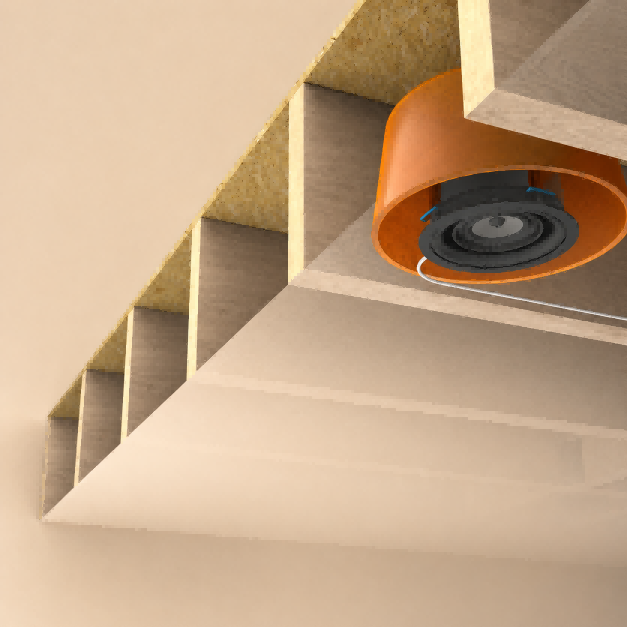
Table of Contents
The Hidden Shield: Why Premium In-Ceiling Speakers Demand Back Boxes
In-ceiling speakers naturally radiate sound waves backward into the ceiling cavity just as forcefully as they project sound forward into a room. Without a dedicated enclosure (back box), this rear acoustic energy bleeds through the floorboards into upstairs living areas and alters frequency response. Utilizing solid, fire-rated back boxes prevents sound migration, optimizes mid-bass punch, and satisfies strict structural safety codes.
The Unseen Leak: Where Half Your Sound Energy Is Going
When an architectural speaker is installed directly into open drywall without an enclosure, the rear of the speaker cone treats the entire ceiling cavity as its cabinet. This creates a dual-layered problem: structural noise pollution and unpredictable acoustic performance.
First, low and mid-frequency sound waves travel effortlessly through hollow plasterboard joists, turning the floor above into a giant vibrating sounding board. A movie played in a downstairs media room becomes an unwelcome distraction in an upstairs bedroom. Second, because ceiling cavities vary wildly in volume, insulation density, and structural layout, the exact same speaker will sound rich and punchy in one home, but thin and hollow in another. Controlling this variable requires shifting from open-cavity mounting to engineered isolation.
[Open Installation] ======> Rear Sound Waves Sound-Bleed into Upstairs Rooms & Cavities
[Back Box Shield]   ======> [Solid Metal/ABS Enclosure] Locks Sound In & Enhances Front Bass Punch
1. Acoustic Volume Control: Defining the Infinite Baffle
Speaker drivers are carefully engineered to perform optimally within a specific cubic volume of air. This air acts as an acoustic spring that cushions the speaker cone's backward stroke and controls its excursion.
By sealing the rear of the speaker chassis within a rigid, precision-molded acoustic back box (such as those integrated into premium LECOVITA architectural speaker lines), you establish a fixed, idealized acoustic enclosure. This controlled environment eliminates the randomness of the ceiling cavity. The result is a dramatically tighter, more impactful mid-bass response, crisper vocal clarity, and consistent, predictable audio quality across every single room on a project site.
2. Fire-Rated Compliance: Protecting the Structural Barrier
In commercial high-rises, multi-family residential complexes, and luxury custom homes, ceilings act as critical fire barriers designed to contain smoke and flames during an emergency. Cutting a hole in the plasterboard to mount an open-backed speaker creates a breach in that barrier.
                  [Upstairs Subfloor]
=======================================================
          |   (Ceiling Cavity / Plenum Space)   |
          |       [Rigid Fire-Rated Box]        |  <-- Restores Fire Barrier Integrity
          |     [In-Ceiling Speaker Frame]      |
=====================[Plasterboard]====================
                     [Downlight]
To maintain structural integrity, professional installations mandate Fire-Rated Back Boxes. These enclosures are constructed from heavy-gauge galvanized steel or specialized zinc-plated alloys lined with intumescent materials that expand rapidly under extreme heat. If a fire breaks out in the room below, the intumescent material seals the speaker opening completely, preventing fire, toxic gases, and heat from sweeping upward into the plenum spaces and upper floors. These boxes typically carry strict UL 1480 / ASTM E119 safety ratings to satisfy rigorous local building codes.
Structural Implementation Profiles: Open Cavity vs. Enclosed Back Box
| Performance & Safety | Open Drywall Mounting | Fire-Rated Sealed Back Box |
| Sound Bleed (Upstairs) | Severe; low frequencies migrate easily | Minimally isolated; stops acoustic bleed through floors |
| Bass Response Precision | Unpredictable; depends on cavity volume | Tight, punchy, and highly uniform |
| Building Code Compliance | Fails commercial and multi-family codes | Meets UL/ASTM fire-barrier safety standards |
| Environmental Protection | Exposed to dust, drywall debris, and pests | Fully protected internal crossover and wiring |
| Installation Stage | Cut-and-mount during trim-out phase | Pre-construction framing or integrated drop-in |
3. Dust Protection and Long-Term Component Health
Ceiling cavities are inherently hostile environments for electronics. Over time, shifting fiberglass insulation particles, drywall dust, moisture, and pests can settle directly onto the delicate copper coils of a speaker's crossover network or degrade the flexible surround of the woofer cone.
An airtight back box acts as a protective protective shield. By isolating the internal speaker components from the dirty environment inside the ceiling grid, it prevents electrical oxidation and mechanical wear, ensuring the audio system retains its premium performance profile for decades.
Expert Q&A
Q1: Can I add a back box to an existing in-ceiling speaker after the drywall is already up?
A: Yes. While rigid steel boxes are best installed during the pre-construction framing phase, many premium brands offer flexible, retrofittable acoustic enclosures made from heavy fire-resistant cloth or split-cabinet designs. These can be folded up, inserted carefully through the existing speaker cutout hole, and unfolded inside the ceiling cavity before mounting the hardware.
Q2: Does a metal back box cause the speaker to sound "tinny" or metallic?
A: No. High-quality metal back boxes are internally damped with thick acoustic foam or mineral wool lining. This acoustic absorption material eliminates high-frequency internal reflections and dampens standing waves, ensuring the enclosure remains sonically dead and does not color the speaker's natural tone.
Q3: How much sound reduction can I expect from a premium acoustic back box?
A: A well-engineered, sealed acoustic back box can reduce sound transmission into the room directly above by up to $15\text$ to $20\text$ across mid-to-high frequencies. This represents a massive perceived drop in volume, turning loud music upstairs into nothing more than a faint, unnoticeable whisper.
