
Defying the Elements: Engineering Architectural Speakers for High-Humidity and Marine Environments

About Author: Kevin Wu
Founder & Principal Audio Engineer, LECOVITA
Specialize in acoustic engineering, high-fidelity speaker and amplifier design, precision manufacturing, sonic innovation, immersive audio solutions, and premium audio system development.
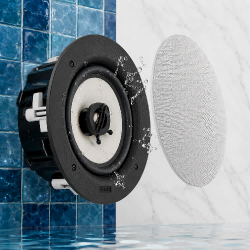
Table of Contents
Defying the Elements: Engineering Architectural Speakers for High-Humidity and Marine Environments
Standard architectural speakers quickly fail when exposed to steam, salt spray, or extreme temperature swings. True environmental resilience requires a comprehensive, marine-grade design blueprint—combining UV-stabilized ABS chassis structures, waterproof woven cones, and completely sealed internal component encapsulation to withstand continuous moisture without sacrificing acoustic linear response.
The Corrosive Reality of High-Humidity Zones
Whether designing an upscale commercial spa center, a luxury residential bathroom, an outdoor patio, or a yacht entertainment deck, integrating architectural sound presents a severe engineering hurdle: moisture-driven degradation.
Standard in-ceiling speakers rely on treated paper or basic poly cones and standard steel grilles. When placed in high-humidity or marine environments, airborne water vapor and corrosive salt ions quickly bypass basic seals. Within months, this causes voice coils to oxidize, paper cones to sag, and steel grilles to rust, resulting in total system failure. Creating lasting sound in these challenging spaces demands a dedicated, specialist engineering approach.
1. Material Innovation: The Waterproof Acoustic Core
The front face of an outdoor or bathroom speaker bears the direct brunt of moisture and temperature cycling.
To ensure long-term durability, specialized waterproof lines—such as the LECOVITA RISCW Series—replace standard materials with highly resilient alternatives. The main woofer is built using a hydrophobic, tightly woven fiberglass or specialized polypropylene cone that repels water molecules instantly. Paired with a high-grade Santoprene rubber surround, the moving assembly remains structurally stable and agile, resisting rot, mold, and humidity-induced stiffness over decades of continuous exposure.
2. Guarding the Internal Architecture
True environmental survival happens behind the ceiling line. Steam and ambient moisture often gather heavily inside ceiling cavities, directly targeting the speaker’s electronic brain: the crossover network.
An environmental specialist speaker must feature complete encapsulation protection. This means the internal crossover PCB is treated with a thick, military-grade conformal anti-corrosion coating to shield delicate solder joints from oxidation. Furthermore, the input terminal blocks are upgraded to gold-plated, spring-loaded brass hardware or completely sealed marine pigtail leads, ensuring an airtight connection that prevents moisture from wicking down the speaker wire into the voice coil gap.
Engineering Profiles: Standard vs. Marine-Grade Specialist
| Engineering Spec | Standard Architectural Speaker | Environmental Specialist (RISCW) |
| Cone Material | Treated Paper / Standard Polypropylene | Hydrophobic Woven Fiberglass / Sealed Poly |
| Grille Material | Powder-Coated Steel (Prone to rust) | Marine-Grade Aluminum / UV-Stabilized ABS |
| Crossover Protection | Bare PCB / Exposed Components | Conformal Coated PCB / Encapsulated Joints |
| Surround Material | Standard Foam or Light Rubber | Heavy-Duty Santoprene Rubber (Anti-UV) |
| Optimal Placement | Living rooms, retail floors, dry boardrooms | Yacht decks, steam rooms, pools, ocean patios |
3. The Aluminum and UV-Stabilized Chassis Solution
External components must also combat two silent killers: rust and UV discoloration.
Standard speaker grilles rust rapidly when exposed to continuous moisture. Upgrading to a premium, powder-coated marine-grade aluminum grille guarantees a rust-free aesthetic for the lifetime of the installation. Additionally, the outer bezel structure must be molded using high-impact, UV-stabilized ABS plastic. This specialized polymer prevents the outer rim from becoming brittle or yellowing under constant exposure to direct sunlight or intense commercial UV sterilization systems.
Expert Q&A
Q1: Can a waterproof speaker like the RISCW series be installed directly inside a steam room or shower stall?
A: Yes. Because the RISCW architecture is engineered with a completely sealed front boundary, hydrophobic cone, and rust-proof aluminum grille, it can easily handle the 100% relative humidity and high temperatures found inside a steam room or luxury shower enclosure, provided the rear connection is sealed appropriately during installation.
Q2: Does marine-grade waterproofing reduce the sound quality or clarity of the speaker?
A: Not when engineered properly. By utilizing premium woven fiberglass for the woofer and specialized dome tweeters, the moving mass stays incredibly light and rigid. This allows the speaker to maintain excellent transient response, wide dispersion, and crisp vocal clarity that cuts through environmental ambient noise smoothly.
Q3: How do I protect the wire connections behind the ceiling from salt-air corrosion?
A: We highly recommend using marine-grade, tinned copper speaker wire for high-humidity installations. When connecting to the speaker terminal, applying a small amount of dielectric silicone grease over the gold-plated terminals before sliding on the protective boot provides a long-lasting barrier against salt-air intrusion.
