
STIPA Testing for Commercial PA Systems: How to Improve Speech Intelligibility

About Author: Kevin Wu
Founder & Principal Audio Engineer, LECOVITA
Specialize in acoustic engineering, high-fidelity speaker and amplifier design, precision manufacturing, sonic innovation, immersive audio solutions, and premium audio system development.
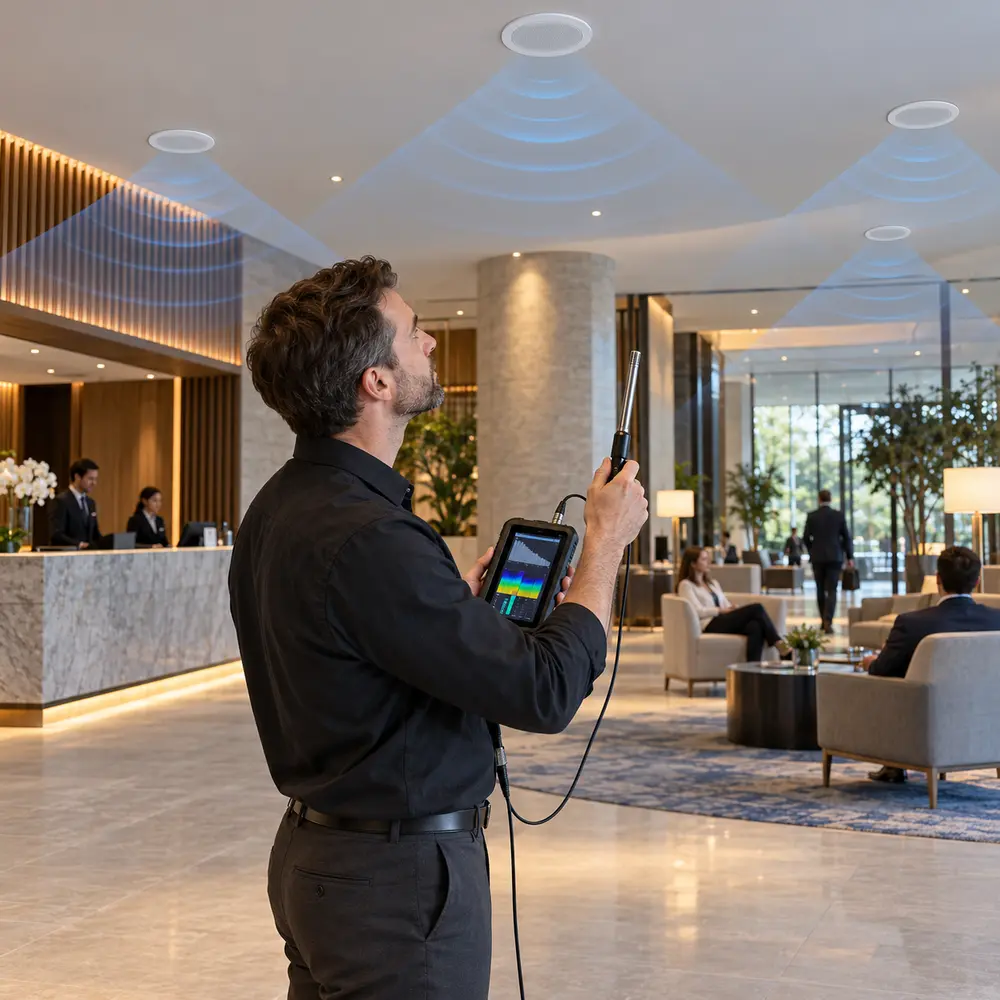
Table of Contents
STIPA Testing for Commercial PA Systems: How to Improve Speech Intelligibility
A commercial public-address system is not successful simply because every loudspeaker produces sound.
In a hotel corridor, railway station, school, shopping center or factory, listeners must be able to understand the message. If an announcement is loud but blurred by echoes, background noise or overlapping speakers, increasing the amplifier volume may make the problem worse rather than solve it.
This is why professional audio designers use the Speech Transmission Index, or STI, to assess speech intelligibility. For installed PA systems, the practical measurement method is commonly known as STIPA—Speech Transmission Index for Public Address systems.
What Is STIPA?
STIPA is an objective method for evaluating how clearly a speech-like signal travels through an audio system and reaches the listener.
The applicable international reference, IEC 60268-16:2020, defines the STI model, test signals, measurement procedures and prediction methods. The IEC also explains that the standard itself does not prescribe one universal pass value for every application; acceptance requirements must come from the relevant project specification, regulation or voice-alarm standard. webstore.iec.ch
During a STIPA test, a specially modulated test signal is reproduced through the PA system. A compatible acoustic analyzer measures how well those modulations are preserved at different listener positions.
The result is expressed on a scale from 0 to 1:
| STI result | General quality classification |
|---|---|
| 0.00–0.30 | Bad |
| 0.30–0.45 | Poor |
| 0.45–0.60 | Fair |
| 0.60–0.75 | Good |
| 0.75–1.00 | Excellent |
These categories help describe the result, but they should not be treated as universal regulatory pass limits. The required result depends on the building, system purpose, local rules and contract documents. nti-audio.com
Why Can a Loud PA System Still Be Difficult to Understand?
Speech intelligibility depends on more than sound pressure level.
The principal factors include:
- Background noise
- Reverberation time
- Early and late reflections
- Loudspeaker frequency response
- Loudspeaker directivity
- Signal-to-noise ratio
- Distortion
- Speaker spacing and delay
- Microphone and signal-processing settings
A loudspeaker can provide sufficient volume while still producing a poor STIPA result.
For example, adding more low-frequency energy may make an announcement sound powerful, but excessive bass can mask the consonants that carry much of the information in speech. Hard walls, glass surfaces and high ceilings can also produce long reflections that overlap successive words.
The Four Main Causes of Poor Speech Intelligibility
1. Excessive background noise
Crowds, HVAC equipment, machinery, traffic and other sound sources reduce the difference between the announcement and ambient noise.
Simply raising the PA level has limits. Excessive sound pressure can become uncomfortable, increase reflections and drive the amplifier or loudspeakers into distortion.
The better approach is to establish the normal background-noise conditions and design suitable coverage and headroom for the occupied space.
2. Long reverberation time
Sound continues reflecting after it leaves the loudspeaker. In highly reflective rooms, the end of one syllable can overlap the beginning of the next.
Typical problem locations include:
- Glass entrance halls
- Concrete railway platforms
- Large warehouses
- Indoor swimming pools
- Shopping centers with hard floors
- High-ceiling atriums
Possible improvements include acoustic absorption, more directional loudspeakers and shorter distances between speakers and listeners.
3. Poor loudspeaker placement
One powerful loudspeaker at the end of a long room may create high volume near the speaker and weak direct sound farther away.
A distributed system using several correctly positioned loudspeakers can reduce the required level from each unit and improve the ratio of direct sound to reverberant sound.
However, adding loudspeakers without controlling coverage can create another problem: listeners may hear the same announcement from multiple speakers at different times.
Correct spacing, orientation and delay settings are therefore essential.
4. Unsuitable frequency response or DSP settings
Speech does not require exaggerated low-frequency output. A voice-paging system should prioritize natural midrange reproduction and controlled coverage.
Poor results can be caused by:
- Excessive bass boost
- Incorrect equalization
- Aggressive compression
- Signal clipping
- Unstable automatic gain control
- Incorrect delay settings
- Low-quality microphones
- Loudspeakers with insufficient midrange clarity
DSP can improve a properly designed system, but it cannot fully correct unsuitable speaker locations or severe room-acoustic problems.
How Is a STIPA Test Performed?
A practical commissioning procedure normally includes the following steps.
Step 1: Confirm the applicable acceptance criteria
Before measuring, identify the project specification and applicable local standard.
IEC 60268-16 explains how STI is determined, but it does not establish a universal certification requirement for every PA or voice-alarm installation. webstore.iec.ch
Step 2: Establish representative operating conditions
Background noise should be evaluated under realistic conditions. An empty shopping center at midnight may be much quieter than the same building during business hours.
If occupied testing is impractical, ambient-noise measurements may be recorded separately and incorporated into the analysis using suitable equipment and procedures.
Step 3: Feed the STIPA signal into the system
For systems using an announcement microphone, the acoustic test source may be positioned in front of the microphone so that the complete signal chain is evaluated:
Test source → microphone → DSP/mixer → amplifier → speaker → room → measurement microphone
If the test signal is connected directly to a line input, the microphone and its acoustic environment are excluded from the measurement. The selected method should therefore match what the project intends to verify.
Step 4: Measure representative listener positions
Measurements should be taken where people will actually hear announcements, including:
- Front, middle and rear areas
- Room corners
- Locations below or between speakers
- Noisy entrances
- Areas behind structural obstructions
- Upper and lower floors in atriums
- Accessible circulation routes
One measurement directly below a loudspeaker cannot represent an entire building.
Step 5: Record and investigate the results
STIPA equipment measures a standardized signal and expresses the result as a single STI value. Portable STIPA measurements typically analyze the signal over approximately 15 seconds, although repeated measurements and proper documentation are important for reliable commissioning. nti-audio.com
Low-performing locations should be investigated individually rather than corrected with one global volume increase.
How Speaker Selection Affects STIPA Performance
Controlled dispersion
A loudspeaker with appropriate dispersion directs more useful sound toward listeners and less energy toward reflective ceilings and walls.
A wider dispersion pattern may reduce the number of speakers required in a low-ceiling room. In a large reflective space, more controlled coverage may provide better intelligibility.
Consistent midrange response
Voice paging relies heavily on clean and even midrange reproduction. The system should reproduce speech without severe peaks, gaps or unnecessary bass emphasis.
Adequate sensitivity and headroom
A speaker must produce the required level without excessive distortion. However, higher sensitivity alone does not guarantee better intelligibility; coverage and room interaction remain critical.
Suitable installation format
Different spaces may require different products:
- Ceiling speakers for rooms and corridors
- Wall-mounted speakers for directional coverage
- Column speakers for reverberant halls
- Horn speakers for outdoor or high-noise areas
- Weather-resistant speakers for transport and exterior zones
Product selection should follow the acoustic and environmental requirements rather than appearance alone.
STIPA Design Example: Hotel Corridor
Consider a long hotel corridor with a ceiling speaker every 12 meters. Guests near each speaker hear a loud announcement, while those between speakers hear more reflected than direct sound.
Possible corrective actions include:
- Reduce the spacing between speakers.
- Use more speakers at a lower individual level.
- Select models with suitable dispersion.
- Check polarity and transformer-tap settings.
- Balance the output of adjacent zones.
- Re-test at room doors and midpoint locations.
For a 70V/100V system, transformer taps must also be selected so that total connected load remains within the amplifier’s rated output, with suitable system headroom.
Common STIPA Testing Mistakes
Avoid these frequent commissioning errors:
- Testing only one favorable location
- Measuring an empty venue without considering occupied noise
- Using normal music instead of the standardized test signal
- Increasing every speaker tap to maximum
- Ignoring amplifier clipping
- Measuring too close to a loudspeaker
- Changing equalization without recording the original settings
- Assuming every building requires the same STI value
- Treating STIPA as a substitute for electrical and safety testing
STIPA evaluates speech transmission performance. It does not by itself verify electrical safety, loudspeaker-line supervision, fire resistance or regulatory conformity.
Designing for Intelligibility From the Beginning
The lowest-cost time to improve speech intelligibility is during system design, before the cables and loudspeakers are installed.
The design team should review:
- Expected background-noise level
- Room dimensions and surface materials
- Loudspeaker coverage angles
- Speaker mounting height
- Required zoning
- Amplifier power and headroom
- Transformer-tap schedule
- DSP and delay requirements
- Representative STIPA measurement locations
- Applicable acceptance criteria
For projects using commercial ceiling speakers, speaker dispersion and spacing should be considered together. Projects requiring directional wall coverage can also evaluate a purpose-designed commercial paging wall speaker.
Large installations may require a multi-zone mixing amplifier so that levels and announcements can be managed for different acoustic areas.
Conclusion
Speech intelligibility cannot be confirmed by volume settings or listening from one convenient location.
STIPA provides a repeatable way to evaluate the complete path from the announcement source through the amplifier, loudspeakers and room to the listener. When results are poor, the solution may involve speaker placement, controlled dispersion, acoustic treatment, DSP adjustment or better management of ambient noise.
For commercial audio manufacturers and system integrators, designing around intelligibility—not only amplifier power—is essential for dependable paging and announcement systems.
Frequently Asked Questions
What does STIPA mean?
STIPA means Speech Transmission Index for Public Address systems. It is a practical method used to measure speech intelligibility through an installed PA system.
Is a higher STI value always better?
Yes, a higher value generally indicates better intelligibility. However, the required result must be determined by the project specification and applicable local standards.
Can a smartphone measure STIPA accurately?
A phone application may be useful for preliminary acoustic observations, but formal testing should use appropriate calibrated equipment and the prescribed test method.
Does increasing amplifier power improve STIPA?
Only when insufficient level is the actual problem. More power will not solve excessive reverberation, overlapping coverage or unsuitable loudspeaker placement.
Should STIPA be measured when the building is occupied?
Real operating noise must be considered. Depending on the procedure, noise may be measured during occupancy and applied to measurements taken under controlled conditions.
Is STIPA testing required for every background-music system?
Not necessarily. Requirements depend on the system purpose, contract and local regulations. It becomes especially important where clear announcements or emergency instructions are required.
