
How to Choose the Right Ceiling Speakers for Your Home: Size, Power, and Connectivity

About Author: Kevin Wu
Founder & Principal Audio Engineer, LECOVITA
Specialize in acoustic engineering, high-fidelity speaker and amplifier design, precision manufacturing, sonic innovation, immersive audio solutions, and premium audio system development.
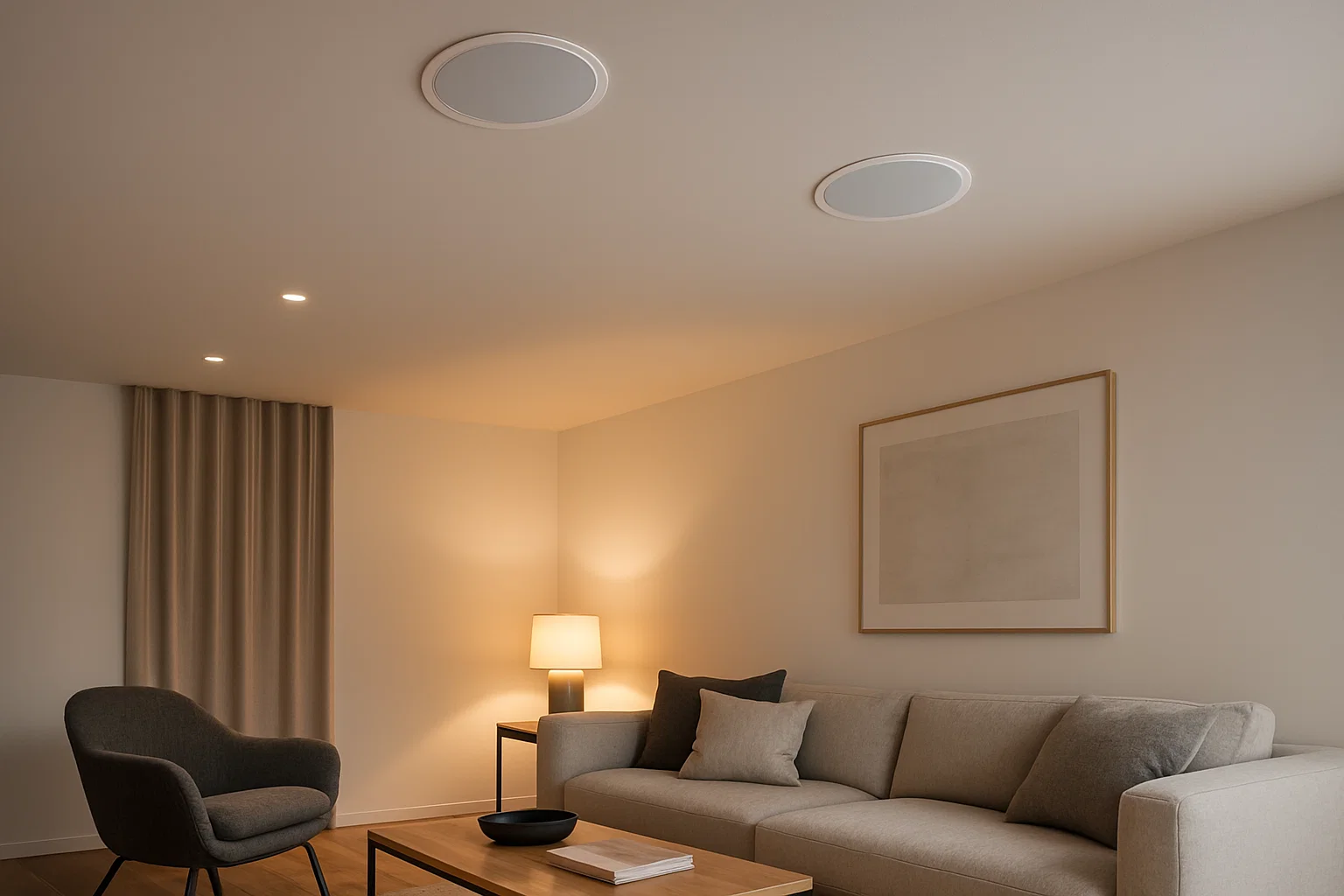
Table of Contents
- Introduction
- Speaker Size: Getting the Dimensions Right
- Power Handling: Ensuring Adequate Power and Performance
- Connectivity Options: Wired vs Wireless Ceiling Speakers
- Installation and Placement Guidance
- Expert Advice and Best Practices
- Real Use Cases and Scenarios
- Comparing Ceiling Speaker Options (Product Comparison)
- Why Choose LECOVITA for Your Home Ceiling Speakers
- Conclusion and Call to Action
Introduction
-
Ceiling Speakers for Immersive Home Audio: Ceiling speakers are a discreet, long-term audio solution that can fill your room with sound for decades. They mount flush in the ceiling, saving space and keeping your decor clutter-free while delivering quality background music or even party-level audio.
-
Who This Guide Is For: This outline targets global beginners and entry-level consumers seeking cost-effective in-ceiling speaker solutions. It will walk you through the basics without heavy technical jargon, ensuring you make an informed choice for your home audio needs.
-
LECOVITA’s Expertise: As a professional home speaker system manufacturer, LECOVITA brings industry expertise to help you choose wisely. With years of experience and a range of in-ceiling and wall speaker products, LECOVITA understands how to match speaker size, power, and connectivity to different rooms and budgets. You can trust advice backed by engineering know-how and a commitment to customer satisfaction (aligning with Google’s E-E-A-T guidelines for experience, expertise, authority, and trustworthiness).
-
What You’ll Learn: This guide covers the three main criteria for choosing ceiling speakers – speaker size, power handling, and connectivity options – and includes expert tips, product comparisons, real-life use cases, and installation guidance. By the end, you’ll know exactly how to pick the right ceiling speakers for your home and how LECOVITA can support your audio journey.
Speaker Size: Getting the Dimensions Right
Common Ceiling Speaker Sizes
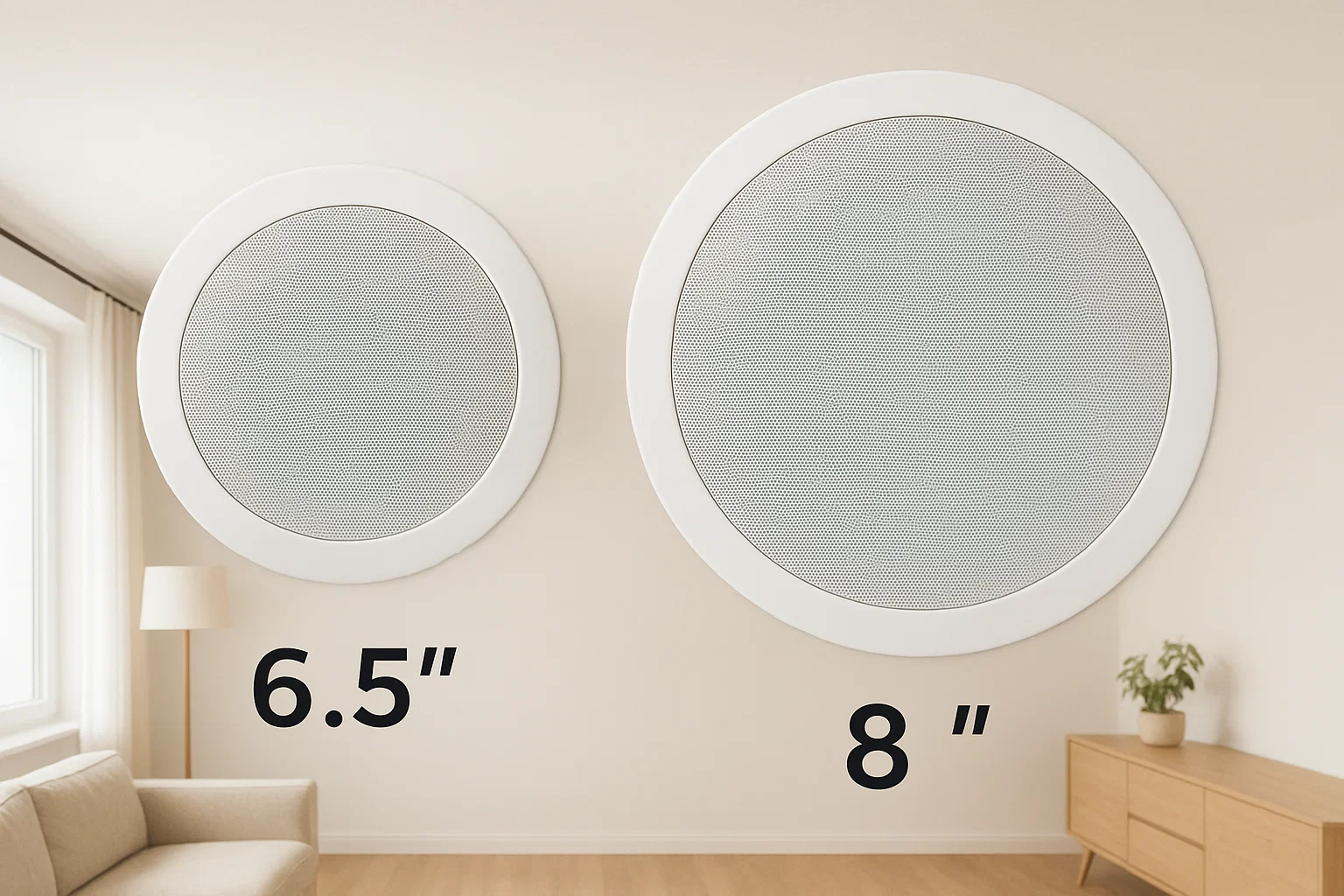
Standard Sizes (6.5-inch vs 8-inch): The most common in-ceiling speaker diameters are 6.5″ and 8″. The measurement refers to the woofer cone size, not the grill’s total width. A 6.5-inch speaker is versatile for small to medium rooms, offering clear mids and highs with moderate bass output. Upgrading to an 8-inch driver yields significantly deeper bass and broader sound dispersion, as the larger cone pushes more air and carries sound further. In short, 6.5″ speakers are great all-rounders for most rooms, while 8″ speakers excel in bass and volume for bigger areas.
Impact on Sound: Larger drivers generally produce more low-frequency response and can fill larger spaces with sound. Smaller drivers have limited bass but can sound very precise in smaller areas. Keep in mind that an 8-inch speaker will be more visually noticeable on your ceiling than a 6.5-inch, so there’s a trade-off between audio performance and aesthetics. Extremely small speakers (e.g., 3-inch micro speakers) exist for special cases where you want them to blend in with ceiling lights, but they provide only modest sound due to their size.
Ceiling Speaker Depth: Size isn’t just about diameter – depth matters too. Ensure your ceiling has enough clearance for the speaker’s mounting depth. Standard speakers might need 100–160mm of space, whereas ultra-slim models can fit into shallow ceilings (often at higher cost). If you have tight ceiling cavities (say, in older homes or concrete ceilings), look for “slim” in-ceiling models designed for those conditions. Otherwise, a full-depth speaker usually provides better bass and overall performance.
Matching Speaker Size to Room Size
Room Dimensions and Ceiling Height: Fit the speaker to your room’s size. In a small room (e.g. a bedroom or home office), a 6.5-inch ceiling speaker can typically deliver ample volume and clarity. For large rooms or open-plan areas, 8-inch speakers (or multiple speakers) might be necessary so sound reaches all corners without sounding faint. High ceilings also affect sound — with very tall ceilings, sound can dissipate; larger 8″ speakers or specialty angled speakers help maintain clarity and presence in those cases.
Coverage Area: Manufacturers often give rough guides for speaker coverage. As an example guideline, one pair of ceiling speakers (stereo left/right) is often sufficient for rooms up to around 3m x 3m, providing balanced stereo sound. For bigger rooms (around 5m x 5m or more), using two pairs (4 speakers in total) can ensure more even, room-filling sound. Essentially, larger spaces benefit from either larger speakers or additional speaker units spread out to avoid “dead spots” in audio coverage.
Use Case Considerations: Think about how you’ll use the room. If it’s for ambient background music in a small area, smaller speakers or even a single stereo-input speaker might do the job. If it’s a home theater or entertaining area, lean towards larger speakers or multiple speakers for dynamic, immersive sound. Also, in rooms where placement is constrained (like a small kitchen or bathroom), a single dual-tweeter stereo speaker can save space and still deliver both left and right channels from one unit. Just remember, for primary living spaces or where you’ll listen critically, bigger or multiple speakers will enhance sound quality and volume.
Number of Speakers and Coverage
Determining Quantity: The number of ceiling speakers needed ties closely to room size and desired volume. As mentioned, one pair generally handles a small to medium room well. For large rectangular rooms, you might place two pairs – one pair towards each end of the space – to maintain even sound levels. Always aim for balanced coverage: speakers should ideally be spaced out such that their sound fields overlap slightly for consistency. For instance, two speakers placed roughly an equal distance apart and from the walls can cover a standard living room with stereo sound.
Stereo vs. Mono Setup: Remember that ceiling speakers usually come as mono units (each speaker is one channel). So you typically install them in pairs for stereo. In very small rooms (under ~3x3m), if you only install one physical speaker, consider a single-stereo ceiling speaker (with dual tweeters for left/right in one body) to avoid losing one channel of audio. In larger rooms or any space where you install an even number of speakers, you’ll pair them into left-right sets for true stereo imaging across the room.
Even Distribution: Plan your layout for uniform sound. Avoid clustering all speakers in one part of the ceiling. If using four speakers (two pairs) in a big area, a common approach is to space them roughly in a square layout. Also, maintain a reasonable distance between any speaker and the adjacent walls (e.g., at least 2 meters away from walls, if possible) for better distribution. This avoids strong reflections and boomy bass build-up near corners. By thoughtfully choosing both the right size and number of speakers, you ensure that your entire room gets an enjoyable listening experience without overly loud or quiet spots.
Power Handling: Ensuring Adequate Power and Performance
Understanding Speaker Wattage and Ratings
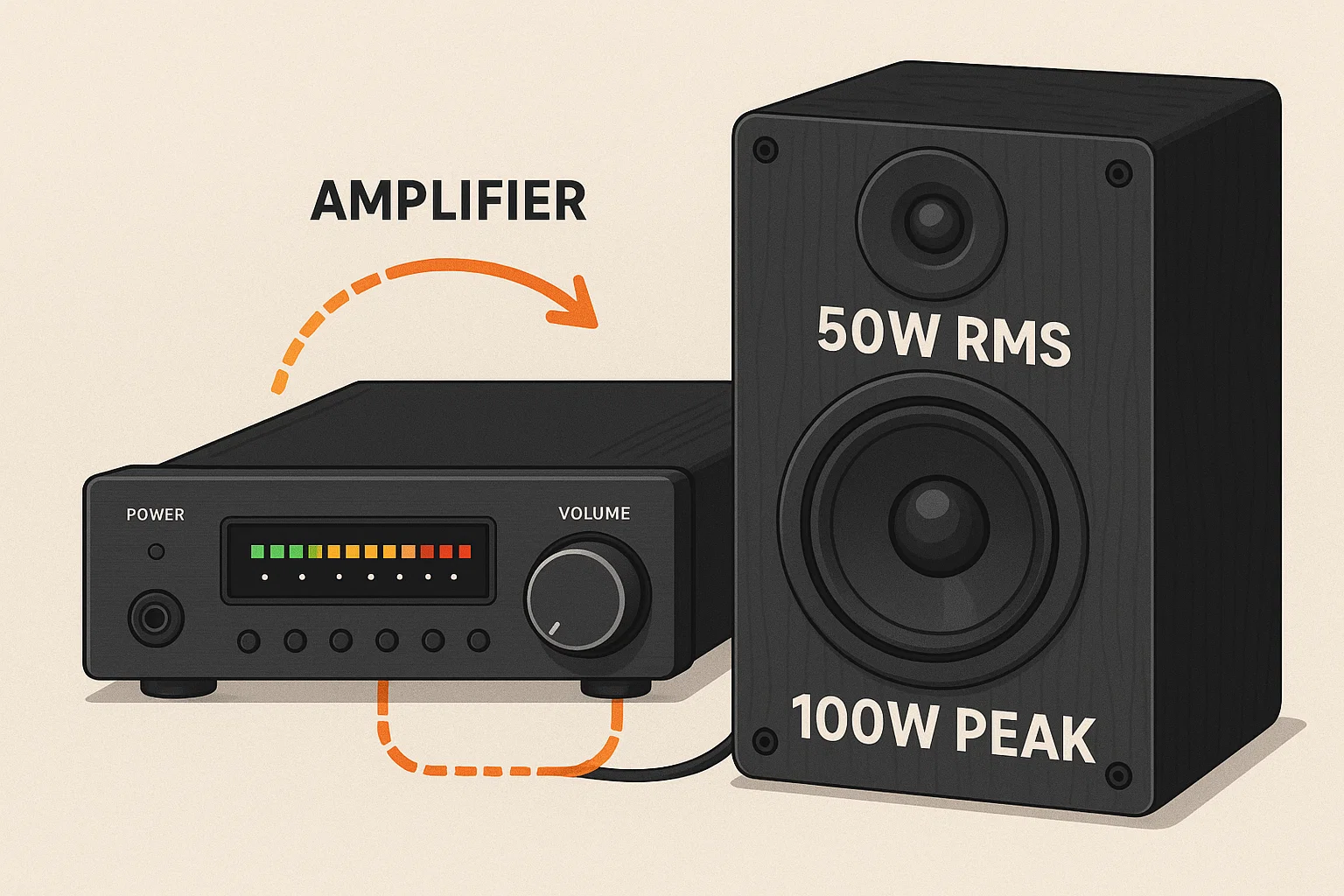
RMS vs. Peak Power: Ceiling speakers (like all speakers) have power ratings. RMS (continuous) power is the wattage the speaker can handle continuously, while peak (or max) power is the short-term burst it can tolerate. For example, a speaker might be rated 50W RMS / 100W peak, meaning it plays safely at 50W all day but can handle peaks up to 100W occasionally. When choosing speakers, match them to your amplifier’s output: the amp’s continuous power per channel should be in the same range as the speaker’s RMS rating for optimal performance.
Amp Headroom: It’s actually wise to have an amplifier that’s slightly more powerful than what the speakers require – this provides headroom so you’re not always pushing the amp to its limits. A common rule of thumb is to pick an amp that can deliver about ~2x the speaker’s RMS power for clean, undistorted sound. For instance, if your ceiling speaker is 50W RMS, an amplifier that gives ~100W per channel ensures it can drive the speaker without strain. (This doesn’t mean you’ll run 100W into it constantly, just that the amp won’t clip or distort on peaks.) Remember, doubling the wattage only yields a small ~3 dB volume increase, so it’s more about clarity than loudness.
Power Handling vs Room Size: Don’t assume you need extremely high wattage speakers for a home environment. In a small room, a 30-60W RMS speaker can be plenty loud. Larger rooms or home theaters might use speakers 80W RMS and up, especially if you want cinema-level volumes. However, higher power handling often correlates with better build quality (and price). It’s a balance: you want enough power so your speakers aren’t overtaxed at the volume you enjoy, but you don’t need to overspend on wattage you’ll never fully utilize. Consider how loud you like to play music and choose accordingly.
Sensitivity and Loudness
Speaker Sensitivity Explained: Sensitivity is measured in dB (decibels) and indicates how loud a speaker plays for a given input (usually measured as dB at 1 watt of power, 1 meter away). For example, a sensitivity of 88 dB means at 1W it produces 88 dB of sound. A higher sensitivity (say 90 dB) will sound slightly louder than a lower one (85 dB) with the same amp power. High sensitivity is beneficial if you have a lower-powered amp or want maximum volume – the speaker will deliver more sound per watt.
Loudness Needs: For casual listening in a small space, sensitivity might not be critical; but for large areas or if you desire high volumes (like during parties or for home theater explosions), look for speakers with sensitivity in the high 80s or 90s dB. This can reduce the strain on your amplifier because the speakers are inherently efficient. For instance, going from an 85 dB to a 91 dB sensitivity speaker is roughly like doubling your amplifier power in terms of resulting volume (every 3 dB increase ~requires double power, or conversely yields more loudness for the same power).
Balancing with Power: It’s important to consider sensitivity together with power handling. A speaker with moderate power handling but high sensitivity can often get louder than a high wattage speaker with poor sensitivity. Beginners need not obsess over the exact numbers, but checking this spec can help ensure your chosen speaker will meet your loudness expectations without an oversized amp. If in doubt, LECOVITA’s experts can advise on the optimal combination of speaker sensitivity and amplifier power for your room size and listening habits.
Impedance and Amplifier Compatibility
Ohms and Wiring: Most home ceiling speakers are rated at 8 ohms impedance, which is compatible with virtually all home amplifiers and receivers. Impedance matters when connecting speakers to an amp – you must stay within the amp’s supported range (commonly 6–8Ω for home audio). If you wire multiple ceiling speakers to one amplifier channel (for example, two speakers on one output), the combined impedance changes. Two 8Ω speakers in parallel result in 4Ω load, which many amps can’t handle well unless they’re 4Ω stable. So plan to either use the proper number of amplifier channels or wire speakers in series/parallel carefully to avoid dipping below safe impedance.
Matching Amp and Speakers: Always check that your amplifier is rated for the impedance of your speakers and the way you intend to connect them. If you have multiple speakers in one room driven by the same channel (common in 70V commercial systems or some multi-room setups), you may use special 70V/100V ceiling speakers with transformers or an impedance-matching volume control. However, for a home setup with standard 8Ω speakers, the simplest approach is usually one speaker per amplifier channel (or one stereo pair per stereo amp). If you want to put four speakers in one large room, consider a 4-channel amp or a stereo amp that supports A/B speaker switching without dropping impedance too low.
Avoiding Power Loss or Damage: Using an amp outside its impedance spec can cause it to overheat or shut down. Conversely, if total speaker impedance is too high (e.g., wiring in series), the speakers will receive less power than expected. The goal is to hit the “sweet spot” – for most, that means sticking to 8Ω speakers with a decent amp. Fortunately, many home audio amps support 6–8Ω loads easily. When in doubt, consult with an audio professional or the speaker manufacturer (e.g., LECOVITA’s support) to design a safe and optimal system.
Connectivity Options: Wired vs Wireless Ceiling Speakers
Traditional Wired Ceiling Speakers (Passive Systems)
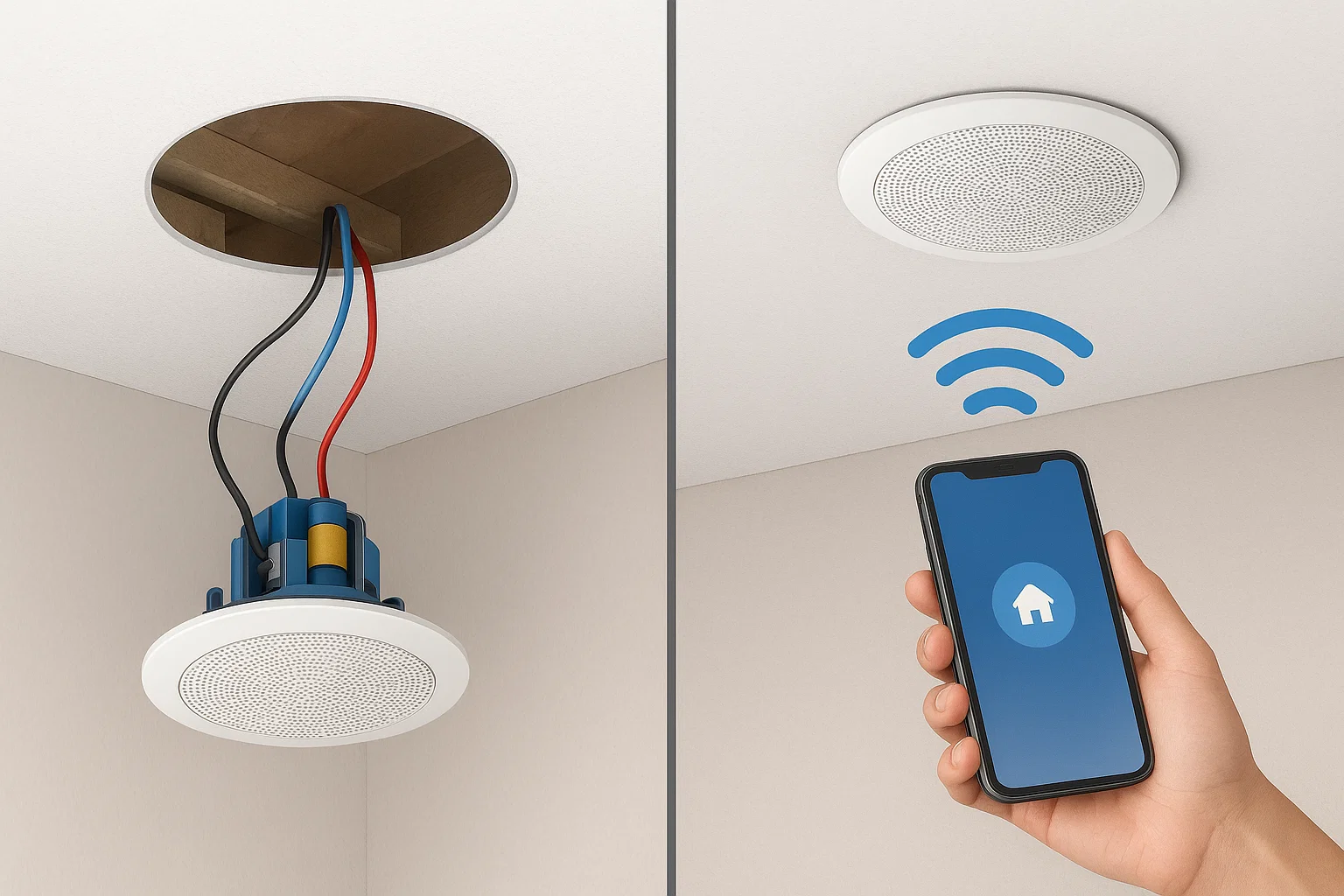
Passive Speakers with Amplifier: The majority of ceiling speakers on the market are passive, meaning they have no built-in power source. They must be connected via speaker cables to an external amplifier or A/V receiver which provides the power. In a wired setup, you’ll run speaker wires through your walls or ceiling from the amp to each speaker location. All your music sources (TV, phone, streaming, etc.) connect to the amplifier, which then sends audio signals over those wires to the ceiling speakers.
Pros of Wired Systems: Wired connections are very reliable – there’s no signal interference or latency, and sound quality is consistently high since the analog cable carries the full audio without compression. You’re also not limited by wireless range; as long as the wire is connected, the speaker works. Additionally, passive speakers tend to be more affordable individually than active wireless ones (since they lack electronics inside), making them cost-effective for multi-room setups when paired with a decent centralized amp.
Considerations: The main drawbacks are the installation effort and planning required. You’ll likely need to fish wires through ceilings and walls, which can be challenging for a DIY beginner (though manageable with some tools and attic access). It’s often easiest to do during renovations or new construction. If running wires isn’t feasible, you’ll want to look at wireless options. Also, remember that each passive speaker needs a corresponding amplifier channel. For example, a 4-speaker setup (in stereo pairs) requires at least a 2-channel stereo amp with A/B outputs or a 4-channel amp to drive them properly.
Wireless and Active Ceiling Speakers
Built-in Amplifier Solutions: In recent years, active ceiling speakers have appeared, integrating an amplifier and wireless receiver directly into the speaker unit. These units only need a standard power source (mains electricity) to operate – no separate speaker wire back to a central amp is required. For instance, products like Lithe Audio’s Wi-Fi or Bluetooth ceiling speakers are all-in-one: they contain an amplifier and either a Bluetooth or Wi-Fi module. You simply run a power cable to them (which can tie into a lighting circuit or outlet), and they’ll receive audio signals wirelessly from your phone or network.
Bluetooth Ceiling Speakers: These connect directly to your phone/tablet via Bluetooth. They’re generally easy to set up (pair your device and play) and good for a single room or small zone. However, Bluetooth has limitations – range is usually ~10 meters and it’s one-to-one (one source to one speaker/pair at a time). If you leave the room with your phone, the signal might drop. Bluetooth is best for simple setups or bathrooms/kitchens where you just want quick music without installing an amp.
Wi-Fi / Multi-Room Ceiling Speakers: Wi-Fi enabled ceiling speakers (or those that work over your home network) allow more advanced features. They can integrate into multi-room audio systems, use apps, and even support voice assistants or casting protocols (like AirPlay 2 or Chromecast)litheaudio.com. Pros: Wi-Fi speakers don’t suffer from the short range of Bluetooth and can be grouped for synchronized multi-room playback. You could, for example, have one in each room and play the same music house-wide, or different music in each zone, all controlled from your phone or voice commands. They often support higher audio quality streaming and can connect directly to online services over the network. Cons: They are more expensive and still require running AC power to each unit (which might involve an electrician if you’re not comfortable wiring to the mains). Also, they rely on your home Wi-Fi network stability.
Passive vs Active – Trade-offs: To summarize, passive wired speakers + a central amp give you tried-and-true performance and potentially lower cost for multiple speakers, at the expense of installation work and less direct app control (unless your amp is a smart amp). Active wireless speakers simplify installation (no long speaker wires, just local power) and offer modern streaming conveniences, but cost more per speaker and can be harder to retrofit in a finished ceiling if no power is available nearby. Many entry-level users opt for passive speakers with a user-friendly amp (like a Sonos Amp or a small Bluetooth-enabled amplifier) as a middle ground – you still run wires, but you get app control of music. Speaking of which, a device like the Sonos Amp is a popular choice to drive ceiling speakers, combining amplification with streaming capabilities and easy control for multiple rooms.
Integration with Home Audio Systems
Multi-Room Audio Setup: If you plan to have music in several rooms, consider how your ceiling speakers will tie together. One approach is using a multi-channel amplifier or a network of amps (one per area) that you link via a system like Sonos, Denon HEOS, or other multi-room platforms. For example, the Sonos Amp (or similar) can power a pair of ceiling speakers and connect to your Wi-Fi, letting you group it with other units in different rooms for synchronized playback. LECOVITA’s range of amplifiers and controllers can similarly be used to create zones and manage audio throughout your home with a unified control interface.
Home Theater Integration: Ceiling speakers are often used as surround speakers or Atmos height speakers in home theater setups. Ensure the connectivity matches your AV receiver – most AV receivers easily drive passive ceiling speakers for surround channels. If using active wireless speakers in a home theater, latency can be an issue (audio delay), so generally wired is preferred for TV/movie use to keep everything in sync. Plan wiring from your receiver to the ceiling positions for clean installation of surround speakers.
Smart Home and Voice Control: Many modern systems allow you to incorporate voice assistants or smart home routines. While a passive speaker itself isn’t “smart,” the amplifier can be (for instance, using an Echo Dot to control a smart amp). Some wireless ceiling speakers support voice control through integrations. If this is important to you, look at the compatibility of the speakers/amplifiers with Alexa, Google Assistant, or Apple HomeKit. For example, certain amplifiers can be triggered by Alexa to play in specific zones (via skills or routines). Planning connectivity with future upgrades in mind will ensure your ceiling speakers aren’t an isolated system but rather part of your connected home ecosystem.
Installation and Placement Guidance
Placement for Optimal Sound
Even Coverage: Proper placement is key to getting the best sound. Ideally, ceiling speakers should be installed at points where they can disperse sound evenly across the listening area. In a rectangular room with two speakers, this often means each speaker is roughly the same distance from the adjacent walls and from each other (forming a balanced triangle or rectangle relative to the listeners). This symmetry helps create a cohesive stereo image and avoids one side of the room being louder. For four speakers, imagine dividing the ceiling into quadrants with a speaker towards the center of each quadrant.
Avoid Obstructions: Be mindful of what’s above the ceiling. Large light fixtures, fans, or ductwork can interfere with placement. Also, try not to mount speakers too close to corners, as corners can cause boomy bass and uneven sound reflections. If possible, keep at least 2 feet (60cm) away from corners. If your room’s layout is irregular or open-concept, you might opt for ceiling speakers with pivoting tweeters or even angled baffles so you can direct sound toward the listening area. This is especially useful in L-shaped spaces or rooms where ideal symmetrical placement isn’t possible.
Height and Acoustics: Standard 8–10 foot ceiling heights pose no issues for most in-ceiling speakers. If you have vaulted or high ceilings, placing speakers might result in sound being further from the listeners; in such cases, consider models specifically designed for high ceilings (some speakers can be angled or have wider dispersion). Also, note that very reverberant rooms (lots of hard surfaces) might cause the sound to bounce around. Placement won’t fully cure that, but you can angle tweeters or use acoustic panels/rugs in the room to improve clarity.
DIY Installation Tips
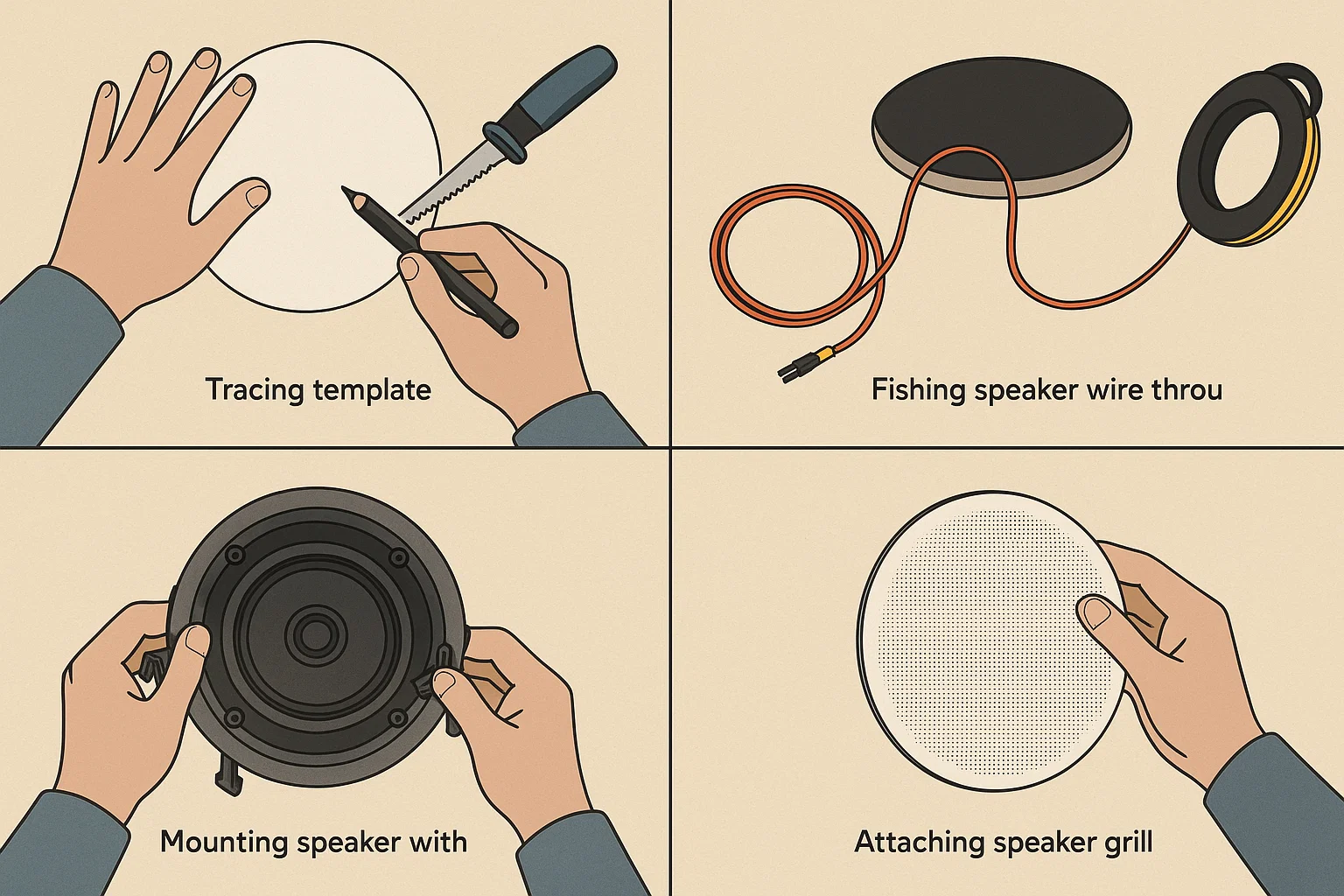
Preparation: Installing ceiling speakers can be a DIY project if you’re comfortable cutting into drywall and running wires. Start with a template – almost all in-ceiling speakers come with a cardboard or paper cut-out template. Use painter’s tape to fix the template on the ceiling where you want the speaker, and trace the circle. Before cutting, check above the ceiling! Use a stud finder or cut a small pilot hole to ensure you won’t hit a joist, electrical wiring, or plumbing. Clear insulation away in that spot if present (wear gloves and mask for fiberglass insulation).
Cutting and Wiring: Use a drywall saw or rotary tool to cut the hole along your traced line. Go slow to keep it neat. Once the hole is cut, run the speaker cable from your amplifier location to this hole. This may involve fishing the wire through wall studs or across the attic. If you’re not in a renovation phase, it can be tricky – you might need to snake wires through limited spaces. Consider hiring a professional if running new wires is beyond your comfort level. If doing it, use fish tape and try to utilize any existing conduit or run alongside electrical lines (while keeping some distance to avoid interference). Use CL2 or CL3 rated in-wall speaker cable for safety. 16-gauge two-conductor cable (16/2) is standard and works for most installs up to ~25m runs. For longer runs, or if driving many speakers, 14-gauge might be better.
Mounting the Speakers: Most ceiling speakers use dog-leg clamps that flip out and tighten against the drywall. After connecting the speaker wire to the speaker’s terminals (ensure + on amp to + on speaker, – to – for proper phase), carefully insert the speaker into the cut-out. Tighten the screws which engage the clamps – don’t over-tighten to avoid cracking the drywall, just snug enough to secure. Attach the grill (many grills are magnetic or snap-in). Pro Tip: If the speaker grills are paintable and you want them to match your ceiling, paint them before installing (and follow manufacturer guidelines – usually spray painting the grill lightly to not clog holes, and never paint the drivers).
Safety and Building Codes: If you’re cutting into a fire-rated ceiling (like one that’s part of a separation between apartments or floors), you may need to use fire hoods over the speakers to maintain fire protection. These are covers that go above the speaker in the ceiling space. Also, always turn off power when working near any electrical lines and comply with local electrical codes if tapping into a power source for active speakers. When in doubt, consult a licensed electrician or installer.
When to Seek Professional Help
Complex Setups: If your plan involves more than a straightforward two-speaker install – for example, a whole-home audio system with multiple zones, a surround sound configuration with many speakers, or integration with a 70V commercial-style system – a professional installer or audio consultant can be invaluable. They will ensure proper wiring, impedance matching (if multiple speakers per channel), and optimal placement. They can also help with tricky tasks like fishing wires through insulated or obstructed walls and ceilings, or installing in-ceiling speakers in multi-story homes where there’s limited access.
Ensuring Performance: Professional installers bring measurement tools and expertise to fine-tune the speaker placement and aim (especially for advanced setups or high-end speakers). They can also calibrate your amplifier or AV receiver settings (such as channel levels, equalization, and delay) to suit the room. This can significantly improve sound quality – your ceiling speakers will blend seamlessly into your environment with balanced volume and tone. As Totem Acoustic notes, consulting with a professional can ensure optimal placement and phase alignment of speakers for the best performance.
Time and Convenience: If you’re short on time or unsure about cutting into your ceiling, getting a professional avoids potential costly mistakes (like a misplaced hole or damaged wires). They’ll also usually handle cleanup, patching small issues, and guarantee their work. Many audio specialists or electricians can do in-ceiling speaker installs relatively quickly with the right tools. In summary, DIY is great for the budget-savvy and handy, but there’s no shame in hiring help to get the perfect result, especially for your primary living spaces or if the installation looks challenging.
Expert Advice and Best Practices
Prioritize Key Rooms: Not all rooms need top-of-the-line speakers. Expert tip: focus your budget on rooms where you’ll use the audio most (living room, media room, etc.) – those should get the more powerful or higher-quality speakers, whereas bedrooms, bathrooms or occasional-use areas can use smaller or more economical models. This way, you allocate resources efficiently and still get great sound where it matters most.
Match Speakers to Usage: An experienced installer would ask how you plan to use each space. Are you looking for cinematic surround sound in a family room? Or gentle background music in an office or kitchen? Tailor the speaker choice accordingly. For instance, you might use 8″ speakers with wide frequency response for the TV room (so even movie dialogues and bass are clear), but 6.5″ basic speakers in the study just for soft music while working. Using appropriate speakers for each zone is both cost-effective and performance-savvy.
Avoid Common Pitfalls: One common mistake is under-powering speakers with a weak amp – this can lead to distortion or flat sound. Ensure your amplifier is up to the task (if unsure, remember the Rule: Amp ~1.5-2x speaker’s RMS power for clarity). Another pitfall is spacing speakers too far apart in an attempt to cover a large area with just two units; this can create “holes” in the sound. It’s often better to add an extra pair rather than pushing two speakers beyond their comfortable coverage angle. Also, don’t mix vastly different speaker models in the same area (e.g., one cheap speaker and one high-end speaker in a stereo pair) – it will sound imbalanced. Maintain consistency in each room.
Product Quality and Ratings: When comparing options, look at build quality (materials like Kevlar or polypropylene woofers, titanium or silk dome tweeters, etc., can indicate performance and durability). Check if the speaker has any certifications like UL-rated for fire safety or IP-rated for moisture if installing in a bathroom or porch. Reading user reviews or expert reviews can provide insight; for example, whether a manufacturer’s stated frequency response holds true in real rooms, or if there are any known installation quirks.
Future-Proofing: It’s easier to install wiring and possibly extra speakers while you’re doing the work than to add later. So if you think you might want 4 speakers in the open-plan area eventually, but start with 2, maybe pre-wire for 4. Likewise, consider running conduit or at least leaving some slack in cables for potential changes. If you plan to upgrade to a more advanced system (like adding a subwoofer or switching to a different multi-room system), try to choose speakers that would still be compatible (standard passive speakers are quite future-proof in this regard). In essence, think a step ahead – your needs might grow, and a true expert plans for tomorrow as well as today.
Real Use Cases and Scenarios
(This section will provide practical examples to illustrate how to choose ceiling speakers for specific situations, making the advice more concrete.)
Use Case 1: Small Room or Apartment Setup
-
Scenario: You live in a moderate-sized apartment with a cozy living room (~12–15 square meters). You want a simple, affordable audio upgrade for background music and occasional movie nights, without cluttering the space.
-
Solution: A pair of 6.5-inch ceiling speakers installed in the living room can be ideal. They are compact yet provide sufficient sound for the space. You pair them with a small stereo amplifier (perhaps a compact Bluetooth-enabled amp for convenience). This setup remains budget-friendly – you avoid paying for features or power you don’t need. The speakers are placed roughly at either end of the main seating area to spread sound evenly.
-
Why This Works: The 6.5″ speakers have good midrange clarity at low to moderate volumes, perfect for background listening. They won’t overwhelm your neighbors with excessive bass, and they’re easier to fit in a shallow ceiling (common in apartments) than larger models. If you’re renting and can’t run extensive wiring, you might choose a wireless active model instead – for example, two Bluetooth ceiling speakers that only need a power connection from the lighting circuit. This way, installation is minimal. You get an unobtrusive audio system that transforms your small room without a hefty price tag.
Use Case 2: Large Living Room / Home Theater
-
Scenario: You have a larger living room or an open-concept family area that also serves as a home theater. Let’s say it’s a 25–30 square meter space with a mix of uses (TV, music, entertaining guests). You want a more immersive sound experience, including clear dialog for movies and rich music playback for gatherings.
-
Solution: Here you might opt for multiple 8-inch ceiling speakers. For instance, two speakers positioned towards the front (near the TV area) and two towards the rear of the seating area, creating a surround-sound-like spread for movies and uniform background music coverage for parties. You choose higher-power speakers (e.g., 100W RMS capable) to handle louder volumes. These are wired to a high-quality AV receiver or multi-channel amplifier. If the setup is for a true home theater, the AV receiver drives the ceiling speakers as surround/Atmos channels, possibly complemented by floor speakers or a subwoofer for the low bass.
-
Why This Works: The 8″ speakers ensure that even in a large room or one with high ceilings, the sound remains full-bodied (the deeper bass and higher output of larger speakers fill the space). Using four speakers means you don’t have to crank the volume on just two speakers to reach the back of the room – which would cause front-area listeners to get blasted. Instead, sound is distributed. For music, this means people can converse comfortably anywhere with music evenly in the background. For movies, placing ceiling speakers appropriately can create enveloping surround effects (e.g., rainfall or aircraft noises feel like they come from above/around you). You’ll want to calibrate levels so each speaker is balanced. This scenario shows that for bigger spaces and demanding uses, investing in larger, more powerful speakers (and more of them) pays off in audio quality.
Use Case 3: Multi-Room Audio on a Budget
-
Scenario: You’re aiming to have music in several rooms of your home (say kitchen, living room, and bedroom) for whole-home audio, but you need to keep costs reasonable. You’re okay with moderate sound quality but want the convenience of controlling music in each area.
-
Solution: A cost-effective strategy is to use pairs of in-ceiling speakers in each of the key rooms, all connected to a single multi-zone amplifier or a set of synchronized amps. For example, you install one pair of 6.5″ ceiling speakers in the living room, one pair in the dining/kitchen area, and one pair in the master bedroom. Instead of buying a high-end system for each, you use an affordable 6-channel amplifier (or three stereo amps) and connect a Chromecast Audio or Echo Dot to each to enable wireless streaming to each zone. Alternatively, a single 4-zone amplifier with app control (there are models from Dayton, AudioSource, etc.) could drive all speakers and let you adjust volume in each area.
-
Why This Works: By selecting entry-level ceiling speaker models from a reputable brand like LECOVITA, you keep the per-room cost low while still getting reliable performance. These speakers handle everyday listening nicely. The multi-room amp approach centralizes the equipment to one location (perhaps a media closet), simplifying control. Each pair of speakers can play the same source or different sources depending on the setup (for example, quiet music in the bedroom while a podcast plays in the kitchen). This scenario underscores that you don’t need to spend a fortune for a house filled with music – with careful product selection and an efficient amplifier setup, even budget-friendly speakers can deliver a satisfying multi-room experience.
(Through these scenarios, readers can identify with their own situations – whether they have a small space, a big open area, or multiple rooms – and see how speaker size, number, power, and connectivity come into play in real-world terms.)
Comparing Ceiling Speaker Options (Product Comparison)
Entry-Level vs. Premium Speakers: It’s helpful to compare what you get at different price points. Entry-level ceiling speakers (often $50-$100 each) typically have basic polypropylene woofer cones, simple crossovers, and average sound – perfectly fine for background music and casual listening. Premium speakers ($200+ each) might offer kevlar or aluminum woofers, pivoting silk or titanium tweeters, more refined crossovers, and broader frequency response (including better bass and clarity). For example, an entry model might only go down to 60 Hz and have slightly muffled highs, whereas a premium one could reach 45 Hz with crisper detail. If you’re an audiophile or installing a home theater, the premium is worth it; if you just want pleasant tunes while you cook, entry-level does the job.
2-Way vs. 3-Way Designs: Most ceiling speakers are 2-way – they have a woofer (for mid and bass) and a tweeter (for high frequencies). Some high-end models are 3-way, adding a mid-range driver or having dual tweeters for more dispersion. A 3-way speaker can produce more detailed sound since each driver covers a narrower frequency band optimally. However, 3-ways are costlier and often larger in size. For typical home use, a good 2-way is sufficient and very common. 3-ways might appeal to those wanting the absolute best music quality in a listening room.
With Enclosures vs. Open-Back: Ceiling speakers often come as open-back (the back of the speaker is exposed to the ceiling cavity). This makes them easier to fit (no box) and usually cheaper. However, sound can bleed into other floors/rooms and bass response can be a bit loose or depend on your ceiling space. Some higher-end or specialty in-ceiling speakers include back boxes or enclosures as part of their design (or have optional back boxes). Enclosures can tighten the bass and reduce sound leakage, at the expense of added depth and cost. When comparing models, note if one has an integrated backcan or requires more depth for an enclosure. If you care about room-to-room privacy or optimal bass, you might lean toward a speaker with an enclosure or plan to add fire/acoustic hoods which double as enclosures.
Brand Comparisons: There are many brands in this space – from big names like Polk, Klipsch, Yamaha, to specialized install brands like Sonance, KEF, or Monitor Audio, and emerging manufacturers like LECOVITA. It’s wise to compare reviews and specifications. A lesser-known brand might offer very competitive specs for the price (better value), whereas established brands may charge more for a similar spec due to reputation. For cost-conscious buyers, compare things like frequency response range, power handling, and sensitivity across a few models. You might find that a mid-priced LECOVITA speaker, for instance, matches the performance of a higher-priced famous brand speaker – thus being a smart buy. On the other hand, certain patented technologies (like pivoting arrays or ultra-thin bezels) might sway you towards a particular brand if those features matter.
Feature Checklist: When comparing, create a checklist: Size (does it fit your cutout and aesthetic needs?), Power/Sensitivity (will it get loud enough with your amp?), Frequency Response (does it cover the bass you want or will you need a subwoofer?), Moisture Rating (if for bathroom/outdoor), Warranty and Build (longer warranty and solid build give peace of mind). By listing these for each candidate speaker, you can objectively see which one meets your criteria best. It’s not always the most expensive; it’s the one that ticks the most boxes for your specific use. LECOVITA, for example, prides itself on balancing these features to give you great value – comparable sound quality and durability, often at a more affordable price point than some premium-only brands.
Why Choose LECOVITA for Your Home Ceiling Speakers

Industry Expertise: LECOVITA TECHNOLOGY LTD is a seasoned manufacturer specializing in home audio speakers (including in-ceiling and in-wall models). With years of R&D and manufacturing experience, LECOVITA has become a trusted leader in ceiling speakers, known for professional-grade quality and innovation. You’re not just buying a speaker – you’re benefiting from a company that understands acoustics and engineering deeply, ensuring each product is finely tuned for real home environments.
Quality Meets Affordability: One of LECOVITA’s missions is to provide high-quality sound solutions that are also cost-effective for consumers. As this guide has emphasized cost-effective choices for beginners, LECOVITA embodies that by offering a range from entry-level ceiling speakers (that deliver great performance per dollar) to higher-end models (for enthusiasts who demand the best). All products use reliable components and undergo strict quality control. This means even if you’re on a budget, you can find a LECOVITA speaker that performs reliably for years without breaking the bank.
Global Customer Support: Serving customers globally, LECOVITA understands diverse needs – from small apartments to large villas. Their support team can provide personalized consultations on selecting the right speaker size, power, and connectivity for your specific project. Unlike generic big-box brands, LECOVITA offers a more tailored approach. Whether you have a technical query during installation or need advice on setting up a multi-room system, they are ready to help. This commitment to customer success builds trust – you’re not left on your own after purchase.
Innovative and Comprehensive Solutions: LECOVITA’s product lineup doesn’t stop at ceiling speakers. They also provide compatible amplifiers, wall speakers, and accessories, meaning you can source an entire solution from one professional provider. This one-stop approach ensures compatibility and simplifies troubleshooting. By choosing LECOVITA, you align with a company that keeps up with technology (for instance, integrating Bluetooth/Wi-Fi in some models or designing ultra-slim speakers for modern homes) while maintaining an audiophile’s attention to sound detail. In short, LECOVITA stands out as a brand that beginners and pros alike can rely on for trustworthy performance, excellent value, and expert guidance in the world of home audio.
Conclusion and Call to Action
Bringing It All Together: Choosing the right ceiling speakers comes down to balancing size, power, and connectivity with your room’s requirements and your listening goals. In this outline, we’ve learned that speaker size matters for coverage and bass, power handling and sensitivity matter for volume and clarity, and connectivity options determine how you integrate the speakers into your lifestyle. We also discussed installation tips, real-world scenarios, and compared options – all key factors to consider for an informed decision.
Empower Your Home Audio: The right ceiling speakers, once installed, will virtually disappear into your decor yet fill your home with the soundtrack of your life – be it relaxing music on a Sunday morning or energetic tunes for a house party. By carefully evaluating your needs using the criteria above, you can avoid costly mistakes and end up with a system that just works. Remember, a bit of planning goes a long way toward long-term satisfaction. Don’t hesitate to revisit sections of this guide as you plan your purchase and installation.
Next Steps – Experience LECOVITA: If you’re excited to transform your home audio, LECOVITA is here to assist. We invite you to explore LECOVITA’s diverse range of ceiling speakers and audio solutions – there’s something for every room size and budget. Not sure which model fits you best? Contact LECOVITA for a personalized consultation or recommendation – our audio experts will help tailor a system that’s perfect for your home. With LECOVITA’s professional guidance and quality products on your side, you can proceed with confidence. Elevate your home’s sound experience today by choosing the right ceiling speakers – and let LECOVITA help you every step of the way toward a more enjoyable, immersive audio environment in your home. Your perfect ceiling speaker setup is just a call or click away!
