
Beyond Analog: Engineering Dante & PoE+ Networked Architectural Audio

About Author: Kevin Wu
Founder & Principal Audio Engineer, LECOVITA
Specialize in acoustic engineering, high-fidelity speaker and amplifier design, precision manufacturing, sonic innovation, immersive audio solutions, and premium audio system development.
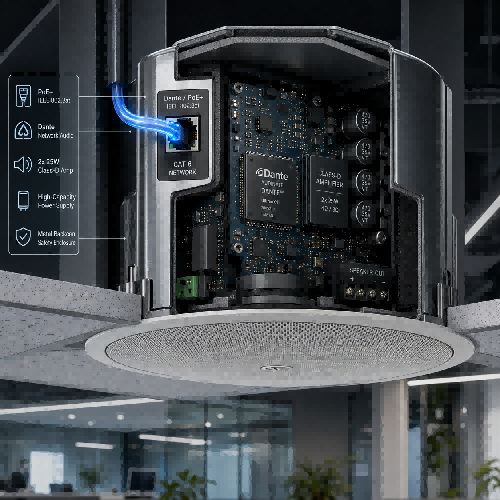
Table of Contents
Traditional commercial sound installation requires running thick, shielded analog copper cables from a central amplifier rack to every single speaker. Transitioning to Audio-over-IP (AoIP) systems—utilizing protocols like Audinate Dante® and AES67—replaces bulky analog conduits with standard Cat6 IT infrastructure. By deploying Power-over-Ethernet (PoE+/PoE++) active architectural speakers, integrators can deliver uncompressed 24-bit digital audio and up to 60W of DC operational power over a single RJ45 cable, granting every speaker its own IP address and software-defined zone routing.
The Infrastructure Shift: Replacing Heavy Copper with Gigabit IT Grids
In large-scale corporate boardrooms, multi-story hotels, or higher-education campuses, traditional analog audio distribution faces severe deployment hurdles. Analog speaker lines are susceptible to electromagnetic interference (EMI) from adjacent lighting cables, signal drop-off over long distances, and ground-loop hums. Furthermore, once an analog cable is pulled through a conduit, its physical routing permanently locks the system's zoning layout.
Audio-over-IP (AoIP) eliminates these physical limitations by converting multi-channel analog signals into uncompressed, packetized digital data transmitted over standard Gigabit Ethernet networks.
[Legacy Analog Setup] ===> Heavy Copper Runs ===> Fixed Hardware Zones ===> Risk of EMI / Ground Hums
[Dante AoIP Network]  ===> Single Cat6 Cable ===> Software Re-Zoning  ===> Lossless Digital Fidelity
1. Packetized Digital Precision: Dante & AES67 Protocol Mechanics
Dante protocol operates at Layer 3 of the OSI network model, wrapping uncompressed, high-resolution audio (24-bit / 48kHz or 96kHz) into standard IP packets.
To maintain sub-millisecond latency ($< 0.5\text$) across complex enterprise network switches, Dante relies on the Precision Time Protocol (PTP / IEEE 1588). A master clock node on the network syncs every Dante-enabled endpoint to within microsecond tolerances. This timing synchronization eliminates packet jitter, buffer overruns, and phase misalignment, ensuring uncompressed, bit-perfect digital audio playback across thousands of endpoints simultaneously.
2. PoE, PoE+, and PoE++ Power Delivery and Dynamic Energy Storage
The most radical evolution in commercial architectural audio is the combination of AoIP audio data with Power-over-Ethernet (PoE) technology inside active in-ceiling and wall-mount speakers.
                      [Standard Gigabit PoE Switch]
                                   │
              ==============[Single Cat6 Cable]==============
              (Transmits 24-bit AoIP Data + 54V DC Power)
  =====================[RJ45 Network Interface]=====================
                                   │
                                   ▼
            [Integrated Dante Ultimo Chip + Class-D Amp]
                                   │
            [Internal Burst Storage Capacitor Reservoir]
                                   │
                                   ▼
          [30W-60W Dynamic Audio Output to Speaker Drivers]
Using standard IEEE networking standards, a network switch delivers continuous DC voltage directly through the Cat6 cable to the active speaker:
-
PoE (IEEE 802.3af): Delivers up to $15.4\text$ at the port ($12\text$ at the speaker).
-
PoE+ (IEEE 802.3at): Delivers up to $30\text$ at the port ($25.5\text$ at the speaker).
-
PoE++ / 4PPoE (IEEE 802.3bt): Delivers up to $60\text – 90\text$ at the port ($51\text – 71\text$ at the speaker).
To deliver punchy, dynamic audio peaks without tripping the network switch's current limiters, premium PoE+ active speakers feature internal energy-reservoir capacitors on their Class-D power rails. During quiet passages or speech pauses, the switch continuously trickles DC power into these storage capacitors. When an explosive transient or loud musical peak occurs, the internal Class-D amplifier draws instantly from this stored capacitor energy, delivering burst peaks exceeding $60\text$ to $100\text$ while drawing a steady, safe DC power load from the Ethernet switch.
Infrastructure Comparison: Legacy Analog vs. Dante PoE+ Active Audio
| System Parameter | Traditional Analog Commercial Setup | Dante PoE+ Active Architectural Setup |
| Cabling Requirement | Heavy 2-core 14/16 AWG speaker wire | Standard Cat5e / Cat6 Ethernet Cable |
| Power Infrastructure | Heavy central power amplifiers in AV rack | PoE+ / PoE++ Network Switch (No power amps) |
| Signal Processing | Centralized DSP matrix in rack | Distributed native DSP inside each active speaker |
| Zone Re-configuration | Requires rewiring physical cable runs | Instant software re-mapping via Dante Controller |
| System Diagnostics | Manual continuity testing required | Real-time IP status, thermal, & load monitoring |
| Audio Bandwidth | Subject to analog cable distance loss | Uncompressed 24-bit / 96kHz lossless digital |
3. Software-Defined Zoning & Remote Diagnostic Telemetry
Because every PoE+ active Dante speaker possesses its own IP address and MAC hardware ID, physical location no longer dictates system routing.
Using Dante Controller or enterprise management software like Dante Domain Manager (DDM), system integrators can group, split, or re-route speakers into distinct audio zones with a single mouse click. A multi-purpose corporate hall can function as a single large room in the morning, and be logically split into three independent breakout rooms in the afternoon without touching a single physical cable.
Furthermore, IT administrators can monitor real-time diagnostic telemetry across the network, checking internal amplifier temperature, voice coil impedance integrity, packet error rates, and operating voltage levels remotely from any web browser.
Expert Q&A
Q1: How does a PoE+ ceiling speaker powered by 25W of DC network power handle high-volume audio peaks?
A: Audio signals are not continuous sine waves; they consist of short dynamic peaks interspersed with lower average energy levels (a high crest factor). A PoE+ speaker utilizes onboard high-capacity storage capacitors connected to its internal Class-D amplifier rails. The network switch continuously charges these capacitors at a steady $25\text$ rate. When a sudden musical drum hit or explosion occurs, the Class-D amplifier instantly pulls energy from the storage capacitors, outputting peak bursts of $60\text$ or more without overloading the PoE switch port.
Q2: Will streaming multi-channel Dante audio clog a company's enterprise IT network?
A: No. A single uncompressed 24-bit / 48kHz Dante audio channel uses roughly $1.5\text$ of network bandwidth. A standard $1\text$ Ethernet network link can comfortably handle hundreds of bidirectional audio channels alongside standard office data traffic without congestion. For maximum IT security and traffic optimization, integrators typically isolate audio traffic on its own Virtual Local Area Network (VLAN) with Quality of Service (QoS) prioritization enabled for PTP clock packets.
Q3: Can PoE+ Dante ceiling speakers be integrated with emergency voice evacuation / fire alarm systems?
A: Yes. Modern commercial Dante endpoints feature dedicated secondary analog override inputs or support priority network messaging protocols. When a fire alarm or emergency announcement is triggered, the system automatically overrides the current Dante audio stream, switches to the high-priority emergency broadcast, and pushes the internal DSP into maximum vocal intelligibility mode to deliver crystal-clear life-safety instructions across the entire building.
