
The Engineering Behind Clarity: How Bridge-Mounted Tweeters and 2-Way Crossovers Optimize Sound Staging

About Author: Kevin Wu
Founder & Principal Audio Engineer, LECOVITA
Specialize in acoustic engineering, high-fidelity speaker and amplifier design, precision manufacturing, sonic innovation, immersive audio solutions, and premium audio system development.
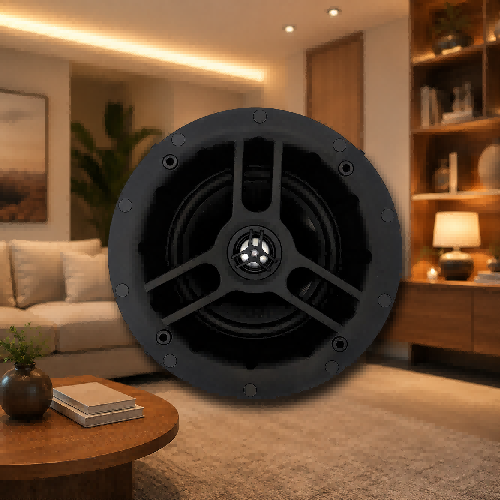
Table of Contents
The Engineering Behind Clarity: How Bridge-Mounted Tweeters and 2-Way Crossovers Optimize Sound Staging
TL;DR: True architectural high-fidelity sound requires overcoming severe space constraints. By mounting a pivoting silk-dome tweeter on a structural bridge directly over a high-rigidity woven fiberglass woofer, and pairing it with a high-order precision 2-way crossover network, LECOVITA eliminates phase cancellation and delivers a beautifully wide, three-dimensional soundstage.
The Acoustic Conflict of Architectural Speakers
In standard cabinet speakers, engineers have the luxury of space. They can separate the woofer, midrange driver, and tweeter across a wide vertical baffle, minimizing acoustic interference. In architectural in-ceiling speakers, however, space is a premium. Drivers must be compacted into a single circular footprint that mounts flush with the ceiling grid.
If engineered poorly, placing multiple drivers in close proximity causes acoustic masking and phase cancellation. High frequencies from the tweeter bounce off the moving woofer cone, creating muddy midrange frequencies and distorted highs. To solve this, LECOVITA utilizes a dual-engine architecture: the Bridge-Mounted Coaxial Tweeter Layout and Precision 2-Way Crossover Networks.
1. The Bridge-Mounted Tweeter: Isolating the Highs
Instead of using cheap pole-mounted configurations that drill directly through the center of the woofer magnet (which degrades bass energy), LECOVITA engineers a rigid structural bridge that arches cleanly over the woofer cone.
This decoupled architectural bridge provides critical performance advantages:
-
Mechanical Isolation: The tweeter is completely isolated from the heavy physical vibrations of the low-frequency driver, eliminating intermodulation distortion.
-
Pivoting Directivity: The tweeter is housed on a 360-degree pivoting ball-and-socket joint within the bridge. Installers can manually angle the high frequencies directly toward the primary listening area, optimizing high-end clarity regardless of where the speaker is mounted in the ceiling grid.
2. Fiberglass and Silk: Material Harmonization
A bridge-mounted layout is only as good as the driver materials beneath it. LECOVITA pairs this structure with an elite material matrix:
-
The Foundation: A premium woven fiberglass woofer cone. Fiberglass possesses an incredible stiffness-to-weight ratio. It resists cone flexing under heavy loads, ensuring snappy, lightning-fast transient bass response and crystal-clear midrange vocals.
-
The Highlight: A chemically damped silk-dome tweeter. Silk delivers exceptionally smooth, non-fatiguing high frequencies, capturing the fine details of acoustic string instruments and high-definition movie soundtracks perfectly.
3. The 2-Way Crossover: The Traffic Controller of Sound
A bridge and premium drivers are useless without an intelligent brain to route the electrical signals. This is the job of the 2-Way Crossover Network.
Audio signals leave your power amplifier as a complex wave containing all frequencies simultaneously. LECOVITA’s proprietary high-order crossover boards use heavy-duty copper inductors and metallized polyester capacitors to seamlessly slice the signal:
-
Frequencies below 2.5 kHz are routed exclusively to the high-output fiberglass woofer.
-
Frequencies above 2.5 kHz are seamlessly transitioned to the pivoting silk tweeter.
This sharp electrical division ensures that neither driver is forced to reproduce frequencies outside its mechanical comfort zone, dramatically lowering total harmonic distortion (THD).
Acoustic Performance Matrix
| Acoustic Component | Standard Low-Cost Speakers | LECOVITA Advanced R&D Standards |
| Tweeter Mounting | Fixed center-pole (Prone to vibration distortion) | Decoupled Bridge-Mounted Coaxial |
| High-Frequency Control | Rigid, non-adjustable straight firing | 360° Pivoting Ball-and-Socket Joint |
| Woofer Cone Material | Standard pressed paper or cheap polypropylene | Precision Woven Fiberglass Matrix |
| Crossover Layout | Simple 1st-order capacitor (Poor signal separation) | High-Order Multi-Component 2-Way Board |
| Soundstage Profile | Narrow, directional, flat sound field | Ultra-Wide, 3D Immersive Soundstage |
Expert Q&A
Q1: Why is a bridge-mounted tweeter superior to a standard center-pole mount? A: Center-pole mounts require boring a hole through the center of the woofer’s voice coil and magnet assembly, which reduces magnetic flux and limits low-end bass extension. A decoupled bridge structure keeps the woofer’s magnetic engine fully intact and prevents the woofer’s physical cone vibrations from mechanically bleeding into the delicate tweeter diaphragm.
Q2: What is the benefit of a 2-way crossover over a single full-range speaker driver? A: A single driver cannot physically reproduce deep bass notes (which require large, slow air movements) and high treble notes (which require tiny, ultra-rapid vibrations) simultaneously without severe distortion. A 2-way crossover splits the workload perfectly between a dedicated fiberglass woofer and a silk tweeter, maximizing efficiency and audio accuracy.
Q3: Can these advanced architectural speakers be used in multi-room residential audio links? A: Absolutely. While the advanced bridge and crossover technology provides the premium audio fidelity needed for critical home theaters, the durable, moisture-resistant build profile makes these models highly adaptable as the reliable baseline standard for whole-home distributed sound grids.
